

When most people think about ice climbing, they draw a blank. Ice climbing? What the heck is that? Most people know all too well about rock climbing, that sport that is now practiced in every gymnasium in the country via artificial rock walls. But ice climbing? It was the late Scottish mountaineer Tom Patey who, perhaps, summed up the most common response the average person has when they learn about the unique sport of ice climbing: “Ice is for pouring whiskey on.”
Patey was right: Ice climbing is weird.
It’s about kicking, hacking, and pressing minuscule points of metal attached to one’s hands and feet into frozen water, water that clings vertically to boulders, cracks, shrubs, and whatever else can be found on the average mountain precipice. But ice climbing’s also an activity full of style and grace, a vertical dance of movement like its cousin, rock climbing. And, surprisingly, it’s become one of winter’s trendiest activities.
A little history
Ice climbing’s roots lie in European mountaineering of the 19th century, as one aspect of an entire raft of mountaineering activities. European mountaineers saw it-in a rather crude form-as just another component of the greater game of mountain climbing. But they also recognized it as something unique.
Ice climbing’s (as a singular sport) most significant development came in about 1908, when British climber Oscar Eckenstein designed a type of toothed claw that attached to mountaineering boots. Eckenstein’s crampons did away with the need for step-cutting in ice, a practice that made winter climbing and mountaineering very slow. In 1932, Laurent Grivel (whose name can be found on countless pieces of ice climbing equipment today as part of the Grivel equipment line) added “front points” to crampons, two fang-like protrusions sticking out the front of the devices, and shortly thereafter, various European climbers began to weld the entire crampon assembly rigid. This allowed very steep ice to be climbed.
Modern ice axes or “tools,” as they’re known, developed much later, in the 1960s, and unlike most mountaineering equipment, were invented by an American. In 1966, Yvon Chouinard, best known now as the founder of the Patagonia clothing line, went to Europe to experiment with axes. With the help of a friend, Chouinard convinced the French equipment company Charlet to shorten the then lengthy mountaineering ice axes to 55 centimeters (about 22 inches) and “reverse” the curve of the pick.
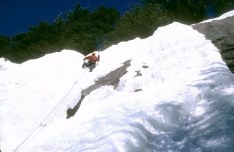
Chouinard’s ice axe designs revolutionized ice climbing as much as Eckenstein’s crampons, and vertical ice could be climbed relatively easily. The new axes and crampons even allowed ice steeper than vertical to be tackled proficiently. But while Chouinard was an expert ice climber within his own right, he is mostly remembered for his innovative equipment. It took a handful of hardcore climbers-based in the United States, Canada, and Europe-to affect Chouinard’s revolution.
Todays’ ice climbing
Today, ice climbing is a sport in its own right. There are ice climbing festivals in Europe, Canada, the United States, and many other nations. But today’s ice climbing isn’t what it used to be. Today the sport has evolved to the point where climbing miniscule patches of ice separated by long stretches of very difficult rock form the basis of a climb. It’s called “mixed” climbing, and it’s as gymnastic as anything Nadia Comaneci ever tried.
Of course, there are those of us who like both activities. I’m one, and recently, I had a chance to visit one of the premier places in the world for both “normal” (if ice climbing can be called normal) ice climbing, as well as mixed climbing: Québec, Canada.
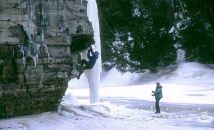
On a Saturday night in mid-February, my friend Luke Laeser and I stepped out of Montréal’s Dorval Airport into -40ºC temperatures, and had our breath taken away. La Belle Province, as Québec is known, was at the tail end of a cold snap, and the winds blowing down from the Arctic sliced through our clothes, skin, gums, and teeth. We found a rental car and, after some incredibly poor navigation efforts on my part, headed north toward Mont Tremblant on Highway 15. (North is, apparently, still north in Canada. Yes, Lucas, that’s right: I do have the navigational abilities of a concrete block….)
The Mont Tremblant region is not particularly famous for its ice climbing, but there is a large national park (Mont Tremblant Provincial Parc), and the climbs that do exist are superb. After a warm night in the quaint little village of Mont Tremblant (which is like a spanking new version of a European village), we met up with a local guide, Mike Oullet, who gave us a tour of the area’s ice climbs. We settled on a particular area called La Vache Noire (the Black Cow), and took turns picking our way up and down several beautiful ice routes. Like some of the more popular ice climbing destinations in the United States (Vail, Colorado, for instance) the more popular ice climbing areas in Québec have rescue backboards strapped to trees, in case of bad accidents. Mike was happy to point out that the backboard strapped to a tree at the base of La Vache Noire had probably never been used. We sure didn’t use it!
One of the weird things about ice-and, of course, climbing it-is that ice is not just the solid form of water. It takes on various consistencies at various temperatures-kinda like the banana that shatters at absolute zero we all learned about in high school science class. (Okay, I went to high school in Australia….) Anyway, Luke and I learned this pretty quickly at the Black Cow: The ice was very hard, and it shattered easily. It was not like Colorado’s watery blue (and often sun-beaten) ice. We hiked out as the sun set over the Laurentian Mountains, savoring the soft orange light that this part of Canada boasts in the evening.
The following day we headed east, to the old city of Québec. Québec city is the oldest European-founded city in North America (founded by Jacques Cartier in 1608), and it is the continent’s only walled city. If you like Europe for its history and its rich mixture of culture and language, you’ll love Québec city. Over 90 percent of the residents here speak French and, while most have a working knowledge of English, these people are thrilled to practice our tongue-quite the opposite experience for many of us who’ve visited other Francophone parts of the world. I even had one woman ask me very politely if we could “speak a short time longer because I really enjoy this and I need to practice my English.” She is, I believe, the first woman to ever want to lengthen a conversation with me. Possibly the first human.
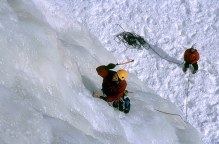
On our second day in Québec city, we were given a tour of the Chute de Montmorency, perhaps the best ice climbing venue in North America, by local ice climbing legend Francois-Guy Thivierge (a.k.a. Frank). Here, the Riviere Montmorency squirts out of a gap 300 feet above the St. Lawrence River and tumbles down a cliff. The falls themselves are dramatic-but for ice climbers, it’s the cliffs on the left side of the falls that are the attraction. Somehow, a lucky quirk of geology and topography has created a situation where water seeps out of the rocks along the entire top edge of this precipice. Gravity pulls it down the cliff face, and it forms beautiful 300-foot-tall walls of perfect ice. Although the ice faces south-which would be cause for major concern in most of the warm United States-in Québec, the colder temperatures keep the ice structurally sound. Not only is the ice always in perfect condition, the amount of climbable ice is staggering (I later estimated close to 35,000 square meters). It humbles world famous Ouray’s Ice Park the way a Hummer humbles my Chevette.
As Québec shrugged off the cold snap (the daytime temperatures rose to a very comfortable -5º C), we spent a day at the chute, climbing ice walls varying from 75 degrees to 90. A couple from Poland climbed next to us; they had read of Québec’s wonderful ice and had flown over for a winter ice-climbing holiday. Next to them, one of the local “technical” policemen (trained in special rescue techniques) climbed the chute with his son. Tourists wandered up every few minutes, fascinated by the falls and the popularity of climbing them. When lunch rolled around, everyone pulled out warm baguettes and thermoses of coffee-it was very civilized ice climbing. You know that when you smell fresh baked bread and steaming hot coffee that a mountain sport has evolved.
In the morning we returned to the chute and “ran a lap” on it again before hitting the road for Charlevoix, a northeastern region of the province that is similar to parts of the French countryside. Charlevoix is a world Biosphere Reserve, which are “areas of terrestrial and coastal ecosystems promoting solutions to reconcile the conservation of biodiversity with [their] sustainable use,” according to the United Nations Educational, Scientific, and Cultural Organization (UNESCO), which governs the biosphere program.

Highway 138 into Charlevoix-which hugs the north bank of the St. Lawrence River-makes for a fascinating journey in winter. Here, the most important river in all Canada is as much as 35 kilometers wide; the vastness makes it looks like an ocean. Meanwhile, the force of the tides pushes and pulls the surface ice, stretching and compressing it, until huge chunks of it are shoved up onto the river’s frozen surface. To drive along the St. Lawrence in winter, through Charlevoix, is to be awed by the power of the sea. There is-we were told by Elyse Busquet, a Québec city historian-a rather large, energy-intensive industry devoted to keeping the St. Lawrence River navigable year-round.
In Charlevoix, we attempted a climb in Parc des Grands Jardins (the Park of the Big Gardens), but were turned away by the late hour. We stopped at the quaint village of Baie St. Paul for the night, and were treated to a beer sampling by the owners of the town’s small microbrewery, Frederick and Caroline Tremblay. Not only can les Québeçois ice climb and ski with the best of them, they brew damn fine beer as well. We returned to Québec city the next day, stopping at a fairly obscure waterfall, Chute Larose for an evening climb. Surprisingly, we ran into Frank, who was teaching ice climbing to some New Yorkers.

Our final day in Québec was spent in a narrow shale canyon, on the outskirts of a small farming village called Pont Rouge (Red Bridge). Here, in 1990, while paddling down the Jacques-Cartier River, a kayaker noticed the walls of the canyon seeped quite a bit of water. He wondered if the seeps froze in the winter because his friend, Frank (who else?), was always interested in new ice climbs. The following winter, Frank and Gilles Brousseau ventured into the canyon and found the equivalent of Ouray’s Box Canyon (the most famous ice climbing venue in the United States), only better. Huge, naturally forming ice climbs scattered along a canyon for over a half-mile, and rock walls perfect for the new, ultra-trendy sport of “mixed” climbing (from the term, “mixed rock and ice climbing”). Frank and Gilles set to work climbing the natural ice routes, then started telling their friends, many of whom were more interested in the rock between the seeps.
Today, Pont Rouge is an international ice climbing Mecca. It has hundreds of both ice and mixed climbs, and is easily accessed from both Montréal and Québec. It hosts the biggest ice climbing festival in North America, Festiglace (glace is French for ice), every February. Climbers from around the globe come and take part in difficulty and speed competitions, judged by a who’s who of ice climbing.
“Our event as been running for six years and we have more than 4,000 people showing up on-site for the two-day event,” noted Yan Bariteau, one of the founders of Festiglace. “Our original goal with the event was to create a climbers and outdoor enthusiast yearly rendezvous; promote the sport; the site and even Quebec as a whole destination for ice climbing adventure.”
Yan was, obviously, working with a good product.
Luke Laeser and I wandered through the canyon, awestruck by the thick, blue, healthy looking waterfalls, frozen like cut crystal candlesticks to the tawny shale. Luke climbed a steep column of ice, then we proceeded to toprope (a type of climbing in which a safety rope is rigged above the climber) about fifteen different variations to the pillar and the rock wall next to it. We had found heaven. And, looking around, we guessed it would have taken us a month of climbing every day just to get acquainted with Pont Rouge.
I’m not sure what I like best about Québec in winter-the ice climbing, the skiing (which is fabulous), the stillness of the Laurentian Mountains, the quaintness of the villages, the hand-made beer, the omni-present French, which I was allowed to take part in, or the warmth of the locals. Certainly, the ever-present smell of warm baguettes and coffee doesn’t hurt.
 Real Travel Adventures