

That was a good point. I was her guest. She wanted to show me the Golden Horseshoe, a loop that takes you to Whitehorse, the capital of the Yukon
Territory in Canada, that circles back down through great expanses of open country in British Columbia, into the United States via the Chilkat Pass, and
back to Haines on the Alaska Highway. When I had lived in Haines, thirty-five years ago, there was no access to the Yukon, save the turn of the century narrow gauge train that still chugs up the ravine, overlooking the Skagway River. The Gold Rush train hauled freight and passengers to Whitehorse. The Klondike Highway opened in 1978, and now the train is used for round-trip tourist excursions to Lake Bennett. The opportunity to drive the road that parallels the path of the river overlooking the Whitehorse Pass trail used by the “stampeders,” was exciting to me.

We rolled off the Malispina, the oldest ferry in the Alaskan Marine Highway
fleet, behind a row of Harley Davidson motorcycles with California license
plates.
“If I’d known I wasn’t driving, I would not have committed to this trip.” I
said. “Neither would I,” She replied, pressing her foot firmly down on the gas
pedal. I told my nephew reading comics in the back seat to buckle up.

We skirted the town of Skagway. I remembered it as a deserted, windblown burgh, streets pockmarked from frost boils, with gangs of mangy dogs roaming free. Ten years ago it was declared, “The Klondike Historical National Park.” Today, wooden sidewalks and old west storefronts, with flowers bulging out of window boxes, make it look like a spring maid. Located at the top of the Lynn
Canal, it is the destination for numerous cruise ships. The year round population of 800 is over-run with 800,000 present day “stampeders” during the summer.
We passed the grave of Soapy Smith, who met an untimely end because he regularly fleeced prospectors of their poke as they were coming back from the Klondike . I spotted the road to Dyea where the Chilkoot trail begins and heads for the sky. I imagined Jack London slogging up the trail darkened by hanging glaciers, and crossing gorges choked with foaming water, strapped into the
150 pound pack that he carried on his back. Originally a trade route for native people, the thirty-three mile trail was abandoned for sixty years after the 1897 Gold Rush. Today, it is refurbished, and enjoyed by about 3,500 hardy hikers a year.
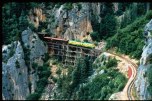
Trying to distract myself from imminent disaster, I stared out the window at the heart-catching scenery. I heard the whistle blast of a steam engine and looked down to see the Gold Rush train hugging the canon wall as it puffed up the steep grade. Thirty men died blasting the shelf of granite for the rails overlooking the 500-foot drop. They built the 600-foot tunnels through rock, and the wooden trestles over roaring falls which are considered an historic civil engineering feat.
Mom pointed to a ramshackle wooden mine suspended precariously on the canyon wall high above us. I desperately wanted her to stop being a tour guide and to keep her eyes on the road. She asked me if I wanted to pull over on a narrow shoulder of the snaking road where a sign was posted, “No Stopping Anytime.” I said. ” No thanks. Keep going,” pressing my nails deeper into sweating palms. She continued to hurtle up the switchbacks in silence. She wanted to get my nephew to the bike shop in Whitehorse before the stores closed. Now it was apparent to me now that I was the captive audience of a Granny with an agenda. It would be a short, sweet, sad, ending: “Three Generations Lost in Fiery Inferno” would be the headline. Grandma Bell, daughter Linda Jane, and nephew Rusty rocket to bottom of ravine; car bursts into flames on impact!” I breathed a sigh of relief when we crested the pass, leaving behind the glacier scarred rock and boulder strewn gorge.
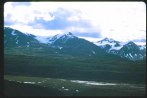
Once we were above the timberline, the scenery changed to a string of turquoise, glacier lakes. Dwarf alders and low flung shrubs are all that survive the cruel winds on the summit. They cling to life in the crevices of the lichen- covered rocks. A small,
unheralded road sign points to the end of Chilkoot Trail where it deposited Klondikers on their way to the gold fields. The daunting passage saw the death of thousands of horses and pack mules. Their limbs snapped in the twisting trail or they tripped and fell into the frigid, foaming water and were pinned to the bottom of the river by their heavy loads. They were left
to rot in heaps along the way, while grown men sat down and wept from
exhaustion.
Once on the summit, Jack London and others, were faced with the reality that
they must build a boat for the second leg of their journey. Jack had
seafaring experience from his boyhood days as an oyster pirate in Oakland,
California, so he decided to build his own craft. It had to be strong enough
to navigate six hundred miles down the string of lakes and connecting rivers
from the upper reaches of the Yukon to the tent cities on the goldfields. The
route he followed carried his party through five narrow lakes: Lindeman,
Bennett, Laberge, Marsh, and Tagish, known then as Caribou Crossing, today
shortened to Carcross.
Mom made a pit stop at Carcross, popping out of the car, leaving the engine
running and the door open, presumably, for a fast get away. The restored
railroad station, left from the days when the Whitepass train came all the
way to Whitehorse, make this a significant stop for tour buses. The original
general store, a weathered train trestle, and few scattered log cabins are
all that’s left in this time warp.

We sped through an unlikely desert region, and passed Emerald Lake, which is a phenomenal deep jade green color due to an algae called marl. Once in Whitehorse, we pulled into the parking lot of the well-heeled High Country Inn where a hundred foot, wooden Mountie stands guard. When the stampeders reached the Canadian border, they were turned back if they didn’t have 1550 pounds of supplies to ensure that they could survive the winter. The Canadians didn’t want to be responsible for the deaths that would take place due to the foolishness of the cheechakos (new comers). Mom made arrangements for us to see the Frantic Follies, a laugh-a-minute corn- fest. The show’s main stay are tourists off buses from Skagway, but Mom was a regular, coming back for the third time. I recalled my stint in the “The Smell of the Yukon” and my days as a Can-Can dancer when I was in high school. I’m certain I could not get my foot anywhere near the top of my head today, but I can still squeal with the best of them. Sam McGee, the star, assumed dead from the cold, is thrown into the fiery steam ship boiler. Instead of finding a charred cinder the next day, we see him laughing because this is the first time he’s been warm since he came to the North.
Backing out of the hotel’s parking lot the next morning, Mom bounced off the
bumper of an SUV. She admitted she wasn’t good at “city driving” and
reluctantly relinquished the wheel. I could feel the spring of tension in my
belly uncoil as I drove toward Miles Canyon where a suspension bridge crosses
the Yukon River. Nephew, Rusty and I walked on the paths that lace the cliffs
overlooking the treacherous Box Canyon rapids, yet another trial for Jack
London and his party. The river runs for nearly a mile through a ravine that
narrows down to a mere slit in the plateau. Midway in the trough is a
widening out where a whirlpool churns slowly around. Jack steered his
homemade craft through the “madness of motion” successfully, then returned to
help other parties make the passage.
Once through this tumultuous stretch of water, he faced the even more
formidable Whitehorse Rapids, so named because the foamy crests of water
resemble the mane of a white horse in flight. The trick for the rafters was
to ride the crest of the mane to safety. “On the side of the Mane was a
corkscrew curl-over and suck-under, and on the opposite side was the big
whirlpool. To go through, the Mane itself must be ridden.” Jack London. Jack
managed all of that and made it to the gold fields, but he didn’t find any
gold. He left the Klondike with a bad case of scurvy, and fodder for four
novels and numerous short stories.
Once back on the open highway, we barreled through great expanses of open
country. In September, the tail end of the season, the long caravans of RV’s
and campers that roam these roads in the summer have all boarded ferries and
gone home. It was as though someone opened the door to the cage of a wild
animal. Riding the crests and dips of the uninterrupted road, blasting
toward the horizon after being gridlocked in Los Angeles was beyond
exhilarating. It was soul-cleansing.
We crossed numerous tributaries of the mighty Yukon River as we flew past
the rust-colored marshes the moose call home. A fresh dusting of snow on the
distant mountains tops, clumps of aspen leaves spinning gold against the
velvet green spruce forest, and dark clouds hugging the horizon spoke of
fall. Splotches of raindrops beaded on the windshield. I opened the window
to suck in the pine-scented air.
When we reached “Supernatural” British Columbia,” Mom wanted to get back at
the helm. I heard her emit a sigh of contentment as she gripped the wheel
with both hands and focused her attention like a laser beam on the sweeping
expanse of open road ahead. Like a low flying jet, we swooped down the
valley, meeting only one car in over an hour. I looked at my snow-haired
mother and realized the ghost of a long-distance truck driver had slipped
into her frail body when I wasn’t looking.
“When did you develop road fever?” I asked.
“I always loved to drive, but your father wouldn’t allow me to when he was
alive.” A perfect example of how a person’s heritage can double back on them in
strange and devious ways when they least expect it. My circumstance today was
a direct result of the fact that my father had wasted a lot of energy trying
to dominate an indomitable spirit.

We headed south on the last leg of the Horseshoe. The road became more familiar when the foreboding granite spires that guard Chilkat Pass came into view. Frothy clouds moving fast across crystalline skies churned about the jagged peaks. Tundra meadows, home to the Willow Ptarmigan and the lone wolf, stretched out in rusty green expanses dotted by mud-colored pools.
“This is where they filmed White Fang,” my Mother said, pointing to a barren gray slope, uninspiring without a blanket of snow. Hollywood chose to use the more accessible Dalton Trail from Haines to the Klondike to re-enact the fabled climb of the stampeders up the ice steps of the Chilkoot Trail. “Up its gaunt and ragged front crawled a slender string of men. …And it went on, up the pitch of the steep, growing fainter and smaller, till it squirmed and twisted like a column of ants and vanished over the crest of the pass” was how Jack London described the sight.
The highway takes you within spitting distance of Dezadeash Lake. My father
loved the brisk wind blowing across the wild heather meadows and purple crags
in the high country. Fly fisher people dotted the shore in bright yellow
slickers. They were casting for Artic grayling, a true Alaskan, dependent
upon clear, cold streams and lakes that exist only in the north. My father’s
ashes are scattered in this lake among his favorite meal.

Once back in the U. S., we crossed the path of an excited river. I looked up
to see a sparkling waterfall tumbling down moss-covered walls of rock. The
Chilkat Valley was as I remembered: lush, verdant, fecund, and bursting with
life. About twenty miles out of Haines, the Chilkat River widens and
parallels the highway. The silt green water spreads into a wide fan laced
with sandbars. I saw the white heads of eagles, scrunched down into their
black bodies, sitting in the trees. Mom pulled over so I could use the new
high-powered spotting scopes installed to allow the roadside traveler to
observe the thousands of birds that congregate in the Eagle Preserve. I saw
an adult pair of the regal birds tugging with strong yellow beaks on
spawned-out salmon. The male looked up and stared back at me with
intelligent, indifferent, orange eyes.
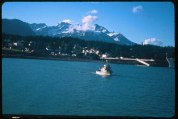
I recalled the day my family arrived in Haines. We were thrilled to see hundreds of black lumps hunkered in the treetops. The highway through the valley has been widened since then, my mother’s platinum-do and pink cheeks give her the countenance of an angel, and my father, who brought us here, is gone. But, the harsh, immutable truths of the north that Jack London captured in his stories remain unchanged.
(All quotes taken from Jack London and The Klondike, by Franklin Walker)
 Real Travel Adventures