

From our very first stroke on, it was serendipity. Our canoes turned to time machines as we paddled through 37,000 years of mankind’s progress. Around each bend, the riverbanks became storybooks unveiling new examples of civilization from prehistoric times to the present.
Waterways have been key to life in the Perigord, best known to Americans as the Dordogne. Each has a different story to tell, beginning with the Vezere, where Cro-Magnon man, and even his predecessors back as far as 400,000 years, made their homes in caves found in the sheer limestone cliffs that rise like sheaths, protecting and guiding the river below. The paintings and sculptures with which these prehistoric artists decorated many of these subterranean homes have miraculously endured and can still be viewed 37,000 years later. In fact, two-third of the 120 or so art-decorated prehistoric caves in the world can be found here.
Along the Dordogne and Lot Rivers, villages of earth-toned stone houses and shops, still occupied and much younger in appearance than their advanced years would suggest, rise almost vertically. They seem to be built one atop the other, climbing up the steep cliffs as they did when they were built in the Middle Ages. Looking down from above are grand chateaux and churches that provided protection and comfort for the townspeople below while the French and English fought ruthlessly to control the region during the Hundred Years War.
The farmlands, meadows vineyards and forests that border the frisky waters of the Cele attest to the region’s modern day reputation as one of the leading bread baskets of the continent. The Dordogne is known for its duck, truffles, veggies, fruits and walnuts. It is the foie gras capital of the world. While the delightful fruity wines of Cahors are not as well known internationally as the reds of neighboring Bordeaux, they are well worth tasting.
 After the four-hour train ride from Paris to Brive, we gathered at a serenely beautiful spot on the riverbank in St. Leon du Vezere, a sleepy hamlet that centuries before served as a key resting place for weary pilgrims on their way to the shrines of Rocamadour. Reflections of the willow trees and the 9th Century church shimmered in the quiet waters of the Vezere.
With our hosts, Jim and Carolyn from the Battenkill Canoe Ltd of Arlington, VT, we picnicked and drank that sunny afternoon, and instantly fell in love with this region and its foie gras, cheeses and mellow vin de pays we sampled. In the tranquil beauty of that riverbank, the 12 of us bonded at once.
It took a good night’s sleep following lots of local wine and a robust casoulet in the town of Sergeac to launch us on our first river day. We soon settled into the leisurely pace of the Vezere, enjoying the rich farmland and thick forests that alternated with towering limestone cliffs. The most dramatic feature of the day was LaRoque Christophe. This half-mile long cliff was sliced by nature into five shelves, forming several of the largest terraces in Europe and providing shelter for 3,000 residents thousands of years ago.
We Paddled through 370 Centuries of History In the Land of Foie Gras, Truffles and Vin Local
On our second river day, a relentless rainstorm greeted us as we neared Les Eyzies de Tayac. Soaked to the skin, we trudged up the river walk towards our hotel, greeted by the mighty statue of Cro-Magnon man perched high on the cliff above the city. It was here just outside of Les Eyzies that the first remains of Cro-Magnon man were discovered in the late 19th Century.
Dry and fresh the next morning, we headed off to Grotte Font-de-Gaume, a short walk from the town center. Eerie though it seemed at first, the shivers as we reached deeper into the cave came from the thrill of seeing 80 paintings of bison and human figures remarkably well preserved, not from the cool, dry atmosphere below ground. It is because of that dryness that these creations remain intact.
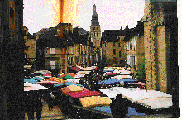 Following our cave visit, the group agreed to forego several hours of paddling to drive to the traditional market held every Saturday in the medieval city of Sarlat. It is still home to 10,000 people, living in venerable gray and tan stone homes along alleys that snake up and down the hills above the city center just as they did in medieval times.
Hordes of tourists and natives mingle on the cobblestone streets below sampling goodies from the cheese, meat, foie gras, veggie, walnut and wine vendors. We quickly slipped into the crowds of merrymakers at this weekly fiesta, bumping our way, as they did, along the crowded, cobblestone streets. We left with backpacks bulging with regional delicacies for lunches and our daily post-paddle cocktail hour.
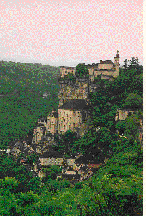
 From Sarlat we drove to Rocamadour, because the river here is no longer navigable even by canoe. It is one of the most popular getaways in the region for the French. Once a major pilgrimage site, today the town is a bit tacky and commercial, but well worth a visit. A huge fortress and magnificent chateau tower several hundred feet above the town. Standing on the ramparts that reach out beyond the face of the cliff is intoxicating…and a bit frightening too. Carved into the cliff between the castle above and the village far below is the Sanctuary of Notre Dame where the Black Virgin still wears her jeweled silver crown as she reigns in the Chapelle de la Vierge Noire.
Ten centuries ago, Rocamadour was regularly visited by the devout. Repentant sinners were forced to climb on bleeding knees up the 216 steps of the Via Sancta to reach the seven chapels, churches and basilicas that once stood alongside Notre Dame. Today visitors ride on ascenseurs (elevators), even if they are sinners.
Bright and eager, we launched early the next morning to balance the day we spent on land with an 11-hour exploration of the Cele. Its frisky waters danced past lush meadows where sheep and cattle ignored us as they grazed near the river bank. Intriguing little hamlets fill the narrow Cele Valley, but none so charming as Marcilhac (156 residents), where we finally beached. A hot shower and the appeal of the village quickly refreshed us as we dug into one of Madame Lagarrigue’s hearty homemade dinners in the hamlet’s only eatery. Veggies fresh from local gardens, bean and pea soup, casoulet, lamb and her signature strawberry pie.
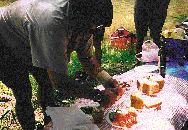 Maintaining our tradition of “fine dining,” at lunch the next day Carolyn placed a festive red and white tablecloth over an upturned canoe and filled paper plates with just-picked tomatoes, peasant bread, cabecou (sharp local goat cheese) and foie gras, we hoarded from our morning in Sarlat.
After spending the following night in Cabrerets, we hiked the two-mile narrow wooded path up to Grotte du Peche-Merle, a magnificent art cave hidden for centuries by a rockslide dating back to the ice age. The colors and the outlines of the animal paintings in the Chapel of the Mammoths and the art and indecipherable symbols on the Ceiling of Hieroglyphics are the best preserved that we saw throughout the trip. These talented craftspersons were history’s pioneer airbrush artists. They blew paint through bone pipes to form the outlines of their creations.
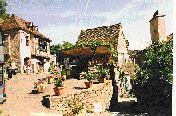 The next afternoon we reached the junction of the Cele and the Lot Rivers, a short distance from St Cirq-Lapopie. One of the most captivating and photogenic villages in France, its 200 residents live on a series of hills 350 feet above the majestic Lot, enclosed in what is left of a Medieval rampart. St Cirq’s cobblestone streets and pathways wind and twist between shops, eateries, homes and even a handful of tasteful hotels, many dating back to the 13th and 14th centuries.
To reach St Cirq, we beached at Bouzies, the closest take-out, then walked along the river on the ancient tow path and through several farms to begin the torturous climb up a difficult and very steep–at times it seemed absolutely vertical–forest path, grateful for the refreshing fragrance of sweet honeysuckle that engulfed us.
Our final destination as we shifted to the Dordogne River was Beynac. Located at the confluence of the Dordogne and the Ceou Rivers, this strategic spot is an ideal place to study the Hundred Years War and the disruption it created. The English were quartered in the imposing Chateau de Castelnaud, given to them by the Caumonts, a French family of wealthy sympathizers. Diagonally across the river, the fierce Dukes of Beynac were billeted with their troops in a huge castle above the town, determined to rid their territory of the British interlopers.
Standing on the parapet of Beynac Castle, one sees how perfectly the fort controlled the river as it meandered around the town. Huge wooden catapults, still operative, hurled massive boulders to shatter the enemy ships below.
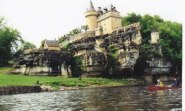
When the Caumonts left Castelnaud, they moved into Les Mirandes, a nearby chateau on their spacious estate. Centuries later, Les Mirandes caught the fancy of Josephine Baker, while she vacationed here. The expatriate chanteuse refurbished the rotting castle to house 13 underprivileged children from countries throughout the world that she adopted as part of her protest against racism. The castle remains open to visitors. Sitting in the circular stone foyer as Baker (on recordings) belted out tunes from her many shows was a wonderfully touching finale to our last day on the water.
That evening we sat together eating and drinking on the verandah of the Hotel Bonnet, listening to the gentle music of the Dordogne as it gurgled and swirled over the rocks. It was a sad moment, for it was our last hurrah, our last foie gras in this enchanting region. We had become very close as we sped on our time machines through those 37,000 years, and it was difficult to say farewell. Although all of us were widely traveled, we all agreed that this had been one of the most rewarding and enjoyable trips we had ever taken.
IF YOU GO
This trip requires participants to be in healthy condition, but is not overly strenuous. A van is available to transport anyone who chooses not to paddle or hike any portion of the trip.
Information on Perigord is available at French Tourist Offices in New York City (212) 838-7800, (312) 751-7800, Beverly Hills (310) 271-2693
The region can be accessed through flights to Bordeaux or Paris. From Paris’ Charles DeGaulle Airport, go to the Austerlitz Rail Station and train to Brive, a four hour trip.
The most pleasant accommodations we experienced were:
Les Ezyies: Hotel du Passeur, (Excellent restaurant) 011 33 5 53 06 97 13
Rocamadour: Hotel du Lion d’Or (Scenic restaurant) 011 33 5 65 33 62 04
Marcilhac: Hotel Les Tilleuls, (Breakfast only) 011 33 5 65 40 62 68
St Cirq-Lapopie: Hotel La Pelisarria (Breakfast only) 011 33 5 65 31 25 14
Battenkill Canoe Co runs guided trips to the Perigord in May, June, September and
October. They can be reached at 6328 Rt 7A, Arlington, VT 05250. (802)
362-2800 or (800) 421-5268. Email: trip@battenkill.com. For information about
company and its many other trips, http://www.battenkill.com or send for a brochure.
Widely published from coast to coast, Charles Jacobs is the Travel Editor of That’s Life Magazine and the former Editor-in-Chief of Travel World International. His most recent book Blood Bond was released this year. He can be reached at jac391@aol.com.
 Real Travel Adventures