

My inability to read a train or bus schedule properly has landed me in hot water before, but occasionally it results in a pleasant surprise, as was the case one Sunday in Ireland.
I’d chosen Galway, the main city in the west of Ireland, as a base for day trips to Connemara, the Burren and the fabled Aran Islands. I’d luckily made all my bus connections until that Sunday when I was on my way to Oughterard. I had misread the Bus Eireann schedule, not realizing that I was too early for summer Sunday service to Oughterard. I now know that summer starts in late June in Ireland.
Stumped, I asked the ticket agent if the transit system went anywhere else. “There’s a train to Athenry in ten minutes,” he replied, “and one coming back this evening. It’s only a fifteen minute trip.”
Well, what is travel if not a venture into the unknown? “Fine, I’ll take it,” I said, handing over about the equivalent of about $11 US. Who knows, Athenry may surprise me, I muttered as I scurried off to catch the train.
Athenry, it turned out, didn’t just surprise me; it delighted me. I discovered a medieval town with Ireland’s finest surviving town wall, stone gate, thirteenth century castle, priory, churches and romantic graveyard ruins picturesquely overgrown with wild flowers and climbing vines.
My exploration of Athenry began where the town began: at the Castle. This rectangular, three-story building towers over everything else in town, which makes it easy to spot upon arrival. Built as an Anglo-Norman stronghold sometime around 1240, the castle lay in ruins for 500 years until it was finally restored in 1990. I walked around the grounds for free but needed to buy a ticket to climb the exterior staircase and look inside.
Apart from a small room set aside as a movie theatre showing a 20-minute video on the history of the town, the castle is eerily empty, although if you listen closely you might easily imagine strains of music from banquets held long ago: the Great Hall packed with revelers dancing, drinking and feasting, then lining up near a door at the back of the room.
 Why yes – the door leads to a quaint medieval toilet – just a closet with a hole for the seat. From the outside, the tiny room juts out like a glassless bow window; below, on the ground, stands a large stone pit.
A few hundred yards south of the castle, the 13th century Dominican priory of S.S. Peter and Paul lies in elaborate ruin. Stone walls pierced with elegantly-shaped gothic windows stand as mute reminders of an ancient power struggle. Moss-covered grave slabs honor the fallen. Here invaders and natives knelt before the same God, each praying for the destruction of the other side.
In 1316, it seemed clear whose prayers had been answered. That year, the Anglo-Norman army defeated the local Irish forces in a decisive battle that, according to the chronicles, left 8,000 dead in one day. From the booty collected after the battle, the victors built a stone wall, which still stands today, enclosing 69 acres.
Not far from the North Gate (the only remaining gate), I found the ruins of the 13th century St. Mary’s Church. At first glance, it’s hard to distinguish this ruin from the stern Protestant Church of Ireland (c. 1828), which stands in the same grounds and seems to sprout miraculously from the ancient foundations. Looking closer, though, I saw that the walls and prim stone steeple of the newer building are dark grey and smoothly cut while the remains of the medieval building are paler, roughly hewn blocks of stone whose cracks are filled with moss, a fertile ground for the weeds and flowers that cover the top third of its surface.
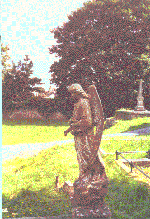
In the church yard, tombstones lie scattered about, many topped by Celtic crosses, many more overgrown with weeds and made illegible by centuries of Irish rain.
While the grounds may still be hallowed, the churches that stand in them are not. The newer building is now home to the Athenry Arts & Cultural Centre, which hosts a small exhibit on the history of the town, including a model of Athenry as it would have appeared in the 14th century, and its ceremonial Mace.
The Center’s gift shop features a curious scene: souvenirs resting casually against a wall covered in memorial plaques dedicated to former parishioners. I found this brash commerce among the dead jarring and disrespectful at first, but then I thought that there was something oddly reassuring about the practice. It reminded me that the town is more than a static historic tourist attraction. I hadn’t just stepped into a time capsule or a movie set; this ancient town is a lively home to Irish descendants of its late sons and daughters, and it is their enduring link to past and present events.
 The evening I was there, for example, I heard a distinct buzz in the air, and followed the sound to find people filing into a large park. Over supper at the Newpark Hotel (an old-fashioned, typically Irish hotel with hearty food, homey decor and meals for about $15 US), I learned from the waitress that a very important hurling match was being held that night. The honor of Athenry, it seemed, was at stake and even though it was a sleepy Sunday night, the townsfolk were out in full force to defend their reputation.
As I boarded the train back to Galway that evening, I reflected that my forced detour had turned out much better than I’d expected. I’ll know now not to panic the next time fate takes me by the hand and leads me down the path to unexpected discoveries.
IF YOU GO:
For more pictures and history of Athenry: http://www.athenry.net/history.html
Ireland West Tourism: http://www.irelandwest.ie
Irish Tourist Board: http://www.ireland.travel.ie/home
Bus Eireann: http://www.buseireann.ie
Heritage Ireland (for information about Athenry and other heritage sites): http://www.heritageireland.com
 Real Travel Adventures