

I had been a reluctant traveler to the Tambupata Jungle Resort of Peru, but my always curious husband insisted it would be like one of those fabulous safaris you see on the Travel Channel, and I was persuaded. The word “Resort” and the price convinced us that it would be luxurious “roughing it.” This was our first truly adVenturous tour to a very remote area, and we had imagined being pampered in a Tarzan setting. Well in advance we got all the immunizations known to modern medicine (except one) and started our malaria pills.
After a week in Lima, we boarded a small jet to fly over the Andes, a beautiful flight, but the snowy peaks seemed a little too close to our questionable plane to put me at ease. We landed in the jungle town of Puerto Maldonado, and the plane’s engines stayed on while we disembarked. (Later we learned that the tiny airport didn’t have the facilities to restart the plane!) Arriving tourists were divided into two groups: those who were already immunized against malaria and those who had to receive an injection before claiming their luggage (no choice!)
Our tour guide met us and threw our luggage into the back basket of a sort of motor cycle with a place for two passengers to perch behind him, and before we could think, we were zooming away on the main dirt road to the docks. Not knowing how far we must go before boarding first-class ship for a delightful four-hour journey up the Tambupata River, I asked our guide to stop somewhere for me to go to the bathroom. His alarming response was, “There is no place.” “I’ll just wait until we reach the ship,” I responded. “The boat has no bathroom,” I was informed. “Well, you have to find a place. The trip is four hours!” After much deliberation, Juan headed for what was either a small restaurant or a large, white adobe brick home arched over with brilliant, fuschia bougainvillea flowers, and persuaded the owner to let us use his facilities, which were in an outer addition to the building.
Just five minutes later the enormous river’s swirling, brown muddy expanse came into view. It was wider than the widest river I had ever crossed in the United States, lined on each side with dense jungle vegetation. The “ship docks” were a roughhewn platform where we and ten other tourists, were helped into a large, wooden, flat-bottomed canoe, with 18 folding chairs lined up beneath a blue plastic tarp! For a fleeting moment I thought this was the dinghy to take us to the ship, but I quickly realized this was it!
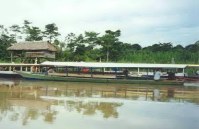 The 35 horsepower, outboard motor whirred reluctantly, and we were off on our four-hour journey upriver. The boatman explained that the river had already risen forty feet in the last week, beginning its swells because the rainy season had begun upriver. This would slow our progress against its swirling, brown currents. For about an hour we puttered along, staying too far away from shoreline to suit me because I’m not a strong swimmer and there were no life jackets aboard. We stopped to pick up several local passengers and part of our food supply for the Resort. Eight open, cardboard flats, each containing three dozen eggs, were stacked on top of each other in front of our young, bronze “captain,” who was dressed in khaki shorts, a torn tee-shirt, and thongs. (At several points along the journey he hopped over the eggs to reach a tool as we held our breaths.) While the motor sputtered quite reluctantly in restarting, we were zipped down-river with the current at lightning speed.
We journeyed another two hours upriver in the hot summer afternoon sunlight, never passing any sign of human civilization, only a thick wall of verdant palms and other exotic vegetation on each side of the enormous river. The peacefully beautiful scenery moving by and the cool breeze lulled us to semi-sleeping state of peace, in spite of the alligators (caiman) we were passing on the mud shores and the huge logs we were dodging in the raging waters. We were jolted fully awake by the screechy microphone announcement above the motor’s noise that we would be stopping for a Terrorist Check Point. “Are we being captured?” I and other tourists asked, alarmed. “No. We have to give all the names of our passengers to the Army here, in case anyone is missing later. There is Terrorist activity everywhere up here,” was the matter-of-fact response. We looked around for a city to possibly escape to and abandon our journey, but the stop and check point was only a small wood dock with a solid wall of jungle vegetation behind it.
Two guerilla army Peruvians took our names and said a few words to our “captain” in Spanish, looked over our cargo of eggs and fruit and vegetables, and waved us on, releasing the small, single rope which held our boat to the dock. We were swiftly shot down-river and out of sight by the powerful, raging current, asJuan pulled the motor’s starter cord. The engine coughed and nothing happened. He repeatedly yanked the cord as we regressed at about three times the speed we had been making the intended passage upstream. For a moment I expected Juan to pull out a radio or telephone and call for help, when it was evident that the motor would not start. He appeared alarmed and stood back and began to make a piercing whistle with his mouth. Repeatedly he whistled loudly, directing the sound toward the impenetrable palm forest. Then we passed another tiny outboard motor boat and saw a man starting his engine to rescue us. We sailed swiftly past him, but he finally caught us a few miles downstream.
Our “savior” wore an unbuttoned white shirt flapping out behind him and exposing his enormous brown belly hanging over his dirty, baggy jeans. His wide-brimmed, cream-colored Panama had was crumpled and stained from years of service. He clamped a stubby, fat cigar tightly between his teeth to the side of his mouth. As he spoke in Spanish it bobbed up and down. He tied onto our boat and cut his motor. With one thonged foot astride each boat he leaned over to work on our motor while his brown backside nearly popped out of his low-slung jeans. He beat on our motor with a hammer and turned something with pliers repeatedly. After a few minutes it began to sputter and burst into life. With a grin and a handshake, the man was gone, and we were on our way upriver again, having lost many miles.
We had to make two more stops for locals to get on or off at “nowhere” in the middle of the jungle, and we passed a few cane huts here and there, but Juan wisely never stopped the motor again. Finally about six o’clock, he announced that we had reached our destination, and he docked at another wooden post. Two friendly men in khaki shorts and thongs greeted us and held our hands as we disembarked precariously onto the mud bank, each of us carrying his own luggage. As I looked up the forty-foot high river bank, into which mud steps had been machete cut, I was thankful that we had wisely been advised to leave our big suitcase at the airport and take only a small bag of necessities. We trudged up the steep embankment, relieved that our luxurious Resort was awaiting us above.
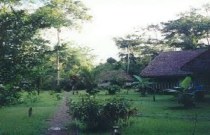 At the top we entered the constant twilight of the dense jungle where sunlight cannot penetrate. We carried our bags down a brief trail to a large clearing. There before us stood our amazing Resort, the scientific research station of the Tambupata Jungle, where erudite botanists come to study native plants and remedies to make pharmaceutical wonders for the world. One large, circular structure of canes and screen with a peaked, round roof of more canes, formed the dining room and bar. Ten smaller huts just like it were lined on either side of a torch-lit path. We gathered in the open-air meeting area of the bar to receive hut assignments. To their dismay, Jane and Bob, on their honeymoon, learned that all the huts were double and they were assigned to the same one with us. Our hut was the farthest from the dining area, but the “best” because it sat at the back edge of the clearing, only about five feet from the dense jungle.
The four of us entered the screen door of our shared cabin and discovered it was a double, partitioned by a bamboo screen six feet high, with another open six feet of air space before the peak of the straw ceiling. Each side had its private bathroom with a small ceramic sink, a flush toilet (no paper allowed in it), and a tin-lined shower stall with plastic curtain and cold running water. The two bathrooms backed up to each other. Our bedrooms consisted of bamboo walls with screens at shoulder height, twin beds made of wood poles and a mattress made up with clean sheets. Each bed was draped with a tent of thick mosquito netting. The small wood table held two clay candlesticks for lighting. We felt like children at camp, and I was immediately frightened of what creepy-crawlies would emerge after dark. I looked carefully and saw none and no snakes inside, but in my mind’s eye I could see every corner wiggling!
 We hurriedly returned for supper in the dining hut. We gathered in the bar for drinks and instructions and to meet the resident ocelot, who sleeps in the bar. Only a few brave men petted him. He yawned and growled and bared his sharp fangs, and we declined the offer to feel his stiff fur. Dinner proved to be a wonderful affair with excellent, freshly prepared food and delightful service by several native men, dressed in shorts and Hawaiian print shirts.
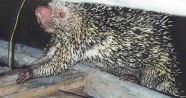
The added attraction was the largest porcupine we had ever seen persistently gnawing his way through the ceiling bamboo overhead. We had wondered about trash service in the jungle, but noticed that all left overs were just tossed out the door in back of the kitchen, where vultures swooped down in delight!
 This was our only opportunity to get to know the other tourists who were leaving before dawn to go to a place famous for butterflies. We learned that our cabin-mates had been sent on a pre-honeymoon to this place by her father who thought they should test their relationship before marrying. They too had thought that “Resort” would be five-star accommodations! None of us had realized that the luxury price was because most of the money funded the research of this station.
By the time we all dispersed for our cabins it was pitch dark, and none of us had brought our flashlights to dinner. In the jungle dark is total blackness! We were grateful for the few blazing torches which lined the little path, but we could barely see our feet. We had many ideas, but no way to verify, what creatures might be on our dirt walkway. Entering the hut was entering the Void, and we fumbled around trying to remember where the candles and matches lay. With one tiny candle in each bedroom, we could barely make out that there were no immediately evident varmints cohabiting with us yet, and we hurried to shower. There was no place to put the candle, so we had to take turns showering while we held the light for each other. Laughing about our spoiled city ignorance, I stepped into the stream of cold water and immediately shuddered loudly, almost simultaneously with the giggles and shudders totally audible from the other side of the thin tin shower wall. We felt so sorry for the honeymooners next door. We all tried to be silent and private, but there are no secrets in grass huts!!!
We bedded down in our respective mosquito nets, hoping we wouldn’t have to make a bathroom run before dawn. The jungle was silent, and we quickly drifted off to sleep. About midnight we were awakened with screeches, chitterings, squawks, quacking, scampering, and constant noises louder than New York’s Times Square! I heard scurrying and scraping across the wall just on the other side of my head and prayed the furry feet were on the outside. I screamed and four people were instantly awake, probably more in other huts. Terrified, I ordered Bill to turn on his flashlight and see what it was, but nothing was inside. We settled down more calmly and tried to sleep while listening to what sounded like a flock of screeching geese in the jungle just past our screen, and more heavy scuffling overhead, and some loud gnawing. Cringing, I covered my ears with my pillow and finally fell asleep. It’s amazing what an illusion of protection a heavy mosquito netting can give.
At breakfast the next morning I commented about the geese or ducks I had heard all night. Luis, our jungle guide, laughed. “Those are not ducks. They are capybara, the world’s largest rats. They are the size of pigs. That’s what you heard. Most of the jungle animals are nocturnal.” (Wonderful! And I have two more nights to sleep in this place!) The first night was filled with apprehension and dismay, but by the last night we mourned that we would have to leave. That little haven in the world of Nature became the wonderful resort it truly is, and we return to it often in our favorite memories.
 Real Travel Adventures