

“The sun is out!” Magic words around the Swiss Alps.
After 2 days of gray skies and intermittent rain in Bern, Switzerland, this sunny day would be the perfect one to see the peaks of the Eiger, the Monch and the Jungfrau mountains.
The train from Bern to Interlaken takes only an hour. Then, from Interlaken, trams, cog railway cars and cable cars climb the mountains. My husband and I chose the train package that climbs to the Jungfraujoch, the highest train station in Europe. It is 11,333 feet above sea level, and the top peak of the massive Jungfrau Mountain rises another 2,000 feet.
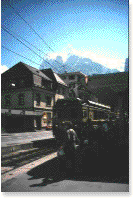
Our climbing journey began in an electric tram, not as old as the 100-year old Jungfrau Railway, but wooden and noisy. It climbed the steep slope and took wide turns well, but we still had to steady ourselves in our seats.
Oh, the scenery — green hills and wild flowers, a lone house on a slope beyond the track and wooden alp houses for the cows. We saw hikers who followed the narrow dirt roads that cut through the grassy fields.
The tram ride ended at Grindelwald, the transfer point to a cog-rail car. As we shifted the transport mode, we noticed that the warm July weather had changed to crisp, invigorating air. All of the travelers around us scrambled for the jackets they’d been advised to bring.
The cog-railcar rattled uphill, with its advanced power system. We stared across deep crevasses, and looked up to glistening, white, mountain peaks. The railcar stopped at Kleine Scheidegg village and at the Eiger Getscher station to let hikers debark, and then it entered the tunnel that loops 11 miles through the Eiger and Monch mountains.
Two built-in observation spots in the tunnel had wide windows and gave us passengers a chance to see the endless rivers of ice and snow that stretched thousands of feet below. Almost three hours later, we reached the super-alpine Jungfraujoch station. It’s like a small village built down the mountainside. We discovered that the five-story complex includes the station, a Glacier Restaurant, conference facilities, a gift shop and post office, and an Ice Palace. A weather station sits at the very top.

Elevators travel up and down the complex. Many of us used the stairs to descend the levels of the building. Glass walls separated us from the outside sea of ice and glaciers. Icicles hung from roofs all around us.
The Ice Palace, on a lower level, has floors, walls and ceilings of ice. The ice corridors lead past ice sculptures set in panoramic scenes. Youngsters, and the young-at-heart, detoured through an ice cave. At the exit, we found an elevator and a restaurant with welcome warm drinks. That ended any wish to stay in an ice hotel.
An outside balcony gave us a chance to breathe the crisp, clean, two-mile-high rare air. Part of a 22-mile long glacier rests beside the complex. Ten years ago, visitors could walk on the glacier. Alas, no more.
Back inside the five-story complex, we found the post office that gives visitors a chance to mail sure-to-become-collectible postcards with Jungfraujoch and “Top of Europe” stamps. From there we boarded a waiting train and planned to stop part way down the mountain to explore one of the villages where we had stopped for hikers earlier.

It didn’t happen. When we changed trains, a conductor shooed us aboard the next one into the overflow area with narrow jump seats, open windows and noise. We missed hearing the long, brass alpenhorns and shopping. But we had a serendipitous trip down the mountain. A local tour guide from Grindelwald sat on an adjacent jumpseat and we got a free talk tour. She told us about the mountains in the winter, and that the tracks and roads are cleared all year, as far as the Eiger tunnel.
“Forty percent of the people who come in the winter are hikers,” she said. The town of 4,000 persons doubles and triples in size in the winter.
“See the small trees? They’re stunted by the cold, but they have strong roots,” she said. “And over there is an alpenrose, just now in bloom, but only for two weeks.”
Her delight in her surroundings showed in her smiling face. Talking with her, dressed in the ethnic dress of a ruffled white blouse, embroidered vest and dirndl skirt, transported us for a time into her world.
The too-short ride ended at Interlaken – the town between two lakes. We walked beside the river and through the town, while the white-topped Jungfrau stood like a sentinel watching over the town. The century-old Grand Hotel Jungfrau faces that mountain and nothing bars its view.
On the balcony of a less-than-grand hotel, we ate dinner and watched the Interlaken world pass by — trains going to big cities, lake boats taking people on a dinner cruise, horse-drawn wagons carrying people in old-world style.
Back aboard a Bern-bound train, we watched the glacier blue Lake Thun as long as we could, and wished for another day in the Bernese Alps. We might ride the gondola car to the top of Shilthorn Mountain and hike to the tiny village of Gimmelwald. Or maybe come again in another season. Then we could see why the serene Alpine tour guide said, “Oh, in the wintertime, it is so-o-o beautiful.”
 Real Travel Adventures