

A 16th-century clocktower puts on a show every hour. Bears and jesters kick and whirl, while a rooster crows and a knight bongs a big, brass bell.
The four-story clocktower sits in the middle of a wide, cobblestone street lined with medieval buildings where bears adorn flags, and bear statues guard buildings and grace fountains. Live bears occupy “the pits” by the river.
A wild place, this Bern, Switzerland.
My family and I, heading for Amsterdam with an almost expired month-long Eurail Pass, chose to stop in Bern for a few days in late August. Travelers acquainted with Bern said, “It’s such a nice, easy place to visit.” That sounded good.

We detrained in the City-of-the-Bear, a UNESCO World Cultural Heritage Site. After a quick orientation in the train station’s Tourist Office, we hoisted bags onto an escalator and emerged at a street-level plaza, the Bahnhofplatz. We saw the fancy Hotel Schweizerhof, a “Leading Hotel of the World,” but turned the corner to our moderate hotel, the Hotel Krebs. Satisfied with the fourth-floor, sparkling clean room with big, airy windows, we left the hotel to explore the city.
The Visitor’s Guide from the station provided a self-guided walking tour map which we followed for three hours. Off and on. We dallied for coffee and Nuss Strudel in a Barenplatz (bears square) outdoor café and watched an ongoing chess game, played with 4-foot high chess pieces.
We roamed the cobblestone streets all the way to the Aare River. Along the way, we found 16th- century fountain statues right in the middle of the street. The majestic figures rise 20 -30 feet into the air above fountains.
Drinking water spouts from pipes into the stone basins beneath the statues. The fountains were the sole supplier of drinking water to Bernese citizens for over 300 years. In 1868, the city had a new way to get the spring water — by pressure pumps. Even though no longer a necessity, most of the 37 fountains have been preserved for their artistic value.
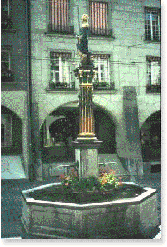
The Justice Statue, designated the “artistic masterpiece” of fountains, was built in 1543. The woman figure, blindfolded and dressed in ornamental armor, holds a sword and balance. The sculptor, Hans Gieng, put representatives of power at her feet — a crowned emperor, the pope, a sultan and the mayor of Bern. Justice, a symbol of the Republic, calls them to account to carry out justice. Nice philosophy.
Our walk also took us to Bern’s Gothic-style cathedral, whose spire, the highest in Switzerland, pierces the sky. The cathedral is open for worship and touring, and its 200 stairs lead to an expansive view of the entire city.
The Swiss government buildings are close by and offer tours. Bern is the capital of both Switzerland and the Canton of Bern.
Bern began in 1191 A.D. as a walled city. Its founders built towers as protection devices. Two towers are part of the old medieval city, an easy walk from our hotel. The present clock tower, first built in 1219, marks the site of the original city walls. The 1256 prison tower, just up the street, marks the extension of the city walls, as does the Christoffel Tower, built a century later.

As people roam the city with its old sandstone buildings and wonderful fountains, platzes and shops, they hear the hourly music and chimes from the Zyttglogge Clock Tower. By the second day, we knew we had to tour.
The inside tours are offered once each afternoon at 4:30, although the tower’s “performance” occurs for four minutes before each hour.
Inside, visitors see a twenty-foot-high ironworks of bars and chains and gears that move the figures and time pieces. Bellows squeeze air to activate the rooster’s crowing, levers creak and clang to twirl armed bears and a dancing jester and a lion.
Our charming German guide, steeped in the history of Bern and clock mechanics, also explained the Astronomical Clock with its stars and moon movement. She, too, was in awe of this marvel of engineering.
“Can you believe the clockworks were constructed in 1530 . . .even before the time of Galileo?”
Bear images show up all over town – on Swiss flags and on banners flying from downtown buildings, on trash barrels decorated with a flaming tongue bear, on statues that flank the entrance to the Bern Historical Museum. We headed for the real thing, the famous Bear Pits by the Aare River.
The pits are close to the Nydeggbruck Bridge, one of several bridges that span the river that winds around the city in a U-shape. The dismal pits attract tourists by the busload. The trees in the deep pit are dead, and lethargic bears have to stay next to the walls for shade. Perhaps by now there are new trees.
Beyond the bears, tree-lined parkways line the river bluff on the east bank of the Aare. Paths lead to a top-of-the-hill Rose Garden. Along the way, inviting benches beckoned us — a good excuse to stop and view the city scene from a high spot. The red tile rooftops of the tan buildings glowed in the sun, showing off the tiny masonry chimney houses atop each chimney flue.
The river is used for recreation, legal and illegal. We watched a water skier practice his sport while attached to a tree on the river-bank. A Bernese acquaintance, a Swiss government official, said the dangerous activity is not legal. “People can and do swim in the river, though,” he said. “I sometimes walk for 15-minutes upriver, and then swim downstream to the city swimming pool. Ladders and handholds are set up along the banks so people can climb out from the swift current.”
We read an ad offering a city tour in a river-rafting boat. In summer, rafters meet at an arranged point and travel down the river in late afternoon, a two hour tour. They return to the central city via a city bus.
Graffiti “decorates” some of the old sandstone buildings in Bern. They were marked by squared script-like initials, and English and German words. We talked to the government man about it. “Yes, I know,” he said. “They come straight from the New York gang influence.” Whoa.
The graffiti on buildings hundreds of years old did not match the proud, sparkling-clean city. Street-sweeping trucks cleaned the street under our hotel window twice in four days — maybe more. On a rainy morning, as I walked through an arcade (one of the longest covered shopping promenades in Europe), I saw a workman riding a motorized cleaner, power-scrubbing the walks.
For museum hopping, visitors can take in Paul Klee at the Kunstmuseum of Fine Arts, the Museum of Communication and the castle-like Bern Historical Museum. Inside the museum, visitors find four magnificent, 15th-century, Burgundian tapestries. In the “Weapons, Armor and Sculptures Room,” 14th – 16th century armor, shields and pikes highlight Bern’s power centuries.
Two wood statues, carved c. 1590, stand at one end of the room. Here, the legend of William Tell comes to light. Tell has a raised bow and arrow and aims for the apple on his son’s head. In the Swiss tale, William Tell defied the Austrian conquerors of the 13th century, and was punished by being ordered to shoot an apple off his son’s head. He successfully shot the apple and not his son, and has remained a Swiss symbol of independence and resistance to subjugation.
More to see in Bern and nearby: Einstein’s home, a museum, and in April 2005, the historical museum will open an exhibition of science and Einstein’s relativity theory. He developed his theory in Bern in 1905. There are easy day-trips to the Jungfrau, Monch and Eiger mountains, to cities like Lucerne and Zurich and Chillon Castle on Lake Geneva.
 Real Travel Adventures