

As we twisted through the mountainous two-lane highway I commented, “This is really beautiful but I’m a little disappointed because, although this is one of the largest mountains in the lower US, from the highway it looks like other mountains we’ve navigated.“
Mt. Rainier National Park, WashingtonThen we rounded another curve and suddenly, incredibly, there she was! In all her majesty, she regally loomed over us, beckoning us to fall hopelessly, eternally in love with her. Her massive, snowy ridges stretched more immensely that we could imagine. It was our first visit to Mt. Rainier National Park, and that was the view that captured our hearts forever. Now we try to revisit this wondrous place whenever possible, although it is nearly 2,000 miles from where we live. It is that wonderful to us!
On that first trip the weather was gorgeous, and the photos-ops were endless, so we stopped many times to capture the viewpoints or explore short stops. We were traveling in our 28-foot RV and not towing a car, so we wanted to see as much as possible before we camped. To have a lovely dinner before finding a campsite, we stopped at the beautiful Paradise Lodge, built nearly a century ago by the CCC during the Great Depression when so many were employed to build our National Parks. However, this was a big mistake! We didn’t check about camping until after dark, which occurs late in mid-summer so far north. We discovered that all sensible RVers in mountainous terrain find their spot and set up well before dark. We could not find a vacant place to camp. We were rounding the “S” curves on the small, two-lane, mountainous highway all alone and feeling quite desparate. Even the dark evergreens pointing to the starlit skies and the full moon overhead did not make us feel safe. Finally, in desperation, we returned to Paradise Lodge parking lot and spent the night, hoping we’d not be arrested. Don’t try it!!! You must settle in well before dark because the road is not easy at night and you miss the beautiful scenery.
A car will make sight-seeing here much easier. For RV’s and trailers, plan your campsites carefully. It is now required that you check-in with a ranger station for any type of camp site, or reserve in advance. Camping is available in six locations within the park (reserve here ).
Many national park visitors walk only about a mile on trails near the Visitor Centers. Most just watch the films there, see the displays, walk around the nearby walkways, buy postcards, and leave. What a shame! We can’t imagine missing the wonder of our amazing National Parks. Bring your hiking gear, and even if you are handicapped, there are trails you can follow. Being in nature is an experience you’ll take away in your heart forever.

Although we have never requested the back country back-packing permits, we have now hiked many of the trails at Rainier, and we have some favorites! For perhaps the easiest, we love the Trail of the Patriarchs, which is a moderately easy trail through forests to see the giants: Western red cedars, Western hemlocks, and Douglas firs, some over 1,000 years old. You can follow the trail, with some moderate ups and downs, through the several-mile loop, which includes some boardwalks through wetlands and lush ferns and has benches and rest stops in strategic places. Or you can just go a little way into the forest to see some trees over 300 feet high. The short walk behind the Visitor Center is resplendent with lush ferns, ponds, and the Christmasy smell of the giant evergreens. If you only have a half-day in the Park, don’t miss this stop.

Our other favorite quick stop for beauty and wonder is Box Canyon, where you’ll see the slice a huge glacier took out of the granite boulders to form the rushing river below. Read the signs to learn how glaciers polished the rock beneath your feet to look like marble.
For a steeper hike, another of our favorites is behind Paradise Lodge and begins with a very steep climb through alpine meadows often covered with snow or wild flowers. We’re always welcomed by friendly deer. This is a huff-and-puff short climb on a very nice walkway as you face the beautiful peaks of Mt. Rainier.

When we’re on this walk or at the lodge, we use binoculars to watch the really ambitious, serious hikers take the BIG climb to the peak, a two-day adventure which requires experienced guide-service from the post just by the parking lot. The ranger guides told me they have even helped 80-year-olds accomplish this feat successfully! We have not attempted it! However, if you start early in the day and are ambitious you can take a wonderful 7 – mile loop beyond the Alpine trail and continue through snowy fields, beautiful forests and return to Paradise Lodge exhilerated and exhausted for dinner. Take water, food, extra jackets, and rain gear.
While you are at Paradise be sure to go to the Visitor Center, a separate building from the Lodge. This modern building has great views of the mountains all around, many explanatory exhibits, and a very good film explaining the area. Don’t miss this!
Another favorite hike of ours is Tremont Mountain View, about an hour and a half away at Sunrise Visitor Center. This must be a very careful drive around steep mountainous bends, but the highway is very good. This hike is not quite as steep as that at Paradise Lodge, although there are a couple of steep parts that will get even the healthiest heart pounding. Wear hiking boots, not tennis shoes, and usually you will have snow to traverse. On a bright sunny day the views of the mountain are absolutely incredible!
Facing the enormous peaks we crossed on a level pathway a route made along an ancient rock slide, with steep, snowy rocks directly upwards and straight downwards from this narrow pathway. Quite a thrill! You can cross an ice field if you choose to at one point, or you can go to the top of Tremont for a great view. You’ll be greeted by friendly little marmots all along the way.
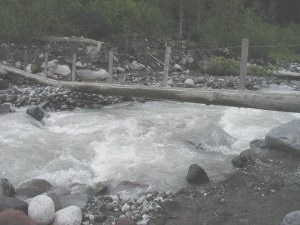
Weather is a big factor in how much you’ll see when visiting Mt. Rainier. One year we had longed for months to return to the mountain and had driven with eager anticipation for several days, only to arrive in thick fog and rain. We made camp at Cougar Rock, which has lovely level camping sites with picnic tables and firepits. However there are warnings about Lahars, mud and rock slides, and earthquakes…not a campground for the fearful! As we huddled under umbrellas at the campfire program that night the Ranger told us that the Park Service had thought of closing this campground because of potential dangers, but so many visitors had protested they decided not to. However, if you ever hear the roar of a train you run as fast as you can for high ground. This campsite is so beautiful, beside the roaring rapids of the milky, glacial-melt, Nasqually River it always seems to us to be worth the remote risk. After all, we want our ashes to be scattered here anyway!!
During our three days, there was no break in the weather, so we took shorter hikes, enjoyed drizzly campfire programs from the rangers, and drove all over the Park. However, the majestic mountain, which is officially recognized as14,411.05 feet high, is so enormous that she creates her own weather, and while we were there she never relented, so we had to move on without ever seeing her gorgeous peaks that year. A huge disappointment, which could happen at any time of year there.
Our other favorite campground is Ohanabigosh, which is beside a calmer river on a vast forest floor. Walking along the quiet river, or climbing the easy hiking trail upwards from here is beautiful. This is a more tame campground it seems to us.
Whenever you go we believe you’ll also fall in love with the incredible place of wonder.
BEFORE YOU GO
Sunshine Point and Input are open all year. Others are open from mid-June or mid-July to September or October. Cougar Rock has maximum RV length of 35 feet, with only a few sites for these longer vehicles, so reserve ahead. Ohanabigosh has maximum length of 32 feet. There are no RV hook-ups at any of the campgrounds, although you can find a dump station. Be sure to check the website above carefully because an RV over 30 feet is difficult to find the right spot for. You must be careful about which loop to take so you won’t get into a problem. We suggest walking the loop before you drive through it, to be sure you can make the curve. Just don’t attempt it if your trailer or RV is longer than the posted recommendation because you WILL get into a problem of curves you cannot maneuvre.
The most interesting approach to Mt. Rainier is not from Seattle, as most folks see it, but from the East, driving from Yakama, Washington, on US 12. At the fork take SR 410 West, which will take you through the inviting mountain scenery of sweet-smelling evergreen forests as you wind ever higher.Arriving on Highway 410 you’ll go over Chinook and Cayuse Passes to the White River Entrance and Sunrise, which is only open in summer.
.
If you come from Seattle, you have already seen Mt. Rainier beckoning you like a graceful, giant mirage enormous above the skyline of the city. Your approach will be South on I-5 to SR 512 (exit 127). East on SR 512 to SR 7. South on SR 7 to SR 706 in Elbe. East on SR 706 through Ashford to the Nisqually Entrance, Longmire and Paradise. This also is a lovely drive, but without the sudden impact of the surprise encounter with Mt. Rainier which the other entry offers.
 Real Travel Adventures