

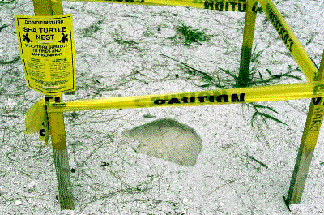
My previous coverage of Anna Maria Island (see A Florida Secret) revealed a myriad of subtropical undiscovered family fun to be explored during the off season. A family destination truly worthy of a visit is one where there is always something new to discover and just when I think I have covered everything, nature reminds us to pay more attention. With a professional background in the natural and biological sciences, I found myself paying special attention to the fenced off endangered see turtle nest directly in front of our oceanfront apartment balcony during our last visit at the height of the August hatching season.
We frequently read local paper coverage of unfortunate artificial light-induced hatchling migrations away from the ocean and have seen nests marked off in the sand before. We knew about how the mother sea turtle returns to there place of birth to lay eggs and how they must hatch in the total absence of artificial light to navigate to the ocean – but never in the day time so as to avoid being sea gull food. We learned that these already endangered species would be a lot worse off if it weren’t for an army of diligent volunteers assuring that the eggs hatch properly. These midwives, and “midhusbands”, of the surf also return to count all the hatched eggs, rescue any stragglers and report all the results to the governing regulatory agency which gives the permits to the volunteers – touching these cute and magnificent creatures is otherwise illegal.

The latest account of a light-induced misdirection of hatchlings to their vehicular death made our room-front nature preserve that much more valuable and prompted a little research with the local visitor’s bureau which led us to the local volunteer office of Anna Maria Island Turtle Watch, Inc. nearby. We learned even more about sea turtles and were inducted into their organization as temporary nest monitors – we even had a chance to view a planned release of hatchlings at another beach. They were held in a bucket from an earlier daytime hatching after notified by lifeguards. Accustomed to such experiences only on TV nature shows, seeing this event for real was something we would never forget.
Armed with their deputized mission of nest monitoring, my children, Drew and Susan, ten and eight years old respectively, diligently checked the nest for signs of activity every night. As we were talking about how cool it would be if it hatched while we were here, two nights before we left, we observed surface sand movement in the afternoon and Turtle Watch quickly arrived with their donated ATV. Loyal residents and visitors joined the volunteers for the baby sitting well into the evening. By 8:00 PM, a sunken hole had formed in the sand and little subsurface flippers could be seen twitching at intervals.
Building lights were strategically off and one was quickly reminded how even starlight, the turtles’ beacon, provides ample illumination once the eye can adjust. Drew and Susan sat faithfully nest-side the whole time and what amazed me the most was their ability to voluntarily sit quietly and motionless for hours. Turtles were able to do what I could not. Under turtle-invisible red beam flashlights, the creatures increased their bouts of fits and starts but failed to trigger the threshold needed to begin the instinctive chain reaction of a nest-synchronized exodus. Finally, at about 9:30 PM, labor ceased and delivery occurred.
As if on cue, they spilled forth from their sandy womb like a heard of tarantulas to the squealing delight of children and adults alike. Drew likened it to a horror movie without the horror and realized this was a rare experience. Spreading into a fan-shaped flow of crawling reptilian carpet, they enveloped many of the bystanders requiring everyone to stand where they were to avoid accidentally stepping on the tykes. We will always remember the tickling of their proportionally large flippers as they crawled over our bare feet toward their awaiting refuge. While interaction with humans is kept to a minimum, some stragglers needed redirecting and coaxing in the right direction. Susan very diligently led one apprehensive turtle in particular to its appropriate destination by pretending to be its mother. Other bystanders herded the rest as necessary. In about 20 minutes, all that was left on the beach was the occasional ghost crab, the gurgling of the surf and a silent breeze.
 Real Travel Adventures