

“A BK Big Fish,” I said to the cashier at Burger King. I was back in Seattle now, amidst tall buildings, cars, lots of people and fast food places of every imaginable kind, not to mention specialty coffee. Just the day before, I had been in Southeast Alaska, a land made distant not so much by being thousands of miles away, but by its natural environment and way of life. There, I watched how wild bears get their fish.
It is 8:30 in the morning. I am at the tour office of Alaska Waters in the City of Wrangell. There are six others waiting with me. We look at each other, giving instant recognition and forming a silent bond, as if knowing that just moments away, we would soon be on an adventure together. We introduce ourselves. Ruth is a retired nurse from New York. Chris and his wife are from Reno. Carol is a school teacher from Illinois. Just then Wilma Leslie approaches our group and announces, “We’ve got sightings. Let’s go down to the pier.” A five-minute walk takes us to Mark, who is standing next to the jet boat that will be our mode of transport from Wrangell (pronounced ‘rangull’), 35 miles south through the Eastern Passage, to the Anan Bear Observatory in the Tongass National Forest.
Mark, wearing sunglasses the entire time, is a dead ringer for the actor, Sam Elliott. Check out his height, build, hair color, and more noticeably, the voice and manner of his speech. It turns out that he has been in Alaska for over 30 years, having come from the ‘lower 48.’ The hour-long ride gives you unbelievably fresh air, snow capped mountains, virgin forests, big blue skies, and water and greenery for as far as the eye can see. Most of all, it offers you space – a sense that you are there alone with nature.
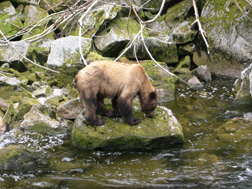
On arrival at Anan, we disembark and place all of our food and drink, with the exception of water, into a metal locker. We then follow Mark on foot for about a half mile through the rainforest to the observatory. The two levels of the observatory offer views from various angles of the creek below. I opt for the lower level first. We can see countless pink salmon swimming in the water. A group of black and brown bears appear with two cubs. They are no more than 30 feet from me. They put fishermen to shame as they easily catch their prey, one at a time. Right then and there, they eat their catch, fresh and tasty. No adding batter, no deep frying, no tarter sauce. The bears seem to know something that we humans do not, when it comes to food and nutrition.
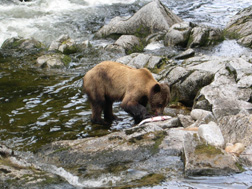
After about two hours of watching the bears playing in their natural habitat and feasting on fresh seafood, we begin our trek on the same trail back to the jet boat. There, we pick up the food and drinks left behind in the metal locker, and have a feast of sorts ourselves. One fellow traveler even has a canned tuna sandwich.
This tour to the Anan Bear Observatory is not to be missed. Peak of the season is July 5th through August 25th, where entrance is by permit only and is limited to 64 per day by the US Forest Service. Both the public and tour companies may apply for the permits equally. After August 25th, viewing is available through the first week of September.
 Real Travel Adventures