

September 11, the war in Iraq, and resultant fears made some wonder why we would continue to travel. However, we needed to put the risks in perspective and use this as an opportunity to interact in a positive way with people outside our borders. Using the same common sense precautions that we would in any large city, we came home with incomparable memories.
It is better to walk than curse the road. – Wolof (tribal, Senegal) proverb
Our cruise began in the Amazon on the Royal Princess . We were docked in Dakar, Senegal, the westernmost point in Africa, a major commercial port.
Senegal: scenic, sensory, and spirited
Yes, the street vendors are persistent in Dakar, but it is part of the culture and experience, best treated with good humor. Produce, household goods, and jewelry dotted the sidewalks. Women in brightly colored dresses balanced bowls filled with cloth dolls on their heads. We made our way along the bustling port to the to the local ferry stop, winding our way through the hubbub of the street. We were headed for the Ile de Goree on a Saturday, the ferry teeming with families, other tourists, and peanut vendors.
Until Dakar was established in the mid-19th century, Ile de Goree was a leading commercial trade center. From the 16th century, shipping barons also profited from intertribal rivalries; victors sold the defeated into slavery. “There it is,” a father told his little boy, pointing to a building just in sight– “The Door of No Return”. We docked and headed for the Maison des Esclaves (Slave House) 1776, preserved as a memorial to past horrors. Looking out the door through which thousands passed, we could see only the ocean. Inside were holding cells, chains… symbols of man’s inhumanity to man… Today the house was filled with tourists, taking photos in what might for some have been the path of their forefathers. !
Now the island is an inviting weekend destination, an escape from the city, with ochre-colored colonial houses, gardens, museums, schools, restaurants and shops. Warm breezes carry the scent of fragrant flowers. Children scurry along the underground passages of the fortress; others enjoy spectacular views.
Shopping here is more laid-back than the markets of Dakar, with colorful wares from throughout Africa — batik cloth, and caftans, jewelry, masks, sand paintings and wood carvings for sale. We bought cloth dolls from one of the young women eager to make a sale. She followed us, pressing into my hand two colorful bracelets, “A gift to nice people”, she said, “a souvenir”— now a personal treasure.
There was time to see the center of Dakar, and boarded the Princess cruise line shuttle to the Place de l’Indépendence and walked to the handicraft markets and the Palais Présidential, surrounded by lush gardens. We returned to the ship just in time for the folkloric show, featuring energetic local dancers, musicians and firebreathers! What a treat!
Morocco— Medinas and minarets, sultans and souks, kaftans and carpets…
Next was Agadir, Morocco, a fishing port and Morocco’s top tourist resort, averaging over 300 sunny days yearly. Once home of Morocco’s Barbary pirates, it was rebuilt after the devastating 1960 earthquake. Our driver took us to the Kasbah (fortress) for the spectacul! ar view overlooking the city, modern harbor, golden beaches and luxury hotels.
Goats herders were on the steep slopes below. Wide, tree-lined boulevards led to narrow streets and the old Berber village souk (market) – a sensory delight — spices, vegetables, clothing, pottery, leather goods, jewelry, metalware, and more — and a display of meats, animal heads and hooves that elicited gasps from unsuspecting tourists! We sat with a merchant clad in a traditional jellaba, the hooded garment with wide sleeves, sampling sweet mint tea as he described spices in a relaxed and welcoming atmosphere….
One more day remained on this continent — in the celebrated Casablanca — Morocco’s largest city, and the busiest seaport in North Africa. This leading industrial and commercial center of Morocco is quite unlike the movie of the same name. We headed first for the capital city of Rabat. Mohammed’s English was limited, but combined with what I remembered of my high school French, we communicated well enough with our driver. A CD of rai music set the mood as we became absorbed in the contrasts of old and new surrounding us.
Rabat, a modern mix of European and Islamic influences, is the last of the four imperial cities. The political and administrative capital since the French occupation, it is also the royal family residence. Our first stop was at Chellah, considered most beautiful of the Moroccan ruins. Established in 200 BC, it was for a millennium the prosperous Roman town of Sala Colonia. From the 14th century, it was a necropolis (burial area) for such notables as the great Sultan El Hassan and the “Black Sultan” and his favorite wife, until destroyed by an earthquake in 1755. Beyond the massive Merenid gate is a valley of flower gardens and fruit trees overlooking the river. Storks swoop down on the menagerie of nests perched high on the ruins, bringing tidbits to tiny mouths. The archaeological museum is the best in Moro! cco.
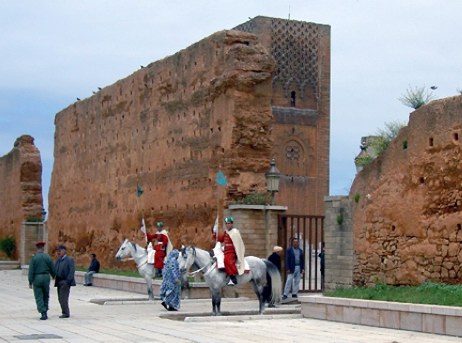
The traditionally Moroccan white marble Mausoleum of King Mohammed V, inspired by Napoleon’s tomb is most impressive. An intricately tiled modern Islamic interior surrounds the white onyx tomb of the king. The Royal Guard protects this magnificent site by day and night, honoring the king who led the country to independence.
Opposite is the 12th century Hassan Tower, a massive 144 foot high minaret with walls 8 feet thick and interior ramps that can accommodate a horse and rider. Two hundred columns stand where the original mosque was to have been constructed. Want a henna tattoo, inexpensive jewelry—or a fez? Bargains are just outside the gate.
After passing the royal palace, mosque and gardens we walked through the grand gate of the Kasbah des Oudaïas, former fortress of the Almohads, Merenids and Andalucians. A labyrinth of colorful lanes led us to a terrace overlooking the ocean. Nearby is the Musée des Oudaïas (Museum of Moroccan Arts), in a 17th century palace, and the lovely Andalusian Gardens.
The scenic shoreline route back to Casablanca brought us past crashing waves and fisherman, some selling their catch. Casablanca’s Corniche area offered beautiful beaches, promenades, popular restaurants and nightclubs.
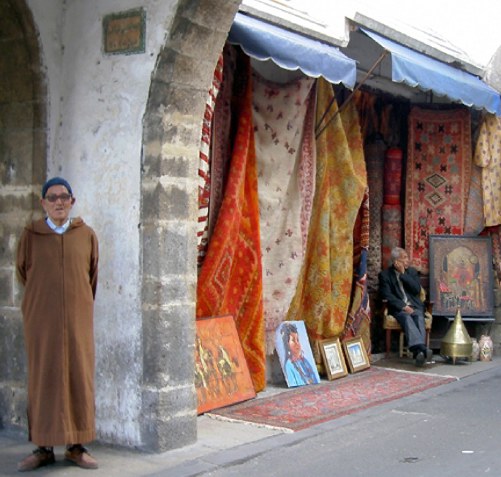
Our focus was traditional Morocco, and our first stop was Old Medina, the original town, now a market district with rampart walls, narrow streets, whitewashed houses, and fascinating food and spice stalls. Many souks line the traditional Arabian style streets and courtyards of the Habous Quarter, or “new medina”. Bargaining for copper, silver, ceramics, cloth, and rugs is an artful game, part of the experience. Hungry? Stop at Chez Benis, renowned for its pastry. The local Central Market completed our shopping experience.
The day’s finale was the magnificent Hassan II Mosque, a masterpiece of intricate mosaics and marble completed in 1993 at a cost of $500 million. It is the only mosque in Morocco non-Muslims may enter. The largest religious building in Africa, it is second-largest in the world, after the mosque in Mecca. It features a retractable roof and accommodates 25,000 inside and 85,000 outside. The world’s tallest minaret stretches 650 feet high, appearing to touch the bright sun.
It was time to return to our ship, but not before our driver had presented us with a bouquet of roses. As we sailed away, darkness surrounded us, except for the brightly lit mosque, the laser beam shining brightly atop the minaret, a beacon toward Mecca, beckoning us to return to this exotic continent.
Believe what you see and lay aside what you hear. Moroccan Proverb
 Real Travel Adventures