

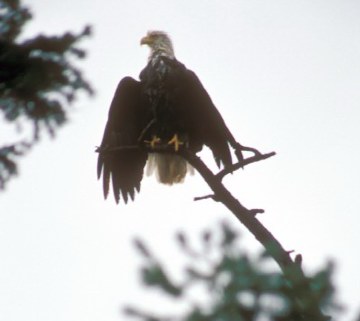
The Bald Eagle is a majestic bird with a wing span of 6 to 8 feet, who fly at about 20 mph. The females are the larger of the species, weighing an average of 15 pounds. The males average 9 pounds and have a slightly smaller wing span. The pair mate for life, which is about 20 years in the wild. They aren’t really bald – the term “balde” is an old English word for “white”. The young eagle has light brown head feathers which turn white around 3 or 4 years of age.
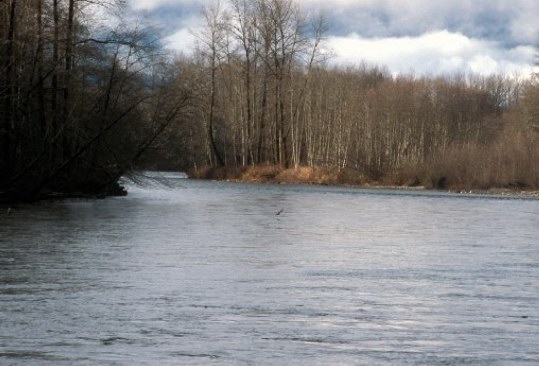
Nooksack River EagleA great place to find Bald Eagles in the winter is to head to northern Washington state, to the Nooksack River valley (near Deming) and the Skagit River valley (near Concrete and Rockport). Searching for spawning chum salmon, this gathering of Bald Eagles is the largest in the lower 48 states of the U.S.. The Chilkat River in Alaska holds the record for the largest gathering, counted at near 750 birds.
The best time to find the birds feeding is in the morning, from daybreak until about 11:00 a.m. In the afternoon, you might see them “soaring” – catching updrafts of air, carrying them up and up in wide arches. By dusk, they head into sheltered areas to roost for the night. Scientists estimate that they spend about 65% of their time at the night roost, another 30% perching in trees and only a small percent actually feeding and flying. They are saving energy before flying back north to breed.
The best time of year to see these transient eagles is mid-December though mid-February. There are two prime areas for spotting eagles on the Nooksack River, just east of Bellingham.
The DEMING HOMESTEAD EAGLE PARK.
This 15 acre park, part of Whatcom County Parks system, is a good place to start your day of eagle watching. The salmon wash up on sandbars out in the river bed. The Parks department has constructed salmon habitat structures which are a great environment for the salmon to spawn and the young to hatch. There is a trail with interpretive signs along the way to give information about the eagles and the salmon. If it is a clear day, bring a picnic and watch the wildlife with your binoculars from the picnic tables. Take I-5 to SR 542 (Mt Baker Highway). Go east to milepost 14, and turn right on Truck Road.
MOSQUITO LAKE BRIDGE.
From the bridge you should see eagles in the trees lining the river. From SR 542, turn right just before milepost 17 on Mosquito Lake Road (there is a little store here with outdoor restrooms). Go for a mile to the bridge crossing the north fork of the Nooksack River. There is parking on the left side of the road.
There are also pullouts along SR 542 paralleling the river. At times you can see eagles perched in the trees.
On the Skagit River, the prime viewing area is between Concrete and Marblemount. On the weekends from mid-December to mid-February, there are volunteers at three Eagle viewing sites to guide visitors:
right off the highway at Steelhead Park in Rockport, the rest area at Milepost 100 at Sutter Creek, and the Salmon Hatchery in Marblemount.
For your family’s safety, make sure you use designated parking places and avoid stopping on the highway.
In February, the Upper Skagit Bald Eagle Festival is held. There are interpreters, walking tours, exhibits and food at the Festival. Check out the website at http://www.skagiteagle.org. To reach Concrete, drive I-5 to Highway 20 and head east. The Skagit River Eagle Interpretive Center is about 40 miles from I-5 in the town of Rockport.
One of the best ways to view eagles is on the water. At least 10 companies have Forest Service permits to lead eagle watching trips down the Skagit River between Marblemount and Rockport. A float trip, about 3 hours long, offers a wonderful opportunity to see eagles a bit closer, on both sides of the river in spots where you could not see them from the road. The trips run between December and early February, generally starting around 11 a.m.
It is winter, so dress warmly with solid shoes that can get wet and muddy. Even if it’s not raining, the ground is still likely to be damp. Bring your camera and binoculars. Sometimes the eagles are close to the road, other times they are visible only on the other side of the river. Don’t try to get too close to the birds or you will disturb them and they will fly away. If disturbed during feeding, they will fly away and may not come back to the spot until the disturbance has left. All in all, seeing eagles up close is an experience not to be missed.
Janice Lovelace has lived in the Seattle WA area for the past 12 years. Previously, she grew up in the Midwest, went to college in Massachusetts, and then moved to California for graduate school. Although trained as a psychologist, she now spends most of her time traveling, photographing and writing.After teaching for 9 years and doing a weekly newspaper column on child development she decided to make the move into travel writing.
Now that the children are grown and out on their own, there is more time to spend on traveling and improving her photography. Her articles, with photos, have been published in regional and national magazines. She writes frequently about family travel. Janice has traveled throughout most of the US (including Alaska and Hawai’i), Canada, Mexico, Belize, Honduras, several Caribbean islands, and Japan and loves to write about it.
 Real Travel Adventures