

It had been over 14 years since I was last in Ireland, and the changes, particularly in the cities, were amazing. Now, you need to travel to the more remote areas of Donegal or Connemara to see the quaintness of the village life that once was found in most of Ireland. But the populace is still much taken with the ancient myth, legend, and folklore, which sustained the spirit of the land through the lean and hard years. It is a culture based more on the mythical than historical tradition, which may be behind its transcendent nature and appeal to the imaginative traveler. Our circular tour from Dublin, Ireland, northwest to Donegal, down the coast to Galway, and eastward back to Dublin, was magical. Around every bend scenes captured our imagination and senses, prompted by reading Irish folklore and myth, as well as poetry of William Butler Yeats and Seamus Heaney prior to our trip.
Tara-IrelandDriving on the N3, our first destination Tara and Bective Abbeyin County Meath, a place steeped in ancient legend and folklore. The advantages of Ireland’s inclusion in the EU can readily be seen in the new, four-lane highways. This new prosperity has gained the country the title of the “Celtic Tiger.” Views over the plains of Meath, and the mounds along with the Stone Age passage grave dating back to 2,500 BC made us realize this was an ancient, sacred place. Much of the Hill of Tara’s mystique is its association with the mythical goddess Maeve and the image of Druid rites taking place on this spot. This was also a place purported to be where the high king of 1st and 2nd Century Celtic chieftains held the royal court. It was also here that St. Patrick used the shamrock to explain the Christian Trinity; hence, the shamrock became the Irish national symbol. The kings of Leinster used Tara as a center of operation through the 11th century. A 15th Century church next to the Hill of Tara has the Visitors’ Center and an excellent audiovisual presentation. The name “Tara” in “Gone with the Wind” was taken from this ancient place. We found this a great place to begin our immersion into the myth, legend, and folklore of Celtic past.
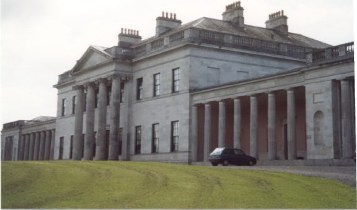
ICountrly Mansionn Northern Ireland we reached Enniskillen, between two large lakes, the Upper and Lower Lough Erne, formed on the River Erne. This is where the writers Oscar Wilde and Samuel Becket were schooled. The Enniskillen Castle houses the Fermanagh History and Heritage Centre and the Regimental Museum of the Royal Enniskilling Fusiliers and is worth a visit to gain an overall historical orientation of the area. Just out of Enniskillen we found the mansion Castle Coole. This 18th Century neo-classical estate was designed by James Watt and is one of the purest forms of neo-classical architecture in Ireland.
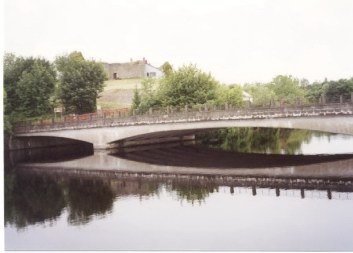
We traveled along the A46 which took us beside the Lower Lough Erne with many quaint villages and scenic vistas. If you have the time there is a waterbus that cruises the lough for about 2 hours, departing from the Round `O’ Quay at Brook Park just out of Enniskillen. Devenish Island in Lough Erne is the site of a 6th century monastery founded by St. Molaise and sacked by Vikings in 837AD. Further along A46 a signpost directs the traveler to Tully Castle, built in 1613 for a Scottish planter’s family. From here it is only 16 km to the border of Northern Ireland and the small town of Belleek, famous for its fine porcelain factory, which you can tour.
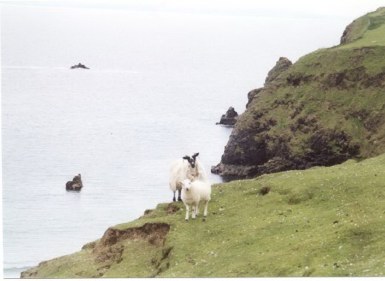
Entering again the Republic of Ireland in the far northwest and most remote region, we proceeded to Ballyshannon on the coast and turned north on the N15 to Donegal. The region is marked with thatched roofed cottages, rolling green hillsides dotted with sheep, and spectacular cliffs jutting up from the sea. The town of Donegal is built on the River Eske with the 15th century Donegal Castle set at a bend in the river in the center of town. Donegal is famous for its woolen Donegal tweeds. All along the roads are shops selling and displaying every kind of woolen wear from sweaters and hats to bolts of fabric and bundles of yarn. But most impressive to the region is a drive along the cliffs bordering the sea on the road to the fishing village of Killybegs and beyond. At the village of Carrick we found the Slieve League. These are cliffs which drop 300 meters straight to the sea. The face of the cliffs can be seen from a boat to change colors, as if by magic. This is a wonderful place for a picnic with extra time just to absorb the ambience.
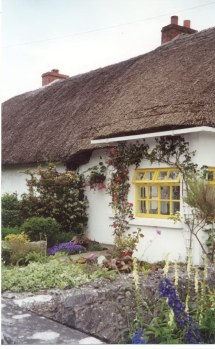
Far west at Glencolumbcille, we stopped for tea at the Heritage Center, where we found thatched roofed cottages built and furnished in the way that inhabitants of the region would have lived in the 18th and 19th centuries. The smell of peat burning in the fireplaces gives a cozy, inviting feeling to the cottages, which offer the visitor shelter from the wind coming in from the sea.
The feeling of remoteness struck us as we moved through this valley that ends at the river and the town of Ardara, not far from an inlet to the sea. Ardara is a center for the weaving industry and the heritage center there demonstrates weaving with handloom weavers at work. The Ardara Weavers Fair the first weekend in June has been held here since the 18th century.
Nobel Prize winning poet William Butler Yeats spent his childhood in the Sligo area and drew on the folklore and myth prevalent throughout this region to enliven his poetic imagination. The town straddles the River Garavogue which leads westward to Sligo Harbor and the sea. Rent a boat and row eastward to Lough Gill and the surrounding hillsides that locals claim to abound in elves and fairies. The best-known island here inspired Yeats’ poem The Lake Isle of Innisfree. At the eastern end of the lake stands Parke’s Castle. Swans add a feeling of enchantment to the scenic surroundings. One legend associated with Lough Gill is that a silver bell from the abbey nearby was thrown into the lake and only those who are free from sin can hear the bell ringing.
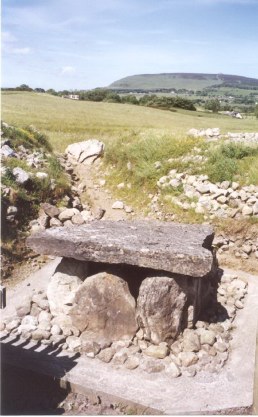
We stayed at a B&B just outside Sligo near Carrowmore Megalithic Cemetery. When I asked about the belief of the existence of elves and fairies in the area, our wonderful hostess could not wait to take us out for a drive to point out how to recognize a “fairy fort” in the countryside and show us the dells where elves and fairies were known to dance and play at night. She cautioned us about such things as throwing dish water out the door in the evening for fear that a passing elf or fairy might be drenched by it, become angry, and place a spell on the inhabitants of the dwelling. In the morning while the dew was still on the grass our hostess wanted us to walk out into the nearby fields in search of fairy circles made by dancing fairies in the night.
Carrowmore Megalithic Cemetery, with over 60 stone circles and passage graves, is one of the largest Stone Age cemeteries in Europe. From the adjacent Information Center excellent guides take groups of visitors to various grave sites, or dolmens. Many of the dolmens are still capped by three massive stone slabs with a fourth set on top resembling a large stone stool. We were cast into ancient mythology as we viewed across the misty countryside to the mountains that surround Sligo. The dominant mountain is Knocknarea with the cairn or tomb at its top, the burial place of Queen Maeve. An estimated 40,000 tons of stone were carried to the top of Knocknarea during ancient times to form a pyramid mound, a huge cairn which has never been excavated. We spent the afternoon climbing to the top for a wonderful view. If you climb Knocknarea, you are suppose to carry a rock to place on Maeve’s tomb for good luck, which we certainly did. You can not escape the feeling that you’re in the presence of the ancient celtic spirits.
Another mountain that shadows Sligo is Benbulben, prominent in many of Yeats’ poems. According to his wishes,Yeats is buried in the churchyard of Drumcliff church at the foot of Benbulben . His gravestone reads, “Cast a cold eye on life, on death. Horseman, pass by.” In Sligo we could sense that both the seen and the unseen imprinted something into our imaginations and memories that will not be erased. This region left its imprint on Yeats, and Yeats, in turn, left his imprint on Sligo, both with everlasting imagery.
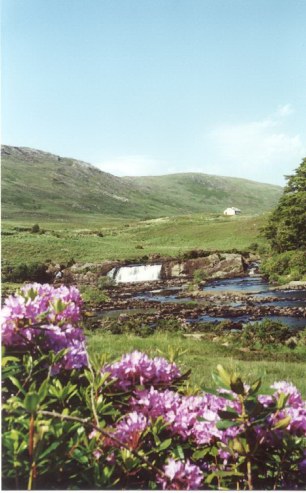
South of Sligo is Connemara. The area is one of the most scenic in Ireland. It is a rocky, somewhat treeless, and sparsely populated area but captivating. The green valleys are dotted with lakes that are interconnected by streams, offering the fly fisherman a wonderful venue. It is also great for cycling tours with winding, seldom traveled roads taking you from seaside haunts to the beautiful mountains of Connemara National Park. By whatever means you’re traveling, the region evokes the feeling of wilderness and adventure as if you ride along on the spirit of the ancient celtic tribes that moved up and down its valleys. You have a wonderful choice of side roads to explore, streams and lakes on which to picnic, mountains to climb, beaches to stroll, and abbeys and ruins to inspect.
It was difficult to pull ourselves away from Connemara and head farther south towards Galway. This city is a wonderful transition from the wild and barren Connemara. The narrow streets and the many shops and restaurants bring you back to the delightful entertaining side of the Irish. The main shopping area, which is a pedestrian only street lined with shops and restaurants, is lively. The University of Galway, one of Ireland’s best universities, is near center of the city. Once a small fishing village on a large, well-protected bay, Galway is now one of Ireland’s fastest-growing cities. The nightlife and pubs are a major attraction for the tourist wanting to experience the wonderful Irish friendliness, talk, and song. Some of the main spots we visited were Lynch’s Castle, Lynch Memorial Window on Market St., the once home of the writer James Joyce’s wife Nora Barnacle, and St. Nicholas Cathedral. You can also take a ferry from the docks of Galway and travel out to the Aran Islands.
We had run out of time for our stay in Ireland but not our desire to come back and continue exploring.
 Real Travel Adventures