

My wife and I were up early that morning before the 7:30 announcement that the ship was getting underway. We dressed hurriedly and went to breakfast before we felt the engines shudder as our ship pulled out from the Rudesheim dock and headed north up the Rhine in Germany. We eagerly anticipated what lay ahead-spectacular views of fairytale castles nestled in the hills above the narrow river gorge.
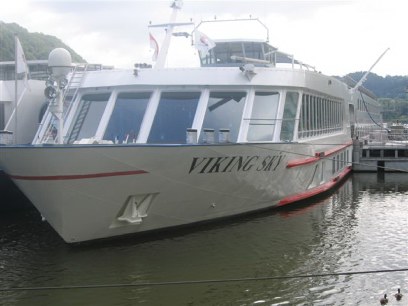
This was the 10th day of our Viking River Cruise on the Danube, Main and Rhine rivers, from Vienna to Amsterdam. We had never been to this part of Germany before nor on a river cruise-two things on our “to do” list. We selected Viking because of its reputation as the world leader in river cruises and its selection as “World’s Best” by Travel + Leisure magazine in 2005, and its inclusion on Conde Nast’s Traveler’s Gold List in 2004. We booked on the Viking Sky for a l2-day cruise in early summer. The Sky holds 150 passengers, but there were 118 on our trip, giving us plenty of elbow room. River vessels are naturally smaller than big ocean liners, and everything was first class on the Sky. There were three levels of cabins and a sundeck on top with lounging chairs and a small swimming pool. A promenade deck contained the large Observation Lounge, with a bar, comfortable chairs and a small stage for shows and dancing. A formal restaurant was at the aft.
Most days we left the ship, visiting historic medieval towns along the river banks. In each town we were given a tour by local guides, included in the cruise price. When sailing, we could enjoy the passing scene, relaxing on the Sun Deck or in the Observation Lounge or just kicking-back in our room, sight-seeing through our large window.
We departed from Vienna on the Danube River, the second longest river in Europe after the Volga, stretching 1,795 miles from Germany’s Black Forest, flowing through 10 countries to its delta at the Black Sea. It has served as an important transportation and trade artery for nearly five centuries. We were given such information in the lounge as tour guides regularly lectured on the history and lore of the regions we visited.
First stop was Melk, in Austria’s beautiful Wachau Valley. Melk has been an important spiritual and cultural center for over a thousand years and is famous for its Benedictine Monastery built in 1089, a splendid example of baroque architecture. Monks still instruct some 750 pupils. We enjoyed a tour of the monastery’s cherub-filled library which boasts 365 windows, a magnificent carved pulpit and shimmering ceiling frescoes. From the garden, we had a breathtaking view of the Danube as it stretches toward the west.
Next day we entered Germany and docked at Passau. Picturesquely located on a narrow tongue of land at the confluence of the Inn, Iltz and Danube, Passau’s history goes back over 2,000 years when Rome occupied the area. Roman walls still stand after surviving onslaughts over the years from the likes of Charlemagne, the Turks and Napoleon.
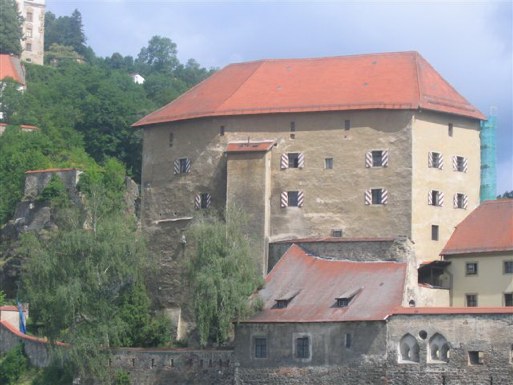
Looming overall in the town square is the magnificent combination gothic/baroque St. Stephan’s Cathedral, which houses the world’s largest pipe organ. Viking had arranged for our group to hear an organ concert. And, believe me, everyone was awed by the booming crescendos which gave way to strains of whispering flute sounds. Each day when we docked, there were usually two or three ships tied up alongside us. Occasionally, we had to walk through another vessel to get to ours. But that wasn’t a negative as it was fun to see the others.
Our ship’s captain, Gerhard Wehrmeyer, told us that the river cruise business has been booming, particularly in the last couple years. European cruises are especially popular, with itineraries ranging throughout Western and Eastern Europe and into Russia. Viking has 25 ships in its fleet. In recent years, the fleet has also added trips in China.
On Day 3, we stopped at Regensberg, one of Germany’s best preserved medieval cities, having suffered virtually no damage during WWII bombings. Attractions include the Gothic St. Peter’s Church, with its gleaming spires and celebrated stained glass, and a 1,000-foot long 12th Century Stone Bridge, Germany’s oldest bridge, a masterpiece of ancient architecture. In most cities we visited, there were colorful outdoor markets.
On the Main-Danube Canal
Heading into the last stretch of our trip, we had four more days on the canal and on the Main River before we came to the Rhine. More historic cities to see. Following are some highlights:
*Bamberg was heaven for beer lovers. After a walking a couple hours through the impressive old center with its 2,000 buildings listed as historical monuments, it was definitely time to try the area’s famous Rauchbrier (smoky-tasting beer), and it was superb. I brought a box back to ship for drinking top-side before dinner, pausing between quaffs to wave at fishermen and campers onshore.
*Rothenburg and Wurzburg were scheduled next day. We boarded a bus for a day-long tour. First we went to the baroque Bishops’ Palace Residence in Wurzburg. In the afternoon we stopped for a traditional lunch of sausages, potatoes and salad in Rothenburg. (By this time, we were addicted to German cooking.)
*Wertheim-We went off on our own to explore the ruins of a castle on a hill, overlooking the town and valley beyond. There was no restoration work on the ancient structure and hardly anyone around. Pondering the ruins of the century-old walls and turrets in solitude was almost a transcendental experience.
*Mainz- On tap was a visit to the Gutenberg Museum which celebrates its most famous citizen, Johannes Gutenberg who invented printing as we know it today. His press and a copy of the Bible he printed is on display A stone’s throw away is the famed Cathedral of St. Martin. Begun in 975 with construction continuing throughout the 13th Century, it contains the lavishly decorated tombs of prominent bishops. Our guide then took us to the smaller St. Stephen’s Church with Marc Chagall’s famous stained glass windows.
*Rudesheim-A visit to the charming Music Museum let us see and hear a world of fascinating mechanical musical devises, some dating from the 19th Century. There was everything from old victrolas to eardrum-busting calliopes. The city is in the heart of German wine country, and there was serious wine-sampling and partying going on in the many wine bars along the walkways.
Castles on the Rhine
Early next morning on Day 10 came the climax of our trip as we entered the Rhine and sailed up the gorge with castle after castle coming into view. While the tour director pointed out each fortress, tower and Roman wall, we rushed from one side of the ship to the other. The view was best outside on the top deck where you could see both sides. It was a little cool outside, however, and about half enjoyed the view from the comfort of the overstuffed chairs in the Observation Lounge. There are too many to list, but a few stand-outs were: Rheineck Castle, with its 66-foot keep tower; the romantic 13th Century Lahnetz Castle which inspired poet Goethe and the colorfully named Katz and Maus Castle.
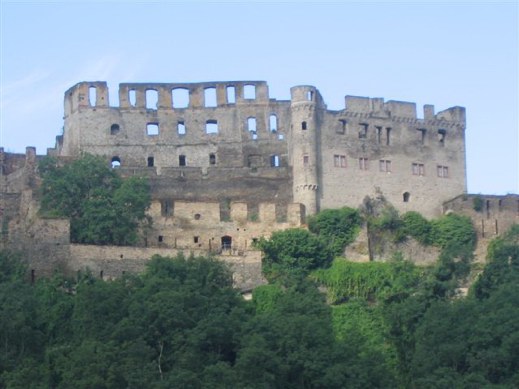
Midway through the gorge we passed Lorelei, the legendary rock rising 440 feet above the river. The story has it that a beautiful temptress sat on the rock, luring sailors to their doom in the narrow and hazardous channel. Over the speakers, our guide gave us anecdotal information about many of the sites. Sterrenberg and Leibenstein castles, for example, literally an arrow-shot apart, were owned by two brothers. They quarreled violently and built their fortresses next to each other. When after years, they decided one night to reconcile and promised to wake each other next morning with a friendly arrow shot. Tragically, one released his arrow while the other was opening his window, hitting him in the heart.
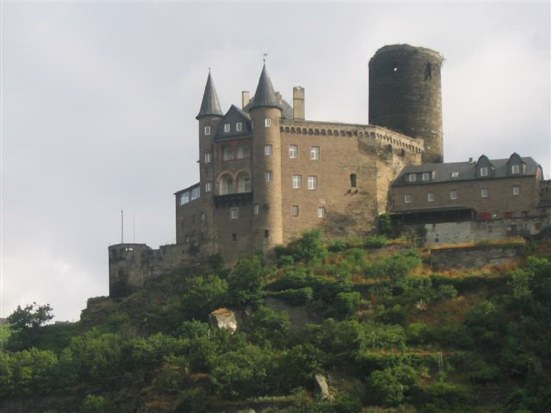
These castles were built hundreds of years ago as enterprising leaders decided to extract taxes from shippers bringing their wares up and down the river. If boatmen didn’t pay, castle forces would attack them. Later that day we reached Cologne, Germany’s fourth-largest city, home of the imposing twin-spired Gothic cathedral. Because of its unique reinforced construction, the cathedral was virtually unscathed during the war when bombings ravaged the city. After a tour of the structure with its beautiful stained-glass windows and ornate gold shrine on its elaborate altar, we were treated to a glass of the area’s famous Kolsh beer served in the lively atmosphere of a “Brauhaus.” That afternoon, back onboard, the Sky pulled out for our final destination, Amsterdam. When we arrived, we were taken on a canal tour of the city which ended up at the Rijkmuseum, with all the famous Rembrandt’s on display. A good way to end the trip.
Pre Trip Exploring Vienna
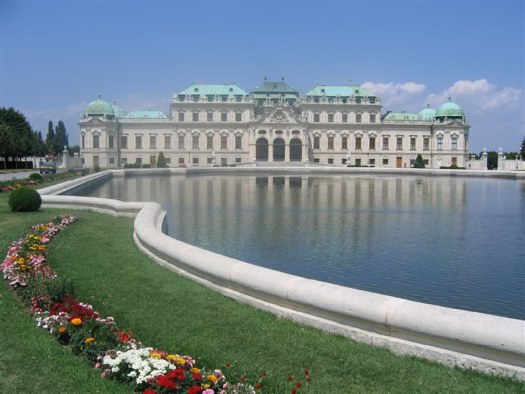
Two weeks before, we had arrived in Vienna in order to have two days to explore the city before the cruise departed. As it turned out, we were like kids in a candy store-so much to see, we had to organize our time.
First day we walked around the medieval inner city, visiting magnificent Belvedere Palace, with its celebrated art collection and then on to glorious St. Stephan’s Cathedral and the venerable State Opera House. (Our schedule wouldn’t permit an organized tour of the Opera House, but that evening we were lucky enough to get opera tickets for a production of Massenet’s “Werther.”)
From there we took a subway out to Maria Theresa’s wonderfully baroque Schonbrunn Palace with its opulent rooms and collection of period furniture. We finished with a walk around the lovely formal gardens. Throughout the city, references to Mozart and Strauss are ubiquitous, and the next night we heard an orchestral concert of favorites from the two masters in the Schonbrunn’s Orangerie.
We saved our second day for the museum quarter. We spent our time in the Leopold Museum and the Kunsthistorches Museum to see some of the world’s finest paintings on display. My wife loves Gustav Klimt’s work, and she got her fill that day from viewing his realistic early pieces to his ornamental later work. In the Leopold there was an especially illuminating show, combining early 20th century contemporaries Egon Schiele, Oskar Kokoschka with Klimt.
There was much more to see, but on the third day it came time to the board ship. (We never had time to take the short train ride out for a hike in the Vienna Woods as we had planned..
 Real Travel Adventures