

The school looks like some bombed out tenement block in Sarajevo. There is no glass in the windows. The walls are pealing. Dirt clings to the dark spots on the floor, where the rain pours through the gaping holes in the ceiling. Twenty students, ranging in age, from eight to twenty-one, struggle in the dim glow of the single 60 Watt light bulb, to read their tattered textbooks. Nearly half of the students have no books at all. At the front of the room, a young Khmer teacher leads them in an English grammar exercise. In other classrooms, students are learning Japanese and Chinese. When classes finish, at eight o’clock at night, the students will begin their long walk home, down dusty, unpaved roads, devoid of street lights. Some of them live as far as eight kilometers from the school.

This is the scene at the Toul Ampil Language College, near the killing fields, in Phnom Penh. The history of Cambodia’s auto genocide is not hidden. It is discussed openly in families. And the children know that the journey to and from school takes them past the site of their grandparents’ murder, as tens of thousands of their relatives were slaughtered at this location, a mere 25 years ago. What the children don’t know, however, is that with each tiny step, they drag their nation a step closer to becoming a modern, industrialized country.
Unlike classrooms in richer countries, like the US or Taiwan, students are extremely respectful of their teachers. They are grateful for an opportunity to learn. And they know, all to well, that learning of any kind was denied their parents. Under the Khmer Rouge regime, schools were closed, in 1975. At that time, learning, even reading, became a criminal offense. Officially, schools re-opened in 1983, under Vietnamese control. But most residents of Phnom Penh will site 1987 as the year schooling actually became available to to the general population. In the provinces, schools took even longer to re-open. Once schools were opened, the battle still wasn’t won, as most families were too preoccupied with their own survival to send their children to school.
A 38 year old magazine editor, named Neehan, told me. “We couldn’t go to school because we couldn’t afford a notebook or a pencil. Some people couldn’t go to school because they had no clothes.” Neehan later managed to obtain a pencil, and started school. “I used that pencil for two years.” He laughed. “By the end, it was so small, I could barely hold it. But if I lost it, that would have been the end of my education.”
Cambodia is a country which has seen a number of new beginnings. Pol Pot declared 1975 the Year Zero. But, the Khmer Rouge regime only lasted till the Year Four, when it was toppled by the Vietnamese invasion. 1980 was the beginning of a new era of Vietnamese domination, which ended Officially in 1987. 1997 was a year important in the the self rule and democratization of Cambodia. Whichever date is accepted as the birth of “The New Cambodia,” Cambodia can be seen as one of the youngest nations on Earth. They are now struggling to catch up with neighboring Thailand and Vietnam, who are light-years ahead, in terms of economics, politics, and development.
Nearly half of the population of Cambodia was born after the Vietnamese invasion. Said another way, nearly half of all Khmers are under the age of twenty-five. In Phnom Penh, the percentage of Khmers attending university rivals percentages in many western countries. It seems that almost every young Khmer is attending college, university, or school of some kind. English, computer science, and business seem to be the most popular majors. In interviewing students, I asked them why they were studying. All of them listed as their first, or second reason, “because I want to help my country develop.”
The Khmers are fiercely patriotic, and willing to sacrifice for the good of their country. In a country where political activism may be a dangerous, even lethal, way to bring about change, young people see education as a way of raising the quality of life for the Khmer people, but without calling dangerous attention to themselves.
The universities are full of dedicated, older students, who did their primary chooling on their own. A 42 year-old Khmer friend, who is now pursing a masters degree, told me. “During the Vietnamese occupation my brother and I studied English in the basement, with a book we had found. If anyone had caught us we could have been killed.” This story is not unusual among older students.
The twenty-somethings are the first generation of Khmers to attend university, after completing high school. They are well aware that they are a privileged group, and new pioneers in the field of learning. Every young Khmer grows up with knowledge that his grandparents, uncles, aunts, or other relatives were murdered. My friend, Sameth, told me, “Thirty members of my family were killed by the Khmer Rouge.” They also grow up with the knowledge that there parents had no access to schooling. Unwilling to waste this precious gift, the young Khmers are seizing every opportunity to help their families, and advance their country.
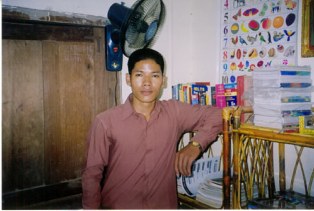
Tou Ampil Language College is an example of the dedication and hard work being done by Khmer twenty-somethings. The college was founded by 24 year old, kakada Chhim, a student at the National Institute of Business. Kakada
finances his university studies by driving a moto-taxi. The idea to start the college came to him after taking a foreign tourist to the Killing Fields. Beggar children surrounded kakada’s passenger, harassing him for money. “I didn’t want those children to grow up to be beggars.” Said Kakada. “But they are very poor, and need some way to get money. I thought, maybe if I could teach them to speak English, they could get a better job.”

kakada had a meeting with the local school principal, and arranged to rent the building, for a fee of $20 per month, and open a night school for local
residents. Children attend classes, two and a half hours per day, six days per week. Kakada said that he would have liked to have made the school free,
but he had to charge a small fee, in order to cover expenses. Most children pay a modest tuition of 5,000 Riels ($1.25 USD) per month. But, if the
children cannot afford to pay, scholarships are liberally awarded. “If the children tell me they can’t pay, I will go and visit their home.” Said Kakada. “I will see how they are living, and read their family book. Sometimes I find a family with nine children, and only an income of $20 per month. In that case, the children can study for free.” kakada also offers similar scholarships to provide needy children with textbooks, pencils, and paper, all of which are unattainable for many poor Khmers.
The teachers at Tou Ampil language college are also dedicated twenty-somethigs. They are all Khmer university students, or even graduates, who dedicate their time to teach the children. “I have no money to pay them a salary.” explains kakada. “But I try to give them a little money each month to pay for their gas.” For Khmers, who sometimes earn as little as $30 per month, even $5 worth of gasoline would make a significant dent in their food budget.
In addition to attending university,and running the school, kakada still teaches classes, as it is hard to find teachers. Kakada’s days are full, as he also teaches English to the employees of Happy Guest House, in the early mornings. The fact that the employees are willing to add two hours of English lessons to their fourteen hour work day says a lot about the work ethic of the young Khmers. “Those girls know that they need to learn English so they can make a living.” Explains kakada. “But they come from the provinces, and are only semi-literate in Khmer. I don’t want them to loose face. But every day, I try to teach them some Khmer while they are learning English.”
On the way back to Phnom Penh, from Toul Ampil Language College, Kakada took the long way round. “There is a more direct road.” He explained. “But it is not safe at night, as bandits will attack your motorcycle.”
Bandits? The problems faced by young Khmers are inconceivable to westerners. Who puts in a fourteen hour work day? Who of us couldn’t afford $1.25 per month for English lessons? Who has ever used a single pencil for two years? When were we ever in danger of being killed because we knew how to read? With odds so thoroughly stacked against them, one would think that the Khmers would just give up.
But the Khmer young people aren’t quitters. They know that education means freedom. It means advancement. And it means that the next generation of Khmers will be born to educated parents. It means closing the gap between Cambodia and the developed countries. And hopefully, it means an end of suffering.
(The Toul Ampil Language College is desperately in need of funding as well as volunteer teachers. They also need computers, books, pencils, pens, paper, and other school supplies.
 Real Travel Adventures