

Traveling in our RV, we crossed the border from Vermont into Canada at Stanstead, Quebec, and immediately felt like we had landed in France. Everything in Quebec is proudly and staunchly French, from the language to the delicious pastries and small shops. In Stanstead we discovered the Opera House, known as the friendliest border in the world. The audience sits in seats in the U.S. and watches the play on stage in Canada! Historically, citizens of either the U.S. or Canada, who could not get passports to cross the border, would meet family and friends in the Opera House for touching visits. Also in town of Stanstead we toured the Colby-Curtis Museum in the 1859 Carrol Croft House, an Italian style villa (www.colbycurtis.ca) . It was owned by three generations, the original being a doctor from the U.S. who graduated from Dartmouth. We also enjoyed there an exhibit by the famous sculptor of the times, Orson Wheeler.
Next we drove a back road, Hwy 247, North to Bleu Lavande, (www.bleulavande.ca) which our campground owner had told us was not to miss, and she was right. It is the lavender farm and showroom for all types of lavender products for bath and skin, health, and room. We never imagined so many products could be developed from the essential oils which the owners, Pierre and Christine Pillerin, proudly showed us. Tours are daily from early June through September. July is the best time to see the fields of over 110,000 plants in bloom.
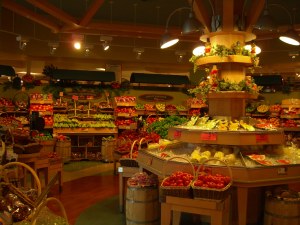
In the Eastern Lakes district of Quebec is the city of Magog on Lac Memphremagog, a huge and beautiful lake with lots of activities. This was one of our favorite cities to visit in the region. The long sandy beach on the lake is right in town with swim area roped off. All public lake swimming appears to have lifeguards after summer solstice, when everything officially opens in Canadian parks. The little town felt like we were in France. Most people seem to understand English and try to help us but always reply in French. Bill said, “Why does anyone from North America bother to fly across the ocean when France is right here!” We bought groceries at Vegeterien, which is the most amazing supermarket we have ever found. It was so beautiful with fresh produce that we both gasped simultaneously when we walked in and just stood to look and take photos.
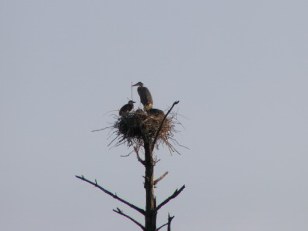
Just up the road from Magog we spent several nights camping at Parc National du Mont Orford, a wonderful National Park with great fishing and water sports, beautiful sights to see, and pretty waterfall hikes. But we were ahead of the season and it was rainy and mosquitoes were starving for fresh meat after a winter of hibernation, or whatever the little beasts do to survive! Along with the pests was the wonderful bird population in the park. Nesting herons with their young could be seen in the marsh areas and the mornings were filled with the different bird songs. One interesting sign in the park was the sign that indicated one should slow down for turtle crossing.


We were just too early in May and June for eastern Canada, but we were here and we would enjoy everything anyway, armed with insect repellent and rain ponchos! Our aim was to explore places in the upper highways and by-ways of Canada which fewer United States RVers discover.
We drove north from Magog and crossed the St. Lawrence River and continued on to the small village of Saint Michel-des-Saints. In Saint Michel-des-Saints, a lovely little town located halfway between the two Naitonal Parks…La Mauricie and Mt. Tremblant. We stayed in an RV park on the large Lac Taureau. The lake is bordered by a beautiful forested shoreline and has a wonderful resort hotel Resort du Lac Taureau. Saint Michel had a number of nice eating places and small shops. We stopped at the special souvenir shop, Artisanat Bellerosa, in front of the historic church. We were thrilled to find authentic Atikamekw Aboriginal (native American) hand-made gifts for quite reasonable prices. We travelled a beautiful winding drive South on hwy. 131, a good two-lane highway beside a river with small waterfalls, very much like Colorado with tall evergreens through the small valley.
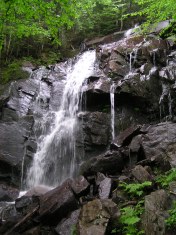
We stopped at St. Zenon at La Glaciere Restaurant in Pourvoirie Trudeau Hotel and got coffee and delicious whole wheat cinnamon buns, freshly made that morning by Linda, the friendly waitress who was fluent in both English and French and told us many places to see in the area. She told us about the Regional Park Sept Chutes just 2 km. farther, so we went there at 4:30 p.m. and found it not yet open for the season. It was late afternoon and pouring rain, but since it is daylight until very late and not really cold, we donned our ponchos and hiked it anyway, and we were so glad we did. It was a lovely, steep walk on a mountain trail through beautiful green dripping evergreens and sugar maples with many spring wildflowers and ferns on the forest floor. The path was wood chips, pine needles, and granite boulders right beside the little river and had seven little waterfalls before we arrived at the really tall one…absolutely beautiful and so peaceful. The rain made it even better…a perfect temperature and kept the mosquitoes and flies away for the most part.

Next we camped in Mount du Tremblant National Park, reaching it via Hwy 347 and then north on Hwy 125 to St. Donat and on north into the Park. The park is 1,510 square kilometres, the oldest and largest National Park in Quebec. At the Park Entrance we registered for $18 (no hook-ups) plus $3.50 each person for a daily use fee. For $30 each we could get a day pass for just Quebec National Parks. Campsites are on the bank of the Lac Provost, which is long and about 200 yards wide. The Riviere Diable runs all the way through this park from the North and there are many lakes. It is really beautiful scenery. The tent sites are away from RV sites and are beautiful on grassy, flat spaces near the river. Boat rentals are available, and this would be a great place for water sports and fishing. However, the mosquitoes are bad until mid July and it is chilly and rainy till then. Then for about two months the weather is warm (around 25 – 30 C. or around 90 F.) and the bugs and mosquitoes are gone. Fall color is reliable for about two weeks in mid-September and then color fades quickly. Snow is intermittent until December when it is heavy. Fall and winter must be spectacular here for all kinds of winter sports. This area near our campground has snow shoeing and cross country skiing, with rentals available on site. We discovered that in the small towns all shops and most restaurants are closed for the week-end. We found it both frustrating and great to see people actually close shop and rest for the week-end! We have lost a lot by having 24/7 shopping in our cities.
Next we stopped for gas at Mt. Laurier, last stop for services of any kind before driving more than 250 km. across the La Faunique du Verendrye, a provincial wildlife reserve. There are, however, emergency phones every few kilometers on the highway. Highway 117 is a very good, winding, hilly two-lane with wide shoulders and frequent passing lanes, which we drove for about four hours. On each side of the road are dense forests of evergreens, maples, birch, and aspen and we hardly went a half kilometer (quarter mile) without passing a peaceful lac (lake) with clear, black water, frequently the highway was just a passage between two lakes, some large and some small. There were several convenient truck rest areas (no services) and many small provincial campgrounds, some with services and some without. There were no towns, houses, motels, or any sign of human communities along the way except one sign to a native aboriginal (Indian) village. We stopped at one of the larger camping areas for the night and learned we should have pre-registered on either end of the highway before entering La Faunique.

We discovered the wonderful area of Val d’Or which was the center of gold mining for years and then the mines were closed. Recently, with prices of gold so high, the mines have been re-opened with mining in full operation. There is a wonderful mine tour you can take to see how gold is really discovered. Next we traveled a bit farther to the little town of Malartic, where we found the most wonderful mineral museum…really worth a stop for the tour. We learned so much about mining. Gold, copper, zinc, nickel, and molybdenum are the major minerals mined in this area. The museum director Jean Massicotte showed us proudly some of the new exhibits that are now bi-lingual and international displays of various minerals through a cooperative swap of sharing local samples. The interactive displays provide a great learning experience for all ages in learning about geology and the many aspects of mining. There was also a great gift shop for purchasing items relating to the mining in this area.
We enjoyed our trip through Quebec’s uppermost roads, stopping in the little towns and staying in the wonderful national and provencial parks. Most of this area is rolling hills, dense forests, and thousands of lakes, both large and small…a paradise for water sports, fishing, bird watching, hiking, and ATV’s. In winter the popular sports include cross-country skiing and snow shoeing and snow mobiling, ice fishing, and sledding. This is truly like a trip to France. However, May and June are the least advisable months to come, and the long trip across which we made was pretty much the same scenery all along. It would be more advisable for RVers to stick with the towns and cities in the lower part of Quebec which specialize in tourism or come to the wonderful parks in upper regions specifically for the sports, not just to drive for the scenery.
 Real Travel Adventures