

We were to go to Dublin in February 2006. My eldest son (`BJ’) and his wife, Jo, are rugby football fanatics and wanted to see the international game between Wales and Ireland. We have not had many times together, so I pushed the cost bit (Dublin is expensive) to the back of my mind and looked forward to a family get-together. I was accompanied by my wife, Diane, and my youngest son, Iain.
What happened? The day before we were due to travel, Jo discovered her passport was out of date! So BJ and Jo didn’t go, and the reason for our very expensive short break suddenly evaporated. Everything was already paid for, so there was no point in cancelling – I was also using the visit to write a few travel articles! We used a budget airline, Ryanair, and those who book-in early can have `priority’ stamped on their boarding cards, and get on first. We reached Dublin in less than an hour and I went to find the car rental desk. Got the car and we were away. Well, almost.
First, I had to find a way to get out of the car parking area…I drove around many times looking for the way out. There was just a single barrier, but the arm was down and there was no slot in the machine to put my car ticket into. Eh? Eventually, an airport worker saw me going round in circles and said “The barrier is automatic – just drive up to it and it will open.” So I did and we were out at last.
The drive into Dublin was easy, almost one straight road, but it was during that drive I discovered a big negative about Dublin – traffic! It was fast and continuous. Dublin has pedestrian crossings, but I’ve never seen such slow changes. Waiting to cross roads must have taken two days off our visit time. We got to the correct road, Parkgate Street, and looked for the Ashling Hotel. According to the map, Parkgate Street was literally less than a quarter of a mile long, but could we find the hotel? Nope! I drove up and drove down, then repeated it, time and again. We did that for over an hour. So, I drove back to the start point and sat looking at map, hotel directions sheet, and buildings. Okay, then, I’ll drive down the main street (Parkgate) toward the centre of the city.
As we drove Diane said “There it is!” and I quickly turned left as other vehicles screeched around me. Left again and we were in front of the hotel – not in Parkgate Street, but in Benburb Street! Was this one of those famed Irish moments? The hotel gave the name of the main road closest to its location…hm. A little further down was another Irish moment – a sign on a gate that said “If you enter, you will be on premises.” Okay.

After signing-in we went for a quick walk. In true explorer style I said “I think the centre is this way”. After all, the hotel literature tells us the centre is “only a 15 minute walk away”. An hour later, and we were still on the edge of town, and the weather was clear but very cold. I was looking for the famed Temple Bar and, without doubt, the map shows it as a single street fronting the River Liffey, which runs through Dublin, giving it a north and south side. Could I find it? Nope.
Next day I discovered the map had its own Irish moment, because Temple Bar was behind the riverside and was a small area, rather than a single street! Oh well. Anyway, we were hungry and we crossed back over the river and found the small Jervis Shopping Centre. In we went, cold. We walked around for a few minutes (it really is small) and found a fast-food floor on top. That will do! I ordered croissants and coffee. The person serving was Eastern European and I didn’t quite understand his English. We came to a sort-of understanding as to what he was actually saying and I handed over some Euros to pay. He asked for another fifty cents, and I handed him a fifty coin. “No good” he said. I had given him a UK fifty pence coin that had found its way into the Euros. He huffed, and I just ignored him, giving him a large denomination Euro note instead. Dublin is an odd place in many ways. I expected it to be closer to British than foreign, but it was unlike other places I had been to. Can’t really explain why. And, almost every other accent I heard was east European, Russian!
We had an evening meal later in the bar of the hotel – the restaurant was expensive. Average food costs in Dublin run from about 6 Euros (sandwiches) to beyond 30 Euros. That’s about $7 or £4, to $35 and £20. Most places, however, charged very much more. There are hundreds of eateries, mainly crammed into in and around the main tourist areas of Temple Bar, Grafton Street and O’Connell Street (north of the river). You can certainly get into the well-known eateries like Bewleys, so long as you are willing to wait for ages. Bewleys is very interesting – a take-away on the left, a sea-food section on the right (with dishes from 25 Euros) and an `ordinary’ section at the back with less expensive meals. The same wait was experienced everywhere so we tended to go for very small, reasonably-priced cafes just off the main streets.
Second day I thought we would drive through Dublin to the docks, to find a particular restaurant, ready for the evening. I reversed the car out of the parking space in the hotel and prepared to turn down the ramp to get out…and…scrape, scrape! Yes, I had driven over an absurdly placed low kerb sticking out from the corner, gouging the skirt of the car. Great! That’s an extra cost to the holiday. We started to drive through the city and found the docks, but nothing else. The drive was frenzied and anxious, such was the traffic. Forget this! No restaurant and no place to stop…back to the hotel and park (carefully). The whole journey took about an hour, over a distance of no more than about 4 miles. If you visit Dublin, don’t attempt to drive in the city! In Ireland they drive on the same side as us in the UK, on the left – but even I found it hair-raising. A cheap modern tram system runs all around the centre, so try using it. It is safer and more convenient and you can get on and off anywhere along the route.

Park the car and out again. This time we stuck to the riverside road and finally reached Halfpenny Bridge. At one time you had to pay a toll of half a penny, hence its name. Across the road and through the archway and we finally found Temple Bar. It’s only a small area, and the best features are the very colourfully painted pubs.
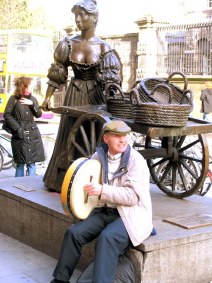
From there we went to Grafton Street, an older shopping street, and then into a larger grander shopping mall (it would fit into a corner of an American one), with ornate ironwork. It took up the corner of Nassau Street and Grafton Street. Outside was an Irish drum player, sitting on the plinth of a bronze statue of Molly Malone.
We came out of the mall and tried to make our way back toward Temple Bar. Oh, I forgot to say – we were in the middle of a full-scale riot. Republicans rampaged from O’Connell Street, north of the river, up the hill through Temple Bar and into Nassau Street. We turned up Nassau Street to be stopped by a wall of riot Gardi (police). It was absolutely freezing.
Next day, Sunday, I relented and took the car out of storage – we would drive north of the city, up the coast and then west. We went through small towns with nothing of real tourist interest, and found ourselves in the port town of Drogheda. It was very cold and nothing seemed to grab us enough to get us out of the car, so we drove on into the countryside. My impression of that part of Ireland is distinctly indistinct. The countryside was uneventful for miles and miles. So we turned back again to head back for Dublin and only on the outskirts did we find two small towns of interest – but it was now late in the day, so we went to the hotel.

Monday. Iain and I go to find the Guinness Storehouse, a five-storey museum. As we walk we realise the enormous size of the brewery site. It is massive. The museum is big and noisy, but in a nice way. It costs 14 Euros entrance for adults. What makes it worth a visit is the social and economic history it contains. On the very top of the building is a round glass fronted room with a bar. There you get a free pint of Guinness (or soft drink) and a view of Dublin which, it must be said, is not spectacular. You can also see the same view from Chief O’Neil’s Chimney Tower on the other side of the river (costs 4 Euro).
Back again to the hotel – Diane didn’t want to visit the brewery – and we got in covered by snow. On the way back out again, the sky was clear. We all went back to Temple Bar, this time for an unhurried and non-riotous visit. Tuesday, we looked for the `Viking Experience’, advertised on leaflets and in guides. But guess what? We searched and searched, and couldn’t find it anywhere. We went back to the Tourist Information Centre, and yes, the leaflet definitely called it the `Viking experience’. We found the street it was supposedly on and, you’ve guessed it – another Irish moment! Oh, okay, I said, we’ll go to the museum called `Dublinia’ instead; we could see it the other side of the cathedral. Over we went and…the `Viking Experience’ is not a separate attraction on a separate site – it is inside the Dublinia museum! And on a totally different street!

It cost us 6 Euro to get in and I was disappointed. What we saw did not live up to its leaflet description. I expected a mock-up Viking village, but what we got was a standard museum presentation mainly on posters. Overall, I do not rate it, but its use is in the information about early Dublin. T hat last evening we threw caution to the wind and ate in the hotel restaurant. Cost us about 30 Euro each. We left for the airport in plenty of time. As I parked the car and the rental guy looked it over, I was expecting a big bill for the damage to the skirt, and to pay for fuel…but he said nothing and we were away! We again had `priority’ boarding cards, the flight was shorter, and we got through baggage reclamation quickly, so all was well.
My total impression of Dublin? I had always wanted to go there, but the actuality was not as good as the hype. It is more busy than `lively’. The traffic was horrendous, and there is very little to see apart from in the very centre – O’Connell Street, Temple Bar and Grafton Street. Loved the colourful pubs, though. I think the way to approach Dublin, especially if you are travelling a long way to get there, is to try and discover the history, from Viking times onward. It was a bleak and dreary place until recently. Maybe sun would enhance a visit – but you would struggle to find much by way of tourist spots in the city itself.
 Real Travel Adventures