

The modern tourism bus picked us up early from our Arenal Country Inn for our boat ride across Lake Arenal, the prettiest and most efficient way to get to Monteverde Cloud Forest from Arenal, unless you want to ride horses there. The road system in Costa Rica is not well developed yet, and five hours on a gravel, rutted road is not comfortable. There are few services along the way. One of the interesting phenomena we saw all over the countryside were the living fences. The ground is so lush that fence posts are “planted” in rows and they sprout and grow into trees! Gorgeous fruit and exquisite flowers are year round.
We were glad we did not opt to rent a car, as we frequently do. The thirty minute boat ride across the lake is pleasantly scenic. We saw a Cabecar Indian native cane house on a green hillside near the water. These indigenous people live on the land in remote places, preserving the way of life in which their ancestors have always survived. They do not live in villages, but scatter their huts throughout an area, appreciating privacy and space. Tour vans met us and piled ten people into each one to take us about an hour and a half to our various hotels. The ride is warm, dusty, bumpy, and cramped.

You can choose one of many hotels of various classes to stay in the town of Monteverde, where there are many shops and restaurants just outside the famous Cloud Forest of Monteverde National Park. However, all top accommodations were full when we reserved our trip for peak tourist season (December, March, and school vacation times). We went several winding, isolated kilometers farther into a private reserve to stay at Mirador Lodge. It is an exquisite location at the top of a windy mountain overlooking Lake Arenal and a perfect view of the volcano. Orange stucco cabinos with red tin roofs had rustic rooms similar inside to a log cabin. The bathrooms are tiled and have hot running water. We had electricity but no heat, although a few of the cabins have fireplace stoves. In this windy mountaintop it is always chilly and misty but a beautiful contrast to the vivid sunny lowerlands. When night fell, at just after 5 p.m. the winds howled and, even though it was the dry season, rain beat intermittently on our tin roof, lending coziness to the atmosphere. The dining room and all services at this country resort are excellent, with a beautiful candlelit dinner and soft, romantic music.
There are several trails here for good self-guided hikes through the cloud forest. You can also book horseback rides to waterfalls or to La Fortuna, several hours away. Horses are gentle and the vacallero, who speaks no English, is experienced, and the ride is a fun and challenging one we were told. We had hoped to ride horses, but there were too many things to do and see in this beautiful place, and we ran out of time.
In the morning the sun shone brightly making the rolling, green grassy hillside sparkle.
We decided to spend the one day we had learning all about the flora and fauna of Costa Rica at Selvatura Nature Center that is well worth the time and money, but plan to spend all day there.
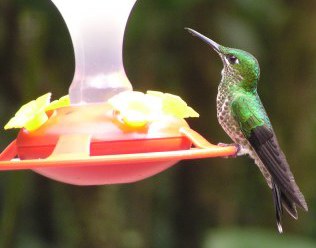
We spent our first hour at the Hummingbird Garden, where the flitting beauties of many different varieties and colors challenged our cameras to the limit. Costa Rica has identified forty species of hummingbirds. Truly amazing little birds, their swiftly fanning wings burn so much energy that they must eat their own weight every day to survive. They have delightfully found easy feeding here at the many sugar-water stations.
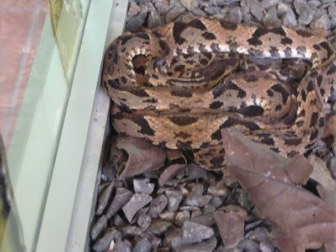
Next, we went to the Herpaterrium where our expert guide taught us all about the many species of snakes and frogs of Costa Rica. They had lots of glass boxes with live specimen displayed in natural settings. Even though we knew we were looking directly at these reptiles and amphibians, often we could not see them among the leaves and sticks. It made us keenly aware of how careful we need to be in nature. However creepy it is to learn about these little creatures, it was comforting to know that of about five million residents and many million more tourists each year, there are only about eight deaths a year from snakebites. Most snakes are nocturnal. The fer-de-lance is the most aggressive and wil chase a person. The boa constrictor only squeezes to death what it can eat, determined by its size. If you are snake-bitten you must get to a hospital within four hours. There is anti-venom for all species except the elusive sea serpents, whose bite kills one person a year average. OOOOH! In a lot of ways I wished not to have gone to the Herpaterrium, but it was fascinating and valuable knowedge. And the little brightly-colored frogs are so cute, even if some are deadly!


We had already taken a Zip Tour so we did not do so here, although they offered a really thrilling one over the canopy. Instead, we chose the Sky Bridges walk, which was one of the most wondrous things we did in Costa Rica.
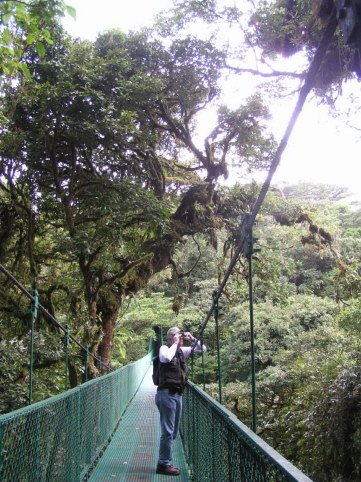
Selvatura has eight steel suspension bridges for walking over great expanses of the jungle at the tops of the trees. It is an awesome thrill to look down from a monkey’s eye view at a stream through the jungle thicket some 300 feet below, or to spot vibrant red orchids at the top of a huge guava tree in the canopy. We looked for monkeys and birds, but our untrained eyes could not spot any, although the birdsongs serenaded us melodiously throughout the two hour walk. Often we were on a trail on the ground through lower stretches of the tropical forest before we got to the next bridge. It was an awe-inspiring experience we’ll always remember.
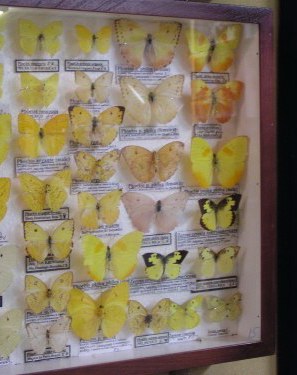
We were disappointed to find the living Butterfly House was undergoing repairs after a devastating storm, so we missed the live flying beauties normally there amids exquisite flowers. The irredescent blue morpho has been our favorite to see in the tropical forests. However, butterflies at Selvatura, Monte Verde, Costa RicaSelvatura is one of the foremost centers in the world for entomologic research, and we were able to spend over an hour on a fascinating guided tour by one of the expert naturalists who work there. Chris Chavez works with Richard Whitten, formerly of Portland, Oregon, who has donated his extensive collection of over a million insects, arthrapods, and arachnids to display here. For over fifty years he as collected these specimen all over the world, and he has created beautiful, artistic displays identifying over a million of these truly beautiful and fascinating creatures. Included is the tiniest butterfly in the world next to the largest, which has been mistaken sometimes for a bird. People can apply to come here and study for days or weeks with some of the world’s most knowledgeable and experienced endomologists.
None of these specimen are living, so even if you are scared of bugs you can look closely and learn so much about them. I was delighted to learn that no single insect can kill a person (although swarms can), unless you are allergic. Insects are identified by having three body parts, wings, and six legs. By contrast,of the arachnids, or spiders (eight legs) and scorpions, many are deadly by even a single bite. The other phylum we saw here were mirapods, of which a single sting can also be deadly. These are centipedes, worms with only one pair of legs per body segment. However millipedes, worms which have more than one pair of legs per body segment, are harmless. There are other displays including a real shrunken head and instructions of how to shrink someone’s head!

The displays of crustacions, which have external skeletons, included vast collections of beetles and other “bugs.” Some are so huge and ugly they may scare you to death, but are otherwise harmless.
Of course, the thousands of butterflies and moths we saw were our favorites. They serve as pollinators,as do bees, moths, and hummingbirds. However, the beautiful silvery-blue morphos are not pollenatoras and never touch a flower but eat rotting fruit. Moths pollenate the flowers which only open at night. Being nocturnal, moths don’t need to be seen to attract mates, so their colors are not bright. Instead, their feelers are extremely sensitive and males can detect female feramones eight miles away. Ninety-five percent of the 230,000 species of lapidoptera in the world are moths. Depending on the environment and the type, most butterflies and moths live only about two weeks to five months. The familiar black and orange monarch is the exception. These live over a year and have the longest migration pattern. They can go up to 260 meters without stopping and travel as far as Alaska to Central America, where they lay eggs on milkweed.
With only 19,725 square miles, the country is about half the size of the state of Virginia. Costa Rica has three times more butterflies than any other country on earth, with 21 percent of all species. In some places Costa Rica is ony 65 miles from the Caribbean coast to the Pacific coast, but the small area contains huge biodiversity and many different micro-climates by altitude.
Costa Rica appreciates its diverse and beautiful resources. The government has passed strict laws to protect these natural wonders and the people are taught to protect their own environment. School children create paintings and advertisements about saving our precious earth. Costa Rica is a place to appreciate this beautiful earth and to reflect on how we can incorporate wise practices of preservation into our own habits and laws when we return home.
 Real Travel Adventures