

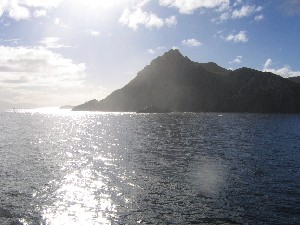
The ocean was calm all around the ship-as if we were on a lake. We hadn’t really known what to expect, but certainly not this. After all, we were sailing around the tip of South America-around Cape Horn-through what can be the most hazardous waters in the world. Since the 17th Century, the Horn has been a challenge to sailors around the world. Here we were on a cruise liner drifting in the sunshine.
This was the 10th day of our 16-day Holland America cruise on the Rotterdam from Rio de Janeiro to Valparaiso. Here at Cape Horn we would leave the Atlantic and sail into the Pacific for the final phase of the trip, going up Chile’s scenic southern coast.
We had arrived early March in Rio, the day after Mardi Gras, and festive decorations still fluttered in the breeze. The weather was hot and humid; after all, this was late summer in the Southern Hemisphere. My wife and I had given ourselves three days to explore this colorful destination before our ship sailed.
The city was still crowded from the celebration, but we had no trouble taking taxis to the famous sites. (Note of caution: Only take official cabs with meters, or you could end up paying twice as much.)
First stop was Corcovado where a little train takes you up a steep track through lush forested area. (Be on the lookout for monkeys on the way.) At the top of the rock outcrop is the grand Christ the Redeemer statue, standing over 90 feet, arms outstretched embracing the city 2,300 feet below. Visitors crowded the base for spectacular views. From here you can see Rio’s other most famous site, Sugar Loaf, which we would visit next day.
After coming back down, next stop was the Museo de Arte Naif, a short block away. This folk art museum, containing more than 8,000 pieces, is reputedly the world’s largest and most complete collection of primitive art from the 15th Century on.
Upon entering, you are struck by the wonderful 22 by13-foot canvas that depicts the city of Rio, a piece that took five years to complete. As we browsed the rest of the collection, we particularly enjoyed the many whimsical paintings of sunbathers in all shapes and sizes on the city’s many beaches.
The following morning we took the cable car to the top of Sugar Loaf, which rises 390 feet, in two stages to the top of the giant granite rock. Not as high as Corcovado but we got closeup views of the beaches and harbor.**
Later we strolled through the old central city, entering under the imposing Aqueducto de Carioca, built in 1774 to carry water from the Carioca River. We were immediately impressed by Catedral de Soa Sebastiao, constructed in 1960, a strange-looking building resembling an enormous beehive. Once inside, though, the beautiful stained glass windows transform the concrete edifice into a warm, serious space which accommodates some 20,000 people. The cold-looking cathedral contrasts greatly with the baroque beauty of the opulent Teatro Municipal. Built in 1909, it’s a scaled-down version of the Paris Opera House.
We’re big jazz fans and since Brazil is the birthplace of bossa nova we had to get out and hear some music. Vinicius, in the Ipanema area, is the fabled place that honors bossa nova. Its nightly shows pay homage to the great bossa nova composers, led by Antonio Carlos Jobim who reportedly wrote “Girl From Ipanema” in the bar across the street. After a great dinner of Brazilian dishes, we heard tasty music from local musicians and were swaying out to the street at evening’s end.
After three days it was time to go, and there is always a feeling of anticipation when boarding a cruise ship. This was particularly true for us with the Rotterdam. In 1997, we had been on the maiden voyage of the new M.S. Rotterdam VI on a Baltic cruise. As it turned out, this South American trip we were embarking on what was to be one of the most varied and interesting of all our many cruises.
Our first day was at sea, giving us a chance to settle and acclimate ourselves to the easy ship-board life. The morning of day two, we docked in Montevideo, Uruguay, for a day’s stay in this small country of just over three million. In every port, there was a selection of shore excursions offered by Holland America. Among possibilities for Montevideo, for example, was a full day’s exploration of the gaucho’s life in the Uruguayan countryside. However, with map in hand, we decided to explore Montevideo on our own.

Close by the dock was the Mercado del Puerto, the bustling port market, housed in an old train station with vaulted iron beams. As we entered, we were tantalized by the savory aroma of meat cooking. Uruguay, along with neighboring Argentina, is famous for beef. Here dozens of stalls had their barbecue grills fired up, cuts of meat on display, being prepared for the lunch crowd.
Resisting temptation to eat, we walked on. We went through the lovely Plaza de Independencia to the highly recommended Museo del Gaucho where we studied the exhibit of articles used in daily life by the gaucho, the “cowboys” of the pampas of Uruguay and Argentina. On display, was a fascinating collection of antique equipment and weapons. We came to the conclusion that we didn’t want to be brought down by a bola, the gaucho’s version of a lasso.
Leaving in the evening, we arrived in Buenos Aires the next morning and left first thing for what would be one of the highlights of the trip-a visit to Iguazu Falls, truly one of the world’s wonders. We had decided to splurge on this pricey excursion which entailed a short flight into the Argentinian interior. After landing, a bus picked us up, taking us to a tram-train which made stops at various paths which led us to see the spectacular spectacle from various angles.
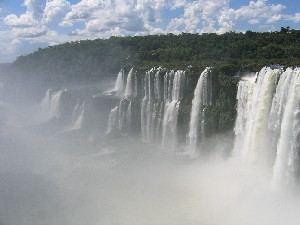
Taller than the Niagara Falls and twice as wide, there are 275 cascades spread in a horseshoe shape over nearly two miles of the Iguazu River. The falls are the result of a volcanic eruption centuries ago which left a vast crack in the earth over which the river plunges down 260 feet below.
The falls appear to be divided by various islands into what are separate waterfalls, straddling the border between Brazil and Argentina. It was late summer and very hot and humid in the jungle ecosystem. Thus it was refreshing to feel the cooling clouds of mist created by the falls. In fact, we had to wait at several points for the mist to clear in order to appreciate the view.

Once at the rim, a series of catwalks took us to the various levels and sections of the falls. Below on the river we could see tour boats gingerly approaching the mighty torrents, and on a small beach not far from the base of the falls, people were swimming. Wiping our brows, we wished we could join. After far too little time there, we returned to the ship for a late dinner, tired but certainly rewarded.
On the second of our two-day stay, we went on our own. One thing that struck us-Buenos Aires has the appearance of a Western-world city with its many European-styled buildings and wide boulevards. Indeed, it has the reputation as being the Paris of the Southern hemisphere.
One of the ship excursions was-“In Evita’s Footsteps”-tracing places associated with Eva Peron, the wife of dictator Juan Peron. She was much revered by the common people from which she emerged. Following guidebook suggestions, we began by taking a taxi ride to the Recoleta Cemetery where she was buried in 1952. This graveyard is ostensibly for rich only, full of opulent tombs-Greek columns and baroque sculptures abound. It’s a fact that some citizens still complain that someone like her from such humble roots doesn’t belong here. Evita’s tomb was simpler than most, but we had no trouble finding it because of the tourist crowd surrounding the site.
After paying our respects, we headed for another “must-see,” world famous Colon Opera house. Inaugurated in 1908, its lavish Italianate design and French interiors feature lovely marble from Europe and, particularly, a spectacular central chandelier with 700 light bulbs (possibly the model for the one in “Phantom of the Opera”).
After a Colon tour, we headed on foot toward the landmark Obelisco, the 230-foot tall obelisk, a monument built in 1936 to celebrate Buenos Aires 40th anniversary. Located in Plaza de la Republica, it was midway on our way to the Plaza de Mayo in the city’s heart.
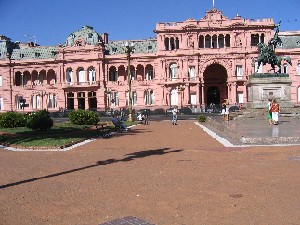
Once there, the big attraction is the Casa Rosada, the block-long Presidential Palace, with its appealing rose-colored facade. From a balcony facing the square, the dying Evita made her famous speech to the people, basis for the musical “Evita’s” hit “Don’t Cry for Me Argentina.”
Tango and Argentina go together. Thus, our final night here, we decided to stay out late to take in the tango scene. Rather than sign up for the big tango show excursion offered, we decided to go where the locals go.
Wife, Gail, even danced herself at the small homey La Cumparsita Club where a quartet played, featuring the essential bandoneon accordion. It accompanied singers, who passionately expressed their love to the rhythmic tango melodies. (We couldn’t understand a word but their emotional feelings were perfectly communicated.) The show included an attractive couple going through the precise stylized motions of the sexy dance. Between sets, locals danced. A good way to end our Argentina stay.
That night we embarked, sailing south for two days at sea, each becoming colder. We were headed for the Falkland Islands.
The two days at sea gave us a welcome chance to relax. We started each morning walking laps around the promenade deck. Relaxing around the pool was an option for later in the day. The weather generally was sunny, and the deck was encloseable which kept the pool area warm.
We also enjoyed the expert speakers on board who informed us about the geography, natural environment and social history of South America, also instructing us on the customs of the people. Plus, for entertainment, there were any number of activities from bingo to bridge. At night shows were presented in Queen’s Lounge, starring musical revues by a company of young performers, as well as guest entertainers ranging from magicians to comedians. Satisfying all tastes, we had two classical musicians performing, a pianist and oboe player.
All together, we were very happy to be on the Rotterdam again and loved the atmosphere of elegant ocean travel that Holland America is famous for. Each HAL ship features a collection of art, and this ship has some our favorites-replicas of the Xian soldiers uncovered in China a century ago and paintings of Holland’s countryside. Cruising also offered an opportunity to catch up on our reading, perhaps because the ship contains so many comfortable spots in which to relax.
The line was founded in 1872, with the SS Rotterdam launched as its first ship. Powered by both sail and steam, her maiden voyage was from the Netherlands to New York City at a speed of just over 10 knots.
As cruise passengers well know, there is the temptation to overeat with all the wonderful food served in the Lido Restaurant’s buffets and the La Fontaine Dining Room. We chose to dine at a large table with several couples. Like us, they had all cruised extensively and agreed that the food on board was as good as it gets at a fine dining establishment, both in quality and selection.
We came to know our table mates quite well, and in the evenings it was fun to share stories about that day’s activities. Everyone was especially enthusiastic about the diversity of the itinerary of this cruise. In fact, Holland American sources say that South American cruises have become more popular each year.
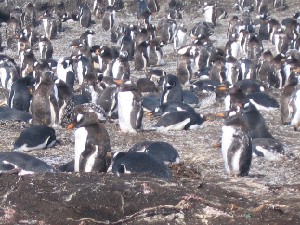
One of the subjects of table talk was penguins. Everyone had seen the recent movie “March of the Penguins.” Getting up close to the little fellows in their “tuxes” was high on people’s list of things to do. When we reached the Falklands on day nine, we would have our first penguin experience.
The Falkland Islands, a British colony, lie 300 miles east of Argentine Patagonia, near the tip of South America. They contain two major islands and many smaller ones, altogether equivalent to the size of Connecticut. Port Stanley, the capital, was founded in 1845 and contains two-thirds of the Falklalnds population of 2,500.
Argentina has disputed British control over the years, and, in 1982 invaded the islands, occupying them for 10 weeks before Britain took them back in a war. One of the excursions scheduled takes in the Falkland battlefields.
Almost treeless because of harsh winds, the islands are green and lush, with sheep grazing on the hilly terrain and birds flocking on the rocky shoreline. Here, we signed up for the trip to the penguin rookery at Bluff Cove.
After a rugged Jeep ride over boggy fields, we arrived to see hundreds of penguins gathered above a sandy beach. These were Gentoo penguins, about two-thirds the size of the monarch penguins seen in Antarctica. The group consisted mostly of late adolescents. This was molting season and the youngsters were shedding their baby feathers, growing new for protection against the harsh winter due in a couple months. Most of their parents were off fishing.
The group was gathered looking like tuxedoed symphony orchestra players at intermission. Most were standing, some sitting, others on their side taking a nap among those down on the ground. A few looked to be in a playful mood, poking each other. Photographers jockeyed for position behind boundary lines. A whimsical scene, but with all those critters compacted, the smell got a little much after awhile.
We returned to explore Port Stanley. The spick and span town with its English pubs, brightly colored houses and charming gardens, projected a more innocent era in the past. Soon it was time to go, and we set out for, what turned out to be, our placid sail next day around Cape Horn, the southernmost point in South America.
At the Horn, the ship lingered while passengers took photos and listened over loudspeakers to the fabled history of the area, before heading north through Beagle Channel to our next stop Ushaia, the gateway to Tierra del Fuego.
Now a national park, Tierra del Fuego is an archipelago, surrounded by the Atlantic, the Straits of Magellan and the Pacific Ocean. “Fuego” means fire, and early explorers named it “land of fire” because of smoke from almost constant fires set by natives to keep warm.
Often compared to Alaska, the scenery in this area consists of beautiful forests and mountains flanked by glaciers. We docked at Ushuaia, claimed to be the world’s southernmost city. The town itself has a rustic natural look, with houses painted in pastels to brighten things up in the cold weather. We went on an excursion into the park to beautiful Lake Escondido, climaxed by a spectacular drive through a pass affording a sweeping view of the lake.
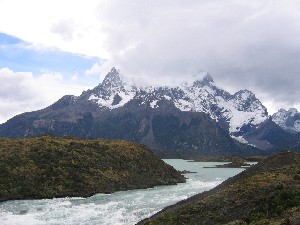
After leaving Ushaia, we left Argentina, taking the circuitous route through many small islands and among fjords to Punta Arenas, Chile, for the highlight of the second part of the trip-we would splurge again to fly to the Torres del Paine National Park. Rated on many traveler books’ lists as one of the world’s top destinations, we would certainly concur after having been there.
Designated a UNESCO Biosphere reserve, the park is one of the most beautiful unspoiled and remote places on the globe. To get there we took a three-quarter hour plane ride and boarded a bus for the trip into the park.
The Torres del Paine are three sheer granite towers surround by glaciers and a collection of jagged peaks covered with snow-a wondrous sight, and the signature of Chile as portrayed in photographs. As we drove through the park we were awed by glacial lakes, rivers and waterfalls. We stopped at a resort for lunch. If for no other reason, you’d get drunk in the lounge here just looking at the view through the picture window.
Along the way we saw herds of guanacos (llamas), nandus (Andean ostriches) and foxes, looking for handouts as we drove through the park entrance. The four hours we had available were certainly not enough. Passing by the many inviting trail heads, we vowed to return and spend several days. Even though this was at the end of the earth.
The next two days the ship wove its way through a maze of channels through the fjords. Each afternoon we went to the Observation Deck to view one glacier after another, some “calving” to create small icebergs. Especially impressive was the Darwin channel, a narrow passageway, some 900 feet wide, with cliffs rising to 4,000 feet above it. Another spectacle was the massive Amalia Glacier, like a wide river of snow flowing into the sea. It had been raining the day we saw it, but, as we passed by, the sun peeped through and gave us a full rainbow to photograph.
After leaving the fjords, our final port stop was Puerto Montt, known as the gateway to Chile’s lake country. We took the Petrohue Falls trip, which included a boat ride on the lovely deep blue Lake Todos Santos that took us to the place for an inspirational view of majestic Osorno Volcano, ringed with snow. Then on to the falls. We hiked the short trail which gave us gorgeous views of the rapids, waterfall and natural wilderness.
Unfortunately our last port of call was Valparaiso where we disembarked ship. We were met onshore by representatives of Southern Explorations who took us for a tour of Valparaiso on the way to the Santiago airport for our departure that night. Valparaiso is a delightful city that keeps its charm despite being a little frayed at the edges. Up to the 20th Century, it had been Chile’s primary port. It prospered mightily until the Panama Canal opened, which meant that cargo ships would no longer have to go around the cape and unload here.
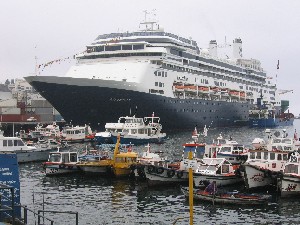
Colorful and lively, Valparaiso is built on two levels with 145 hills overlooking the sea. Among the pathways going up from the central city are many wooden ascensors, or funiculars, to take people to their homes. On the lower level, we walked around the Plaza Sotomayor, dominated by its monument commemorating those who died in the 1879 war against Peru and Bolivia. We then boarded the picturesque old Ascensor Planco up a hill to enjoy excellent vistas of the city and the harbor. We waved goodbye to the Rotterdam below as it sat majestically among all the small boats.
After lunch we left for the two-hour drive to the capital, Santiago. Surrounded by the Andes, the city sits in a valley. The Rio Mapocha flows through town with green parks on its banks. This creates a pastoral swath mediating the grey city look. After noting the contrast between the city’s old buildings sitting next to new, we were taken to the top of the 2,800-foot Cerro San Cristobal to where the statue of the Immaculate Virgin looks over Santiago, much like Christ the Redeemer over Rio. It seemed an appropriate end to the trip.
 Real Travel Adventures