

Manuel Antonio is known as the most beautiful National Park on the Pacific Ocean side of Costa Rica. En route there by car service we had the thrill of crossing a large concrete bridge where we got out to see the many crocodiles in the river below us. The next little bridge was over another, smaller river, but one which also had crocodiles, and this bridge was downright scary! It was of ancient rusted iron with both side rails and many of the roadbed cross pieces missing. Traffic slowed, since this has become not a one lane bridge, but a brave one car bridge, and we held our breath. The driver told us the taxes for bridges have been misappropriated by the last three administrations!

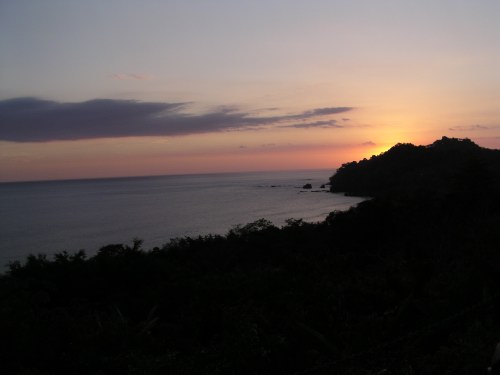
Our resort, Casa Verde, is high on the hillside overlooking the thick canopy of jungle trees and flowers, the tranquil bay, and the arrow-shaped peninsula pointing into the Pacific. In our rustic design cabin, we had an air-conditioned efficiency apartment with stove, refrigerator, sink, and all necessary cooking utensils. The resort has all the amenities you could want for a perfect vacation, including daily maid service. One swimming pool is for families, and the adult-only pool has a tropical sunset view of the ocean and of Manuel Antonio Park.
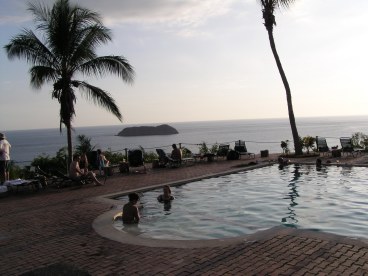
The Anaconda Resturant and bar on the premises has excellent meals and bar service, and your reservations specify whether or not breakfast is included. The hotel is not for handicapped, as there are many steps to the various apartments, which are situated up the hillside amidst lush tropical flowers. The food at Anaconda is delicious, quite reasonable, and freshly made after you order. If you go for an early breakfast or a late afternoon snack, you can watch many monkeys in the trees below the porch restaurant. Almost any time of day or evening in the restaurant you’ll be entertained by the iguana pets that seem to enjoy free runs through the open air reastaurant. On the street in front of the hotel is the bus stop down the steep hill to Manuel Antonio National Park, reputed to be the most prisine coast of Costa Rica. It is also possible to take a very long hike down to the public beach, but the best way is to book a tour at the hotel desk.
Most tours depart very early and return before the extreme heat of mid-day. A driver in a new, air-conditioned van picked us up. George, our friendly naturalist guide spoke good English and was so knowledgeable of this lovely coastala rainforest. Our $7 entrance fee was included, and the nearly four-hour walk was fascinating. We had expected unbearable heat and mosquitoes and found neither. Although Deet repellent is suggested, and we even took malaria pills, we never saw a mosquito during our mid-March week in Costa Rica. The locals told us the mosquitoes are out from 6 – 8 AM and 4-7 PM. Costa Rica is the most ecologically conscious country in the world, and the careful balance of nature allows the thousands of birds to keep pesky insects in check. Of course, we were not there in the rainy season (May and June, Sept. and Oct.), and conditions could be different.
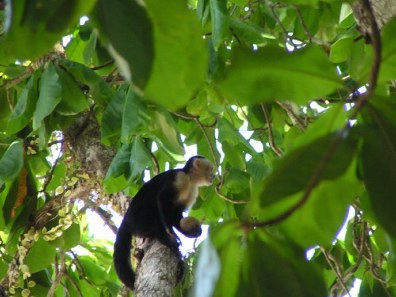
The hike was, for the most part, on a flat pathway through the jungle. We opted to walk partway up the hilly trail in the rainforest called the Catedral, where people usually see Capuchin monkeys. Although we didn’t see them there, we did get to enjoy many near the bathrooms a little farther on. We found all public restrooms in Costa Rica very clean, with soap and paper, although toilet paper cannot be flushed.
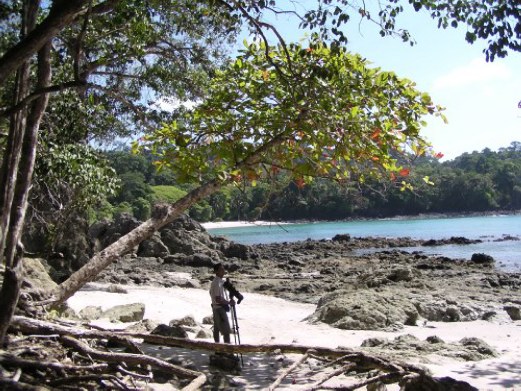
As we walked along in the jungle our untrained eyes searched for the birds we could hear and for other wildlife. On our own we could find none because each species is so well camouflaged, and many are nocturnal. But with our excellent naturalist guide we were able to see so many animals that we teasingly accused him of having some Disneyland animatronics placed at prearranged points.
Park guides carry large Leica lens telescopes and locate the various animals for you. We could even take photographs through these high quality implements. We saw sloths with babies asleep in the trees, an anteater raiding a termite nest in a tree, a strange rodent with long legs, many different kinds of bats sleeping in branches, a rare type of toucan, a small parrot-like bird building a nest, and many other birds, and the quizzical white-faced monkeys. It was quite warm when we arrived at the waiting van, and the cold bottles of water and fresh fruit salad the driver gave us were very refreshing. If you wish, you can stay to play at the Manuel Antonio beach, one of the cleanest beaches on the Pacific side of Costa Rica, for the rest of the day, using your tour ticket. The best swimming beach and the place to rent kayaks is through the jungle path to the south side of the green, arrow-shaped peninsula, where the protected beach has gentle water. Outside the National Park is the free general beach. Numerous souvenir sellers line the sidewalks along the beautiful sandy beach in front of restaurants, which provide restrooms for a small fee. The beach has lifeguards, chairs, umbrellas, but our guide warned that this beach is not good for swimming because of the strong undertow.
Our bus ride to the town of Quepos was only a few minutes in the other direction from Casa Verde. All buses come and go from the bus terminal there, where you can get direct service to the capital, San Jose, and to many other places for a small price. The buses are clean but not air-conditioned,and the people are very clean and friendly. Except for the top hotels, few places in Costa Rica are air conditioned, but there are always cool breezes since this is a humid climate, and most places have fans. Although the air is humid, we found the temperatures averaging 50 – 80 year-round to be much less harsh than our Texas summers. Of course, we were only 9 degrees north of the equator, so we faithfully wore sunblock because a burn can happen in just a few minutes.

The bus station at Quepos is at the center of the local shopping area, which is typical of Central America, with small shops selling life’s necessities with no attention to window display. Quepos is hot and dusty because it is below sea level, with a seawall blocking the breezes. Although we found some nice tourist shops along the water front, as well as small hotels and restaurants, we were very glad we were not staying there for long. This seems to be the center for fishing excursions and boat rentals, as it has a protected small harbor.
Back at our hotel at night we could choose one of many restaurants in the vicinity, all of which specialize in seafood. Besides our hotel’s Anaconda restaurant we really enjoyed the BBQ restaurant just across the street, where the food was delicious and the live music nightly was a terrific mixture of Caribbean dance music and 70’s Latin Romantic songs. The only thing they lacked was a dance floor! By contrast to other Latin countries, Costa Rica observes early meal times, with breakfast from about 6:30 until 9:30 AM, lunch from noon to 2 P.M., and dinner from about 5 P.M. with most places closed by 10 P.M. Siestas and closing business for lunch are not observed here. And we found every service to be very punctual…no “Latin” time, so you must be ready for pick ups and appointments a little ahead of schedules. We loved everything about Costa Rica and hope to return soon and often.
 Real Travel Adventures