

Those people on the Lost TV show have nothing on this lone woman traveler who doesn’t have the slightest vestige of the “direction gene.” Just so that you, fellow traveler, and all the locals who gave me directions will know, there has not been a Visitor’s Center at Seawall and 25th for several years. (For future reference, there are open Visitors’ Centers at 22nd & Strand, one on 61st Street, and a Heritage Center at Ashton Villa.) In my wanderings my first day in Galveston, I happened upon the Pier 21 Theater which featured a much touted film on the 1900 hurricane. A sign inside the theater said that they would not be showing the film until further notice. Serendipitously, another disappointed theater goer agreed to show me the Visitors’ Center on Strand, and we ended up eating lunch at the yummy Phoenix Café and touring Moody Mansion. (Aaah, I had finally hit my tourist groove.)
In her heyday Galveston was a bustling port and named the ‘Wall Street of the South’. The gentile rich and nouveau riche frolicked on this sandy barrier island. Today, raised 17 feet after the hurricane of 1900 and with a 17-foot Seawall that runs about half the length of the island on the gulf side, Galveston is a great vacation destination for history buffs and for those who enjoy sandy beaches, beachcombing, boating, fishing, swimming, bicycling, birdwatching or kayaking.

Galveston’s Victorian past is epitomized by its ‘Broadway’s Beauties’–Moody’s Mansion, Ashton Villa, and the Bishop’s Palace. Moody’s Mansion escaped any major damage from the 1900 hurricane because it sat on the highest point of the island at that time. Built for Mrs. Narcissa Willis in what is called the ‘Richardsonian Romanesque’ style, the mansion was completed in 1895. W.L. Moody, an entrepreneur, had made a ridiculously low bid on the 28,000 square foot limestone and brick mansion just before the 1900 hurricane. (They didn’t name hurricanes back then.) After the hurricane the owners of the house accepted Moody’s bid without even checking to see if the mansion was damaged or
destroyed by the hurricane. Moody’s family lived there in a comfortable yet frugal style. The house is filled with period antiques and is definitely worth seeing.
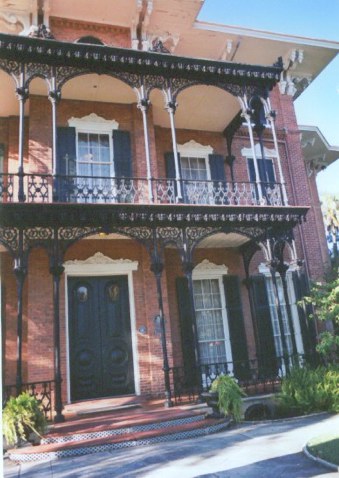
Ashton Villa is the oldest of the Broadway “palaces.” Built in 1858-59 by James Moreau Brown in the “Italianate” style, it is one of the first brick houses to be built in Texas. When the island was raised with fill sand, Ashton’s basement was filled in and the thrifty owners at the time had their 6-foot high cast iron fence partially buried. The last mistress of the manor, Miss Bettie Brown, was an eccentric artist and world traveler. As a child she painted huge paintings rendered on corduroy almost giving them the look of watercolor paintings and these still hang throughout the house. Scandalous at the time, she painted some of her female subjects wearing red and some with their ankles showing. Miss Bettie remained unmarried her entire life even though she had plenty of offers. After her formal artistic training in Paris, her art became the darker, heavier portraiture of the time. There are postcards and pictures of her in Jerusalem, Morocco, and other exotic locations displayed throughout the house. The guide who took us through the house intimated that Miss Bettie is the resident ghost. As we entered a small bedroom, the guide pointed to a small single bed and said that it always had a wrinkled look as if someone had lain on the coverlet. At just that moment someone’s cell phone chimed and my heart popped into my throat. The Villa’s ballroom is available for weddings, and I’ll leave it to you to judge whether you believe Miss Bettie will be attendance or not.

The last ‘Beauty’ is The Bishop’s Palace named after the Catholic Bishop who resided there from 1923-50. Colonel Walter Gresham erected the home at an estimated cost of $250,000 in 1886 of Texas granite, white limestone and red
sandstone. Architecturally it is the grandest of the three ‘Beauties’. It has a turret, a conservatory, impressive fireplaces and stained glass work, uses rare exotic woods, and has the most intricately carved wooden staircase that I have ever seen. The Greshams, who were fireplace and mantel collectors, bought them all over the world and then built their rooms around them. As a gentle lady, Mrs. Gresham painted, too; however, she would not have given Miss Bettie much competition.
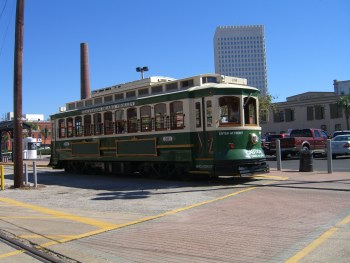
If you love historical houses, then get the free self-guided walking tour map of The Silk Stocking National Historic District which gives the addresses of about 50 houses dating from 1860-1927, many built in Classic, Colonial and Greek Revival and Queen Anne styles. On Postoffice Street you’ll find The Grand 1894 Opera House. It’s designated the “Official Opera House of the State of Texas by the 73rd Legislature.” Damaged extensively by the 1900 hurricane, it has been fully restored and updated to current standards, and modern performances show most weekends. Earl Staley, a Houston artist, recreated the original painted canvas curtain. Around the corner from the Opera House you can pick up the Galveston Island Trolley which circles the Strand area and rounds through some of the neighborhoods of historic homes.
Located at 2219 Market is the Galveston County Historical Museum. (It’s free, which is always a good thing for frugal travelers.) The museum shows ten minutes of vintage film footage of the 1900 hurricane. (The film at Pier 21 Theater never did work during the week I was there.) Thomas Edison had a functioning movie camera in 1900, and his assistant came to film the storm and the aftermath. Officials turned back other ‘ghoulish’ photographers, but they didn’t recognize Edison’s device as a camera, and the assistant was able to score an exclusive. The museum, housed in an old ornate bank building, contains information on all of Galveston’s hurricanes, its original Native American population and its pirate history.
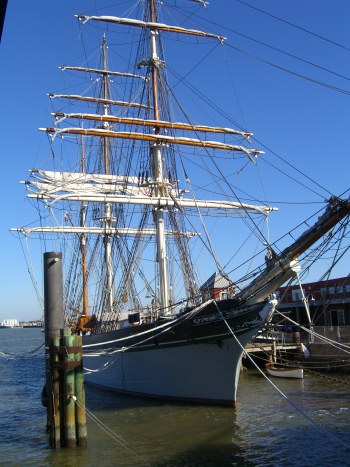
The Texas Seaport Museum/Elissa and harbor tour should not be missed by those interested in tall ships. Watch the video on board Elissa to see how she was restored and is now settled in her berth in Galveston. The museum itself has
some maritime memorabilia, interesting displays on the shrimp industry and a computerized search system to research the names and debarkation point of the immigrants who entered the U.S. through the Port of Galveston. About twelve of
us took the harbor cruise accompanied by playful dolphins and the boat crew, of course. We saw the old docks, the new cruise ship docks, a scuttled concrete ship, Seawolf Park, bay and gulf shrimpers, the Boliver Point ferry, the
off-shore oil rigs, and huge freighters lined up like racing greyhounds ready to make the run up the Houston ship channel.
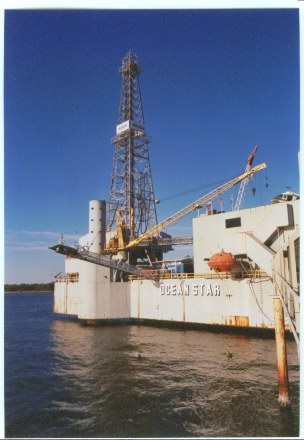
For those of you who are interested in offshore drilling, the Ocean Star Museum, a retired jackup drilling rig, offers interactive displays illustrating the story of offshore gas and oil exploration through actually drilling.
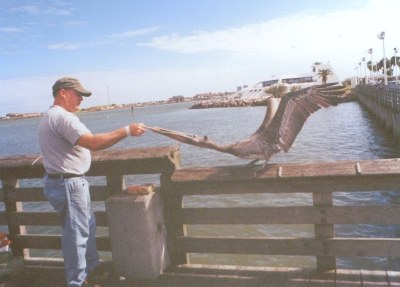
Galveston is still and forever the gentle Southern Victorian lady with her historical east end homes and buildings, wonderful sandy beaches and fishing docks, but she also offers all of the sites and attractions of a modern beach
resort area. I know that Miss Bettie would be smiling and waving as the Carnival Conquest pushes off from its berth on Galveston’s new cruise ship dock. You can also get around Galveston by trolley/bus at a very nominal price if you are not in a hurry.
 Real Travel Adventures