

By Saul Schwartz
My wife Fern and I began our first trip to Switzerland in Zurich, the banking capital of Switzerland. We were able to fly nonstop from Washington Dulles during May. The overnight flight was about 8 hours.
Upon arrival at Zurich airport, we took the train to Zurich central train station (called Zurich HB or Banhof). The trains are very frequent and take only about fifteen minutes, with a few stops in between these two stations. Ticket booths are available within the airport, by following the signage for the train. The cost of the train varies.
Zurich HB (Zurich Hauptbahnof) is a major terminus for train trips throughout Switzerland and Europe. Zurich HB is the largest train station in Europe. Within the train complex, there is a large shopping complex (ShopVille) with many food options and restaurants. We stopped by the complex several times to purchase food before embarking on our train trips.
The Zurich HB station is crowded. It contains many ticket booths for purchases and there is an information center for questions. Upon arrival, we walked about five minutes from the train station to our hotel.
Looking up at the ceiling of the station there is a large colorful sculpture. The sculpture is of a plump guardian angel who is watching over travelers. The whimsical sculpture has hovered over the station concourse since 1997. The artist is Niki de Saint Phalle.
Zurich is Switzerland’s largest city. Its population is over 400,000.
Lodging – Central Plaza Hotel
This four-star hotel has an amazing location in Central Zurich, near old town attractions and the train station. We booked the upgraded double room with a view of the Limmat River. Our sixth-floor room had an exceptional view of the roofs of the old town and the river. For a European hotel, the room size was above average, but very oddly shaped. The price of 268 Swiss Francs per night ($296 U.S. Dollars) is reasonable for a Zurich city hotel. Although somewhat dated, the quaint hotel has charming features. The hotel staff were friendly and helpful. The Internet service was very good. The bathroom tub/shower combination required an unusually high step up that was somewhat awkward.
Without a further charge, hotel guests can use the Activ Fitness gym right across the street from the hotel. We used this exceptional gym for three days. The large gym has equipment over two floors, and daily fitness classes were offered without an additional charge. Although not open 24/7, the gym had good hours. We did not eat meals at the hotel, but there were three restaurants available.
We were able to walk from our hotel to all the old town attractions (which were about ten to fifteen minutes away). The staff readily provided us with helpful information. Because we waived room cleaning each day, we received a daily voucher for a free drink at the hotel bar.
Attractions
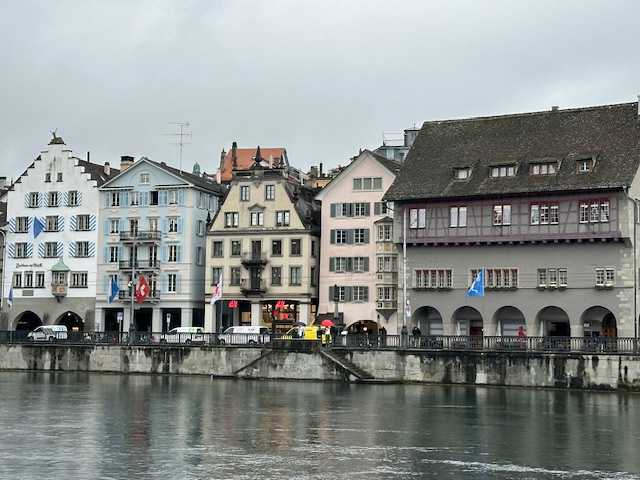
Zurich is much more than an international banking capital. Its cultural scene is vibrant and lively. Fern and I enjoyed walking across the elegant low bridges over the Limmat River, which bisects the city.
Walking Tour of “Downtown” Zurich – Our 90-minute walking tour was booked on-line in advance through Free Walk Switzerland, and it lasted about 90 minutes. This was a tour by tip (where you pick the amount to pay at the end of the tour). About fifteen of us showed up for this tour on the only rainy day of our Zurich stay. As our first activity, the tour gave us an excellent orientation of the old town area and its surroundings. Generally, attendees pay around ten Swiss Francs per person. At the time of our trip, 10 Swiss Francs were about $11.15 in U.S. currency. Although our tour guide was not a long time resident of Switzerland, she knew the sites of Zurich very well.
Our starting point of the tour was at Paradeplatz, next to Credit Suisse. Paradeplatz is a downtown square which now houses the headquarters of two Swiss banks. Our guide Misha explained that the square was formerly a livestock market.
During our tour, we walked by 22 fountains. We first walked by the Munsterhof fountain, near the Fraumunster Church. This large fountain has a diameter of 20 feet. It is an elegant contemporary fountain, with an elegant spout arching over a large bowl to create a pool.
We then walked by the intriguing Hans Waldmann statue. Our guide explained how Waldmann was elected as mayor in 1483 and then he was executed six years later in response to pressure from farmers over his land reform policies. The Haller bronze statue shows Waldmann on a horse in his military uniform. The statue sits in between the Fraumunster and Grossmunster churches.
After walking by the river, we briefly explored the Roman ruins of Zurich at Thermengasse. During renovation work in 1983, Roman baths were discovered. We viewed the remains of the baths through metal grating. The Romans withdrew from Zurich around 405 A.D. At this location, most of the signage is in German. Nearby is a sign with the original Roman name for the city (Turicum).
We next looked up at Europe’s largest clock face on the baroque St. Peter’s Church. The clock tower has a diameter of over 28 feet. The clock uses Roman numerals. Our guide Misha explained that the clock uses the incorrect Roman numeral IIII instead of the correct Roman numeral IV for 4, probably due to purposes of symmetry on the clock face.
On the western side of town, Misha gave us a chocolate sample as we took in the views from the tree-covered Lindenhof. This area is a great overlook of the river and the old town. The peaceful square and public park includes the Hedwig fountain built in 1912, showing a helmeted woman. It was built to honor the women who helped defend the city from a German siege in 1292.
Hidden amidst the homes and public facilities in Switzerland, there are approximately 360,000 shelters which were designed to offer protection in the event of war breaking out. The protective structures were for the most part built during the Cold War. We walked by one of the few remaining shelters in downtown Zurich, numbered 24, which looked like a storage locker!
Our tour ended after we walked by Zurich town hall, the Rathaus, which was built around 1694 to 1698. This building served as the seat of government of the Republic of Zurich until around 1798. The building was built right over the river. It was built in the Baroque and Renaissance styles. Today the building is used for meetings of the city and canton parliaments.
Fern won Misha’s contest for guessing the number of fountains that we walked by on the tour. Her prize was a box of Swiss desserts.
Fraumunster Church – Our next activity was to tour one of Zurich’s major churches. This church is normally open daily from 10 a.m. to 5 or 6 p.m. The adult admission fee of 5 Swiss francs includes a one-hour audio tour. The thirteenth century Reformed church is located within the old town at Stadthausquai 19, on the west bank of the Limmat River. The church was first founded in 853. Its name comes from the fact that its convent was inhabited by the female members of the aristocracy of Europe. It was not very crowded during our visit. Advanced tickets were not needed. Guided tours were not offered.
Highlights of the church interior include the stained-glass windows. Six large stained-glass windows designed by the Russian Jewish artist Marc Chagall were installed in 1970 and 1978. The rose window depicts the stages of Genesis and in the center Noah’s Ark, symbolizing the salvation of creation. The other five windows were designed as a cycle with the window of the prophets, the blue window of Jacob with the ladder to heaven, the green window of Christ featuring Mary, Joesph and the infant Jesus, the window of Zion, and the window of the Commandments. The set of these windows is a unique, highly spiritual work of art that is extremely colorful, and expressive. The church also has a very large Giacometti stained-glass window, created in 1877. This monumental masterpiece has a surface area twice as large as the Chagall windows. It is called the Heavenly Paradise, and it is a composition of dense, bright, colors. The current large organ with about 6000 pipes was installed in 1953 for the church’s 1100-year anniversary. It is the largest organ in Zurich.
Outside the church is easily recognized by its green steeple, on top of its clock face. Also outside there is a courtyard with several lovely stone fountains and colorful murals. The church is a must-see attraction.
Grossmunster Church – On the second day of our visit, we went to the second major church in Zurich. This Evangelical Protestant Reform Church is also located in the old town at Zwingliplatz 7. The church is normally open daily from 10 a.m. to 5 or 6 p.m. The adult admission of 5 Swiss francs includes an audio tour guide and admission to one of the towers. Walking up the 187 steps of the south tower (the Karlstrum tower) provided us with the very best views of Lake Zurich and the old town from six panoramic windows. This church is one of Zurich’s most famous landmarks.
This church opened around 1220. Outside the two towers of the church make it easily recognizable. The architecture is considered Romanesque. The church was first founded in the nineth century. Here a sixteenth century preacher spoke out against the Catholic church, bringing the Reformation and Protestantism’s lifestyle to Zurich. On one of the outer walls there is a sculpture of Heinrich Bullinger, who was responsible for reinforcing the Reformation and Protestantism in Zurich in the sixteenth century.
A church volunteer explained the seven lovely stained-glass windows by German artist Sigmar Polke, installed in 2009. He cut Agate, a semi-precious stone, into thin slices that let light pass through them and give the appearance of brightly glowing walls. The brilliantly colorful result was then expanded with five figurative glass windows. The motifs feature Old Testament figures: the scapegoat, Isaac, the Son of Man, Elijah the prophet, and King David. Of particular interest, the Son of Man window has facing profiles that can look like different figures depending on how you look at the window.
Again, the church was not all that crowded and advanced tickets were not needed. Guided tours were not an option.
Kunsthaus Museum – Also on the second day of our trip, we visited Zurich’s most famous art museum. Although adult admission is normally 24 Swiss francs, we happened to go to the art museum on a Wednesday, when admission is free. Although the audio guide only provides information on a limited number of art pieces, it enhanced our visit, and the cost was minimal. The museum is closed on Mondays, but open every other day, normally from 10 a.m. to 6 p.m. After a renovation, the museum of fine arts now spans two interconnected buildings over two floors.
Switzerland’s largest art museum, the Kunsthaus Zürich brings together more than 800 years of art history. Its collection ranges from the Middle Ages to the present day, with paintings, sculptures, installations as well as works on paper, photographs, videos, and digital works that are shown in regularly changing presentations. We particularly enjoyed the great collection of Impressionism. This collection of 19th century paintings starts with Géricault, Corot, Delacroix, Courbet, and Manet and culminates in a large group of works by Claude Monet. For us, the most impressive room featured three large Water Lilies on three different walls. The unique water-lily paintings are a particular highlight, a testimony to his vision of a novel, ‘all-over’ painting that exploits the entire surface of the vast panels. This museum also has an extensive collection of modern art.
Although we planned to eat at the small bar/café, the only vegan options included corn soup and a boring salad with only lettuce, so we decided to not eat at the museum. The non-vegan options were very limited, as well. Nevertheless, we really enjoyed spending several hours at this museum. For a major art museum, it was not particularly crowded.
Lindt Home of Chocolate – Also on the second day of the trip, we went to begin our exploration of chocolate, a cultural asset of Switzerland. We took the train from Zurich’s main train station to Kilchberg for an afternoon of chocolate delights. Lindt is about a ten-minute walk from the Kilchberg train station. The train is the quickest and most direct way to get to Lindt from Zurich, although it costs a little more. In advance, we booked the 90-minute Choco-Delux public guided tour (30 Swiss francs) and the one-hour Chololateria course to make a chocolate bar (28 Swiss francs). Here an advanced purchase is needed, as both the individual guided tour and the course were sold out on that day. This was the most crowded attraction that we visited in Zurich during our trip.
The public guided tour through the largest Chocolate Museum in Switzerland provides fascinating information about chocolate, in general, and Lindt, in particular. The tour gave us additional insights into chocolate production. The highlight was a series of tasting stations with both Lindt creations and the preliminary products used in chocolate production. The focus of our course was on the making of our own chocolate bars. We got to pour our own chocolate (dark or milk) and then we decorated it with various options. We wore special Lindt chocolate-colored aprons and white chef hats during our course. Our English language guide on both the tour and the course were very knowledgeable and helpful. The room where we made the chocolate bars was decorated with Lindt memorabilia over many years.
Lindt is normally open daily from 10 a.m. to 7 p.m., but the guided tours and various courses must be booked in advance on-line. Lindt contains a very large chocolate shop with extensive offerings. Outside largest chocolate shop in Switzerland, we marveled at the chocolate fountain, more than nine meters tall, pouring 1400 liters of real chocolate continuously. The fountain weighs three tons and is a major photo op! There is a small café where many chocolate drinks are available, featuring Lindt hot chocolate or foamed chocolate.
Lake Zurich Cruise – The highlight of our third day was a lovely lake cruise. The best way to discover Lake Zurich is by taking a boat trip. Cruises of various lengths are available, up to four hours. We chose the 90-minute cruise, called the short lake cruise. Our cruise began and ended at Zurich Burkiplatz. A ticket booth is set up right by the boats. The cost was 9.2 Swiss francs per adult. Food and beverages are offered during the cruise. Although passengers can hop on and off at any of the eight stops on the short lake cruise, we stayed on, relaxed and enjoyed the views of the lake, the interesting houses along the shore, and parks. Our boat was the MS Wadenswil.
The cruises are operated by the Lake Zurich navigation company. The boats were very comfortable with indoor and outdoor seating options, The restrooms were very well maintained.
Niederdorf neighborhood – On several days, Fern and I walked through this old town neighborhood with its winding car-free streets and alleys. The Niederdorf street and its side streets nearby are full of restaurants, as well as many small boutique stores. It was delightful to explore, although the cobble stones are not easy to walk on!
Banhof Street – We also walked several times down Banhofstrasse, which is the famous main street of Zurich. Stretching for about 1.4 kilometers from the main railway station to Lake Zurich, this is one of the most famous shopping streets in the world, with many high-end retail stores.
Day trip to Rhine Falls – We spent our fourth day of our trip at Europe’s largest waterfall. The quickest and most direct route (about one hour) was the train from Zurich’s main station to the Schloss Laufen am Rhein station. There are several intermediate stops. This train stops right at the entrance to the falls at the south bank. Right after disembarking, we began to hear the roar of the falls.
Most of the viewing of the falls are without a charge, but to get the very closest approach to the falls we paid 5 Swiss francs per adult to obtain access to the closest viewing platforms on the south bank. The falls are open daily, around the clock, as there is no gated entry.
The falls are a stunning sight. Some daring individuals take a boat to stand on the tall rock in the middle of the falls, where the Swiss flag flies patriotically. We took the “red boat” to see the falls from the Rhein River and get closer to the falls (at a cost of 3 Swiss francs per adult).
We spent time on both sides of the falls. On the north bank, the small castle Schlossli Worth provides a more panoramic view of the falls. On the south bank, the Schloss Laufen overlooks the falls at closer quarters, as they rush over the cliffs.
After our viewings, we enjoyed a meal at the Schloss Laufen restaurant, at the cliff top castle. The restaurant is part of the Schloss Laufen complex on the south bank. During May, we really enjoyed the seasonal white asparagus. Our selection was to enjoy the white asparagus as part of a salad, along with bread and minty iced tea. The staff was very friendly, and the outdoor seating was quite comfortable. Prices were moderate.
Eating Options
There are many restaurants throughout the old town and beyond. Yalda Grill – This small restaurant advertises itself as taking you into the lively souks and streets of the Orient. We were pleased to find plenty of vegan and vegetarian options. Options include sandwiches filled into pitas or served in a bowl, with a Middle Eastern flair. The pita and hummus were exceptionally tasty. The varied salad choices were fresh and flavorful. The friendly and helpful staff explained the choices to us, as they put together our orders at the counters. The restaurant is located at 4 Theaterstrasse right next to the opera house and Lake Zurich. Prices were moderate. The seating was indoors only. We ordered at the counter and the food was put together for us.
Roots – There are five of these restaurants in Zurich. We enjoyed sharing the large Protein Bowl. This bowl contained quinoa, radish hummus, tofu, avocado, sweet potatoes, cashew-dressing, and lettuce. There were good vegan options at Roots. The staff allowed us to modify the ingredients of the bowl. We ordered at the counter and the food was brought to us at the table. There was indoor and outdoor seating. Prices were moderate. One location is in the heart of the old town.
Tibits – We intended to go to this vegan/vegetarian buffet at the location near Lake Zurich, but it was exceptionally crowded when we went there. Instead we went to Tibits twice later in the trip.
Migros and Coop – To avoid the high cost of Zurich restaurants, we purchased several meals at the two local supermarkets which are located in the old town and beyond. Both stores have many outlets. Fern and I were impressed with the quality of the offerings, including many salad bowls, non-dairy milk, and vegan friendly side dishes. Although prices were high for a grocery store, the costs were much lower than restaurants. Coop has its own brands and numerous branded products. Although both are set up as cooperatives, they operate as normal grocery chains. We found the Coop products to be slightly superior to Migros (especially their Budda Bowls).
ViCafe – There are a series of ViCafes in Zurich. The cute café near the Fraudmeister Church has a cute expresso bar and great bathrooms! There is indoor and outdoor seating. The coffee is local and ethically sourced.
Café 1842 – Sitting in a cute square at Napfgasse 4, the café has great outdoor seating to people-watch. The hot chocolate made from dark chocolate is famous and was well worth it! The original café was established in 1842 in a four-story thirteenth century house. Many patrons ordered delicious looking pastries. The inside was decorated with colorful flowers, cakes, pastries, and little statues. This café sits across from H. Schwarzenbach, a family business of over 150 years,that includes a coffee roastery and a chocolate bar.
Starbucks – We went once to the Starbucks location near our hotel. The iced tea was both smaller in size than the U.S. counterpart, and more expensive.
Tips for Zurich
- Getting around: The old town is very walkable. We took trains when we left the old town for other attractions. The cobble stone pedestrian streets are a little tricky to walk on. There is an extensive tram network which we did not use.
- Connectivity: Switzerland has its own voltage requirements, so a two or three pin adapter is needed for most power sockets (type C or J).
- Currency: Since Switzerland is not on the Euro, we took out some cash at the airport ATM to have Swiss Francs for tips in hotels and for our tour guides. Most restaurants and attractions do take credit cards.
- Tour information: There is extensive information on the internet. We used two guidebooks for general information, although both were somewhat outdated. Lonely Planet Switzerland in its fifth edition and Eyewitness Travel Switzerland were good starting points for trip ideas. The Visit a city app provides a list of sights, sample itineraries, as well as possible day trips to consider.
- Videos: In advance of our trip, we watched several on-line videos to get a better visual feel for various Switzerland locations. Although dated, we enjoyed the Rick Steves video.
- Podcasts: Our preparations also included listening to numerous podcasts. The extensive Holidays in Switzerland series has several good episodes related to each of our planned locations.
- Trains: We did not book our trains in advance because we wanted more flexibility. In hindsight, we could have saved some money by purchasing one of the train passes. Using the trains was easy and the SBB app was helpful. We used the SBB app timetables to figure out the train number, platform, and times offered for each route. The various passes offered were confusing to understand. The trains are on time like a Swiss watch so be prompt as the train does not leave late! Although tickets were not checked on the local trains, there is a 100 Swiss Franc fine if you travel without having a ticket.
- Public bathrooms: There is a charge of about 1.5 Swiss Francs per usage, so it is good to have some change handy.
- Amount of time in Zurich: We thought four days would allow us to see most major sites, have one day trip near Zurich, and to get a real feel for the area. It did!
- Time zone: All of Switzerland is 6 hours ahead of the U.S. Eastern Time Zone.
- Language: Although German is most common in Zurich, almost everyone spoke fluent English.
- Weather: In May, the weather is variable. We had one day of rain, two pleasant days but mainly cloudy, and one very sunny and warm day.
 Real Travel Adventures