

By Saul Schwartz
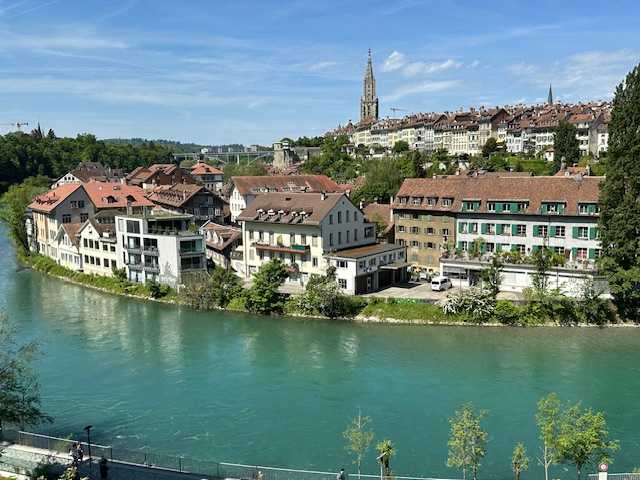
My wife Fern and I continued our grand tour of Switzerland. After our four days in Zurich, we took the train to Bern, the political capital of Switzerland. With its picturesque setting on the Aare River, Bern is a beautiful historic town.
Although the trains from Zurich to Bern are frequent, we booked our train in advance, which lowered the cost to 26.60 Swiss Francs per person (about 30 U.S. dollars). The train ride took a little over one hour, and no line switches were required. The large Bern train station contains a mall with many stores, including many food outlets.
Like most hotels, our hotel provided us with the free transit app (called Bern Welcome), which allowed us to take tram 9 right from the Bern train station to our hotel, at the Kursaal stop. The tram ride took about five minutes, with stops easily identified on the tram by signage. The tram stop was literally right in front of our hotel. There was also a free bus option which we did not use during our trip.
Bern is Switzerland’s fifth largest city. Its population is about 135,000.
Lodging at Swissotel Kursaal Bern – This hotel is right across the Aare river from the old town. With the central location, we were able to walk to old town attractions in about ten to fifteen minutes. Tram 9 provided an alternative for us when we went to and from the train station. The hotel staff was friendly and helpful in answering our questions. Two restaurants are on-site, but we did not eat at either one.
Although the rooms were small, the hotel was bright and modern. Fern and I enjoyed using the large gym on both days of our stay. The gym had weights, machines, and cardio equipment. The price of our room was more reasonable; however our room had no view. We had drinks both days in the modern outdoor bar area, which was decorated with fountains. We booked our rooms in advance through the hotel web site. The daily lodging rate here was the lowest of our four Switzerland stops.
Attractions:
From the hotel, it was a short walk into the charming historic old town. The walk was very scenic, as we crossed over the Aare River. The color of the river is a lovely blue green shade.
Bern Cathedral – Our first stop was the Berner Minster. The Berner Munster Cathedral of St. Vincent is the most impressive gothic-looking building in Bern. It is considered the largest and most important late medieval church in Switzerland. The 35-minute audio guide was very helpful to provide insight for us into the interior and exterior of the church. The cost of the audio guide was 5 Swiss Francs per adult. Guided tours were not available. This church contains the highest church tower in Switzerland. The lofty spire is visible throughout Bern. The church was finally completed in 1893.
The foundation stone of the 600-year-old church was laid in 1421. The church remains a worship place for the Reformed community. Organ music was playing during our tour, from the large organ at the rear of the church. The Minster is open to the public most days from 10 a.m. to 5 p.m. Reservations were not needed for touring, as the church was not crowded.
Outside the church entrance is the impressive Last Judgment architectural work of sandstone. The main portal sculpture contains 294 figures, with the righteous half headed to heaven (including the mayor of Bern) and the wicked half to hell (including the mayor of Zurich)! The church is located on the west side of Munsterplatz. Although the tower is open to the public, its access times are limited.
Across from the cathedral entrance, there is a fountain dedicated to Moses called the Mosesbrunnen. The statue dates from 1544. The blue and gold statue shows Moses bringing the ten commandments to the tribes of Israel. There is some controversy over what exactly is jutting out from Moses’ head.
The serene interior contains vaulted ceilings, impressive stained-glass windows depicting Christ’s passion and crucifixion, as well as intricate sculptures, some dating back to the fifteenth century. The finely carved pulpit dates to 1470.
The Parliament Building (Bundeshauser) – The English language tour of this building must be booked exactly three days before the tour on the official Parliament website. We were happy to get two of the limited tickets for the one-hour tour. The tours only take place when the Parliament is in recess. The English language tour takes place at 4 p.m. on certain days and this tour was the highlight of our first day in Bern. About twenty tickets are available for each tour. There is no fee.
The Parliament is the heart of Switzerland’s democracy. The home of the Swiss Federal Assembly is built is an impressive Florentine and neo-Renaissance style.
Our tour was limited to the central assembly building and did not include the two wings. We began in the official entrance, after checking in at the visitor’s entrance, which requires showing your passport.
Looking up in the official entrance, the 210 feet high stained-glass dome is adorned with emblems of each canton that existed in 1902 (when the building was completed) and a huge chandelier. Also in the official entrance hall, there is a statue of the nation’s three founding fathers, called The Three Confederates. Additional stained-glass windows and sculptures lead you up the steps to the second level.
We were able to spend time in each of the legislative assembly chambers – the National Council (with 200 seats) and the Council of States (with 46 seats). Fern and I were told by the tour guide about the Switzerland Federal government. The Council of States has representatives for each of the cantons and the National Council has representatives based on population. Both houses have equal power. The tour guide, who works for the Parliament, answered numerous questions from our group.
The fresco in the Council of States chamber depicts a people’s assembly in the eighteenth century. The Charles Giron mural in the National Council shows a magnificent view of Lake Lucerne, along with the angle of peace. Both pieces of large pieces encompass one wall of each chamber.
Our tour ended in the magnificent, curved lobby. The lobby serves as a reception hall to receive heads of state. This is also where council members meet and talk during the sessions.
The imposing Parliament buildings face a square (Bundeshaus) on the north side. Peaceful demonstrations were taking place there on one of our days in Bern. The other side of the Parliament overlooks the river, the Swiss Alps, and the Aare valley.
Walking tour of Old Town Bern – The medieval town center is a UNESCO world heritage site. To begin the second day of our Bern trip, we had booked – in advance – a walking tour through Free Tour Expert, but even after the time of the tour was changed, the guide provided us with the incorrect meeting point, so we were unable to join that tour group. This was only the second time in our travels that we had a tour booked in advance that did not work out.
Instead, we took our own guided walk down the city’s long and cobbled streets. The cobble stone pedestrian streets are a little tricky to walk on.
Our first stop was the thirteenth century clock tower called the Zytglogge, which was once part of Bern’s western gate. As the hour approaches, crowds gather to listen to the chimes and watch revolving mechanical figures begin to twirl at four minutes before the hour. Although this sixteenth century clock is less impressive of a show than the astronomical clock of Prague’s old town, we enjoyed watching it once. The time bell tower contains a clockface with large roman numerals.
Next, we walked down the main street of Bern, called Kramgasse. The main street begins at the clock tower. The main street was bustling, as tourists and locals walked by the cafes, historic buildings, and stores. The street is lined with Swiss and other flags, The quaint cobblestone street boats stunning medieval architecture.
We then walked by Bear Park, where the Bernese bears roam in a forested area without obstacles, but within fenced enclosures. They live on the slopes of the Aare River. We watched the bears play with each other, eat grass, and they sniffed around. The Bear Pit, opened in 2009, is a portion of the Tierpark. We saw three different bears frolic. The bear is the symbol of Bern.
We finished by walking to two scenic viewpoints where Fern and I could admire the old town and the Aare River. The historic fourteenth century Nydegg Bridge and the nearby Aagaurstalden viewpoint both offer great views of the shimmering river and the panorama over the old town. Here we could see rooftops and the landmarks of Bern, framed by the Swiss Alps.
Einstein Museum – We spent our second afternoon at the Einstein Museum, which is part of the Bern History Museum. There is sufficient English language signage, but no audio tour guide was available. The Einstein portion of the museum takes up one of the museum’s floors. The museum is open daily from 10 a.m. to 5 p.m., except on Sundays. The cost is 18 Swiss Francs for the entire museum admission.
We were able to walk to the museum from the old town. It is located at Helvetiaplatz 5 across one of the river’s bridges. The Einstein portion of the museum focuses on his whole life, not just his years in Bern. After our visit, we spent some time at the Steinhalle café located outside the west wing of the museum, enjoying the unusual green tea. A life-size statue of Einstein sits on a bench outside the museum. The vast nineteenth century building was inspired by architecture of the fifteenth and sixteenth centuries.
Fountains – Bern is full of decorative fountains. There are about 100 in the old town alone, many from the sixteenth century. The drinking water is very safe. One of the oddest painted stone fountains is that of a colorful ogre eating a series of very young children. This is referred to as the child eater fountain!
Eating options:
We ate two meals in Tibits. Tibits has two locations in Bern. The vegan and vegetarian buffet is extensive. Pricing is based on weight of your items. The offerings were fresh and delicious. There is a choice from about 40 different salads items. Desserts and drinks are also available. The prices are moderate. The location on Gurtengasse was busy, but not as crowded as the Tibits in Zurich. For an informal lunch or dinner, this was our favorite restaurant in Bern.
Migros and Coop: – To avoid the high cost of Bern restaurants, we purchased several meals at the two local supermarkets which are located both in the old town and beyond. Migros and Coop stores have several outlets in Bern.
In hindsight:
- Amount of time in Bern: We thought two days allowed us to see most major sites, and to get a real feel for the area. We think Bern is an underrated destination in Switzerland.
- Language: Although German is most common in Bern, almost everyone spoke fluent English.
- Weather: In May, the weather is variable. We were fortunate to have two warm sunny days!
- Laundry: At the midway point in the trip, we decided to wash and dry our clothes at a local laundromat. Although the residents were very friendly and talked with us as we waited, the washing and drying machines were inferior and costly (11 Swiss Francs per load). We won’t try to do that again!
 Real Travel Adventures