

By Saul Schwartz
Fern and I took our longest train ride (almost four hours) to go from Zermatt to Geneva. It was about one hour from Zermatt to Visp where we switched trains. Then the train from Visp to Geneva was just under three hours. We booked this train in advance to reduce the expense. After riding trains throughout Switzerland in the second-class cars, we checked out the first-class cars which hardly seemed different.
Geneva is Switzerland’s second largest city, with a population of about 200,000. We stayed for three days.
Our hotel shuttled us from Geneva airport to the hotel (without charge).
Lodging at Hilton Geneva Hotel and Conference Center: Lodging in Geneva was a challenge. We were unable to find a hotel right in the old town. However, Geneva hotels provide tourists with a free public transportation card. With the card, we were able to walk about five to ten minutes to the local bus stop (Gd-Saconnex-Place). At that bus stop, we had four options to get to either the old town, Lake Geneva, the international section of Geneva, or the city center in about fifteen minutes. The buses were a little crowded, but comfortable. Although the Hilton was considered an airport hotel, with the availability of the bus transportation, the location was not a problem.
The hotel rooms were larger than typical in Europe. The gym was impressive with plenty of cardio equipment and weights. The Hilton had three restaurants. During each of our three mornings, we enjoyed the extensive breakfast buffet. Although the hotel was busy with a conference during the first day of our stay, it became quiet and more pleasant after the conference attendees left. The staff were friendly and helpful. We also enjoyed using the Executive Longe for relaxing, drinks, and snacks. The room rates were about average for Geneva hotels.
Attractions:
Heart of Geneva Walking Tour – We began our orientation to Geneva with a walking tour, primarily through old town Geneva. Our tour guide Jorge took us through the city center. We booked our tour in advance through Free Walk Geneva (where you pay by a tip at the end of the tour). The tour took place over two and one-half hours (although it was advertised to be two hours). Although Jorge was not a long-time resident of Switzerland, he was very knowledgeable of the country’s history.
The tour began at the Tour de lile (tower). We took the bus to the Bel Air stop which was right by the meeting point. Our guide explained how the Pont de l’Île bears witness to Geneva throughout the centuries. Facing Place Bel-Air, this little island stands on the Rhône River. Its bridge connects the two banks now but was destroyed by Julius Caesar in 58 BC. Its reconstruction made the Genva a commercial center of European importance. In the 13th century, a fortified castle was built there, of which only the tower remains today. There has been a clock, in one form or another, on the top of the tower since 1538. Today it has been restored to the appearance it had when the first mechanism was replaced in 1680.
Our walk next focused on three statutes. There is a statue of Philibert Berthelier at the tower. He fought to maintain the independence of Geneva in the late fifteenth and early sixteenth century but was executed by Savoy in 1519.
Next, we walked by a small statue honoring Henry Durant (1828-1910), the founder of the Red Cross. This bust of Henry Dunant stands at the entrance to the old town, before the large park. It is a sober and elegant work representing Dunant in the prime of life and was sculptured by Luc Jaggi, a Genevese artist who died a few years ago.
After crossing the street, we next saw the statue of G. H. Dufour on a horse. Dufour (1787-1875) was a Swiss army officer, bridge engineer, and topographer who, as general, led the Swiss forces to victory and led to the emergence of Switzerland as a federal state.
Then we spent some time at the Reformation Wall Monument in the Parc des Bastions. The international monument to the reformation was built in 1909 to mark the anniversary of Calvin’s birth (400 years). The wall of reformers consists of an engraved stone rampart adorned with bas-reliefs, in front of which stand statesmen, pioneers, and protectors of the reformation. The central group represents four great preachers, dressed in Geneva robes and holding the little people’s bible in their hands: Jean Calvin, Theordore de Beze, John Knox, and Guillaume Farel. To the left of the central group there are individual reliefs of Admiral de Coligny for France, William the Silent for the Netherlands, and Frederick William of Brandenburg, protector of Huguenot refugees, for Germany. To the right of the central group there are reliefs of Roger Williams for New England, United States, Olivier Cromwell for Great Britain, and Etienne Bocskay for Hungary. Noting that the group was all men, a recent addition is the name (without a picture) of one-woman reformer – Marie Dentiere.
Next, we walked inside Geneva’s City (or Town) Hall, called Hotel de Ville. No security guards protected this building, as our group entered the courtyard. Here our guide explained more about the government of Switzerland and answered questions. For over 500 years, Geneva’s Town Hall has been at the heart of local and even international political life. As the seat of the government of the Canton and the Republic of Geneva, this place has witnessed several events of great historic importance. In 1864, the building’s Alabama Room (marked with an inscription in the courtyard) saw the signing of the very first Geneva Convention and the founding act of the International Red Cross. Also, in 1872 it was here that the international arbitration court ended a long-standing conflict between the United States and Great Britain. The 16th century building boasts three stories of neoclassical design, with a large courtyard and a huge, paved ramp. The interior was not open for visitors.
Cathedral de Saint Pierre – On our walking tour, we explored the unusual exterior of this famous gothic church. Saint Pierre Cathedral is the principal church of the Reformed Protestant Church of Geneva. The exterior is very interesting in the way it combines various architectural styles from Gothic to ancient, as it was being rebuilt over the centuries. The hybrid mix includes a neoclassical façade from the eighteenth century.
We then walked by the attractive Place du Bourg de Four square in the old town. Place du Bourg-de-Four is a city square which is a commercial center, with lovely fountains, restaurants, cafes, gelaterias, and high-end shopping. The central square was used as a marketplace in the Middle Ages.
Our tour ended at the flower clock. The gardens were first planted by Lake Geneva in 1854 to visually improve the harbor and this was the first English-style park in Geneva. The flower clock is made up of thousands of kinds of flowers, which types change periodically. The clock was first planted in 1955 to honor Switzerland’s clock making traditions.
On our second day in Geneva, we first focused on the international quarter. We again took a short bus ride from the hotel, on a beautiful warm day. There are about 200 international organizations here.
Broken Chair sculpture – This giant wooden sculpture is right across from UN Geneva. It was designed and sculpted by Daniel Berset. The Broken Chair is a monument against armed violence against civilians. It was originally conceived by Handicapped International in 1997. The chair stands on three legs. It symbolizes opposition to land mines and cluster bombs.
United Nations Geneva – Unfortunately tours were not available due to renovation work. We walked around the exterior of the building, which has been the UN home since 1966. The building was formerly the headquarters of the League of Nations. The building is an outstanding testimony to twentieth century architecture. The United Nations Office at Geneva is housed at the historic Palais des Nations, originally built in the 1930s. A beautiful art deco building overlooking Lake Geneva, the Palais is the largest center for conference diplomacy in the world. Flags of all member nations line the entry way.
International Red Cross and Red Cresent Museum – Although we purchased advanced tickets through the museum’s web site, the museum was not crowded. The permanent multimedia exhibit takes up one floor of the large building. This museum offered us a unique opportunity to learn about the history of humanitarian actions. An interactive chronology unfolds 150 years of the organization’s history. Also, its current focus allowed us to track Red Cross and Red Crescent operations around the globe. The fee includes an audio guide that, while informative, does not provide dialog for each exhibit. There is plenty of English language signage throughout the museum. We also enjoyed the temporary exhibit focused on photography of humanitarian issues throughout the world over many years. Fern and I found the holocaust survivor photos and stories to be sobering, but valuable to read over.
On our second afternoon, we went over to Lake Geneva.
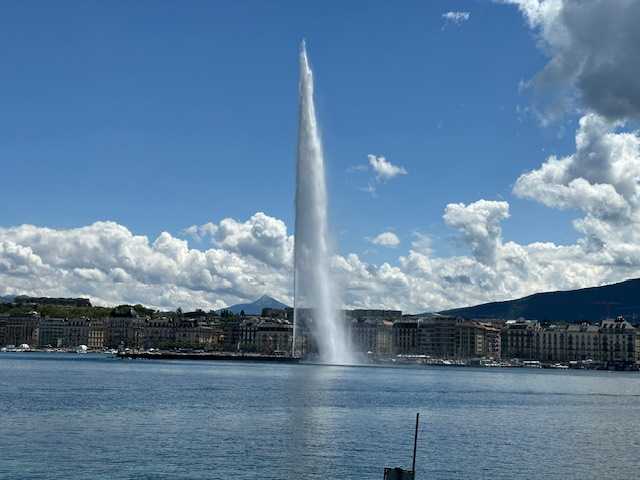
Water Jet Fountain – This famous fountain is the major landmark where Lake Geneva meets the city. Located in the heart of the harbor, the Jet d’Eau is the emblem of the city of Geneva and one of the main tourist attractions. In 1891, the City of Geneva decided to promote the Jet d’Eau as a tourist attraction by installing it at the end of the Eaux-vives pier. It is said to be the world’s tallest fountain and the city’s most impressive sight. The fountain sands on a jetty on the south bank of the lake,
Lake Geneva by boat – We took two different lines across Lake Geneva. There are four “yellow boat” lines that take different routes across the lake. With the free transit card, there was no charge for these short excursions. One route went under a bridge and the other passed right by the Water Jet fountain. Longer cruises were available.
Les Paquis Lighthouse – We walked down the pier to see this historic lighthouse, built in 1857. Along the walkway to the lighthouse, tourists and locals were swimming, sunbathing, eating, or feeding the huge white swans that came up from the water.
Marti Marine – We finished our time at the lake with relaxing drinks, surrounded by the breathtaking landscapes of Lake Geneva, the Jet fountain, and the surrounding snowcapped mountains. Informal options for beautiful outdoor seating are available at several locations along the lake.
Food options:
As with our other destinations in Geneva, we purchased food at Coop and Migros to avoid eating out at high-cost restaurants throughout our three days’ stay. We stopped by once at Starbucks for coffee.
Eat with a local – One of the highlights of our entire Switzerland trip was our seven-course gourmet meal over two and one-half hours with local Chef Anou. The Chef rents out a space called “A Table Chez Anou” at Rue des Pierres-du-Niton 6, close to Lake Geneva. This area is part of Herstreet, an urban space dedicated to women entrepreneurs. We walked in at 6 p.m. to a lovely table setting. The Chef has brought some of her personal furnishings to make the space warm and homey. Two local Swiss residents joined us at dinner. We booked this experience in advance through EatWith.com at a cost of about $110 per person. Chef Anou explained to us how she made her way to Geneva and developed herself as a plant-based chef. With each course, she told us about the ingredients and their health benefits. She was assisted by her chef friend, who had worked at a Michelin star restaurant in Geneva.
The experience was in the nature of a supper club, with great conversation between the Chef and her guests. This experience starts with a glass of bubbly or water and takes you on a journey of food inspired by cuisines from around the world, with a touch of Indian. The tasty meal is focused on seasonal, organic, and fresh ingredients sourced from the local markets and farms! The food is either vegan or vegetarian and organic. The courses included mango, soup, a stuffed mushroom, a dish of seasonal white and green asparagus, a tortilla, a rice-based dish, and a dessert with fruit and chocolate. The menu varies based on the season. It was an exceptional world-class meal and loads of fun. We would highly recommend booking a similar dinner with Chef Anou Boccasam.
In retrospect:
Although travel expert Rick Steves often recommends skipping Geneva, Fern and I really appreciated our three days in the only French-influenced location of our trip. With its French language signage and after listening to French speakers around the city, we felt that Geneva reminded us much more of Paris than of the other three locations we visited in Switzerland.
The hotel shuttle took us to the busy Geneva airport early, which was helpful due to the very long security lines. After our three days in Geneva, we took a non-stop flight home to Washington Dulles, ending our Grand Tour of Switzerland! Our four stop Switzerland trip was one of our favorite trips abroad ever!
 Real Travel Adventures