

By Saul Schwartz
My wife Fern and I spent the second part of our first South American vacation ever in Montevideo, the capital of Uruguay. About half of the population of Uruguay (3.4 million) live in greater Montevideo. Our winter getaway to the South American summer ended with three relaxing days in the capital city.
In mid-January, the weather in Montevideo was extremely pleasant (with highs in the 70s Fahrenheit) and low temperatures in the 60s. Days were sunny, with a strong sun, during a period when our home in the Washington, D.C. area was experiencing snow and cold (with high temperatures in the 30s, low temperatures in the 20s).
Montevideo hugs the Eastern bank of the Rio de la Plata, a huge river that feeds into the Atlantic Ocean. The capital city features a massive coastal promenade, the Rambla, which passes fine beaches, restaurants, and numerous parks.
Lodging:
We were very pleased with our stay at the Hyatt Centric in the charming Pocitos neighborhood. Our hotel choice was based primarily on Hyatt’s ideal location, right across from the Pocitos Beach (Playa Pocitios), on the other side of the street. Located at Rambla Republica del Peru 1479, the hotel is also right on the Montevideo Rambla promenade. Walking out of the hotel, Fern and I had stunning views of the waterfront.
Our contemporary hotel room had a comfortable king bed, a modern bathroom with a rain shower head, a television with English language stations, a city view, and plenty of space. Although the hotel offered three restaurant venues, we only experienced the Moderno Bar, which offered superb outdoor views of the beach and wonderful cool infusion black teas (of several varieties).
Another criterion for our selection of the Hyatt Centric was its extensive gym facility. The gym included weights, cardio equipment, and mats. In the room next to the gym, Fern and I enjoyed relaxing by the indoor pool on comfortable lounge chairs in a sauna-like environment.
Room rates were relatively reasonable. The hotel participates in the World of Hyatt frequent stay program. Members of the hotel staff were fluent in English and answered all our logistical questions about Montevideo.
Airport transportation:
The major international airport (Carrasco International) is about a twenty-minute drive from Pocitos. We arranged transportation in both directions in advance to avoid the hassle of carrying the luggage and waiting for transport in the airport or at the hotel. Both companies that we used provided English speaking drivers who engaged in interesting conversations about Montevideo. The drivers were prompt and courteous.
Our driver from Welcome Pickups (Jose) and our driver through Viatour (Pablo) were assigned in the days prior to the transport. Both companies communicated with us to provide details of our pickup locations and timing. Although the companies required payment prior to the trips by credit card, we added tips in the local currency (pesos) for their fine service.
The airport in Montevideo is very easy to maneuver around. There are eight international gates. Food and drink options are plentiful, including Starbucks.
Airlines:
There is no nonstop service from the three Washington D.C. airports to/or from Montevideo. We arrived in Uruguay after a week in Buenos Aires. We opted for the very short flight (less than one hour) on the national airline of Argentina, Aerolineas Argentinas. The price of the flight was less than the ferry alternative, which takes much longer, even on the high-speed ferry options, which take around three hours. This flight left from Jorge Newberry airport in Buenos Aires, the smaller airport of that city which serves Latin American destinations.
Attractions and Sightseeing Activities:
Playa Pocitos (Pocitos Beach) – Each day we went to the beach. Going to the beach in January was delightful. Although the beach was crowded, Playa Pocitos is a very large beach with plenty of room to spread out. The Hyatt gave us chairs, an umbrella, and towels to use. The sun is very strong, so we used lotion for protection and did not stay long. Due to the constant winds, putting up a beach umbrella is a challenge.
Rambla – The Rambla promenade extends approximately fourteen miles along the shoreline. We walked or jogged daily in both directions. At certain points, the coastline reminded us of California scenery. Residents take advantage of the Rambla to walk, jog, bike, lounge or fish. In the distance, commercial boats are in view. The street name of the Rambla changes about a dozen times.
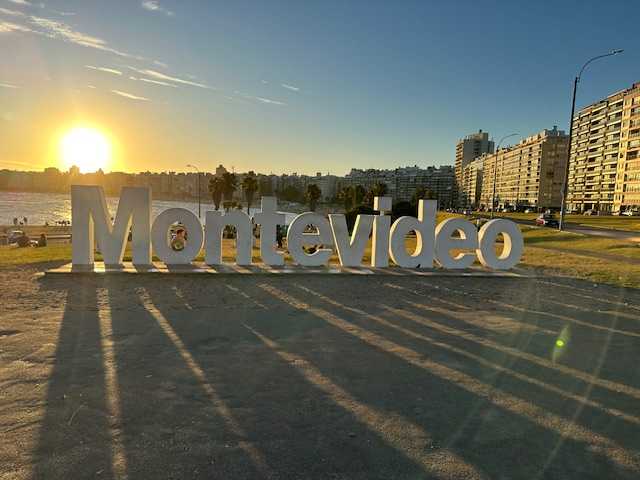
The Montevideo sign: Directly across from the Hyatt is the picture spot for the Montevideo sign. This view beyond the sign is the Pocitos Beach as it curves along the Rambla. Locals come to the sign every evening to picnic and see the colorful sunsets, which took place around 8 p.m. in mid-January. Palm trees provide some shade. There are plenty of benches to sit on and enjoy the sun setting.
Walking tour of Old Montevideo: We booked in advance a two-hour English language walking tour thorough Guru Walks. Our guide (Oscar), although not born in Uruguay, was extremely knowledgeable about Montevideo. He was very engaging and did not hesitate to answer our questions. One other tourist (from Holland) joined us on the guided walk.
The walk began at the fountain next to the Artisans Market in the Old Port Market Square. The Old City is an historic neighborhood about 3.5 miles from the Hyatt. Old Montevideo retains some colonial architecture and narrow cobble stone streets. The Old Port market was established in 1868 and now contains many eateries.
Leaving the market and heading away from the water, Oscar pointed out streets with signs that dated back to 1730 (Calle de la Cruz) and 1778 (Calle de San Pedro). We spent some time viewing the chapel inside the Hospital Maciel, a national historical monument from 1788. The exterior of the chapel has a classical white appearance. The interior is in the process of restoration and is open to the public sporadically. The golden alter is ornate with religious images (including angels and Christ) and candles. The ceiling and floor have colorful geometric patterns.
We spent some time in the shade of several squares. Oscar pointed out a Gaucho monument, a tribute to the cowboys of Uruguay. In the sculpture, the Gaucho is herding animals. Uruguay is a major producer of beef.
We next headed down the major pedestrian street Sarandi, which was full of stores, including an art gallery with a map of the original layout of Montevideo and a sculpture outside the entrance. The street goes on for about one-half mile. It is the major lane of the old city and has been pedestrian since 1992.
Constitution Square is the heart of the old town. This tree lined square is also known as Plaza Matriz.
Arriving at Constitution Square, we went inside the large Cathedral of Montevideo, also known as the Cathedral of the Immaculate Conception. The Cathedral exterior has a distinctive pair of dome-topped bell towers. Both the dome near the alter and sides of the church feature beautiful, colorful stained-glass windows with biblical scenes, and rich marble throughout. The rear of the chapel is the site of a large organ. Oscar advised us that the organ is played during Sunday services. The altar of the Cathedral, in shades of red, brown, and yellow, contains religious figures and candles. The colorful floor tiling has patterned shapes, with colors of blue, yellow, red, and black. The interior contains the tombs of several religious, military, and political figures. The classical exterior does not look like a typical church, with its columns on the white building. The Cathedral is the oldest public building in Montevideo.
On the other side of Constitution Square, the history museum contains several sites that we stopped by briefly. Ascending the stairs, there is a large statue of Artigas, the George Washington of Uruguay. He was the founder of the nineteenth century independence movement for the country.
On the second floor of the museum, one room is the location of the signing of the Constitution of the country. Oscar explained the country’s shield at the front of this room, which includes representations of the scales of justice, the beef industry (i.e., a cow), the gaucho culture (i.e., a horse), and the mountain top which gave Montevideo its name. This room contains elaborate chandeliers above wooden seats. Finally, we went into the courtyard which houses the first fountain of Montevideo, now relocated to the museum. The European style fountain contains whimsical carvings on all four sides.
Our tour ended in the more modern Independence Square, the heart of Montevideo. At one end of the square stands the remaining original city gate, called the Gate of the Citadel. The very large stone gate is in the shape of an arch. The gate is the only remaining wall of the former Spanish fort.
Independence Square includes the Greek/Roman style former Presidential palace, known as Palacia Estevez. One of the most beautiful buildings in the city, it was the seat of government until 1985. The front of this white building contains a series of columns underneath the second-floor windows. Oscar informed us that the President now works in the modern building next to the former Presidential palace. The former Presidential palace is now used for ceremonial purposes.
Independence Square also houses the Solis Theater. This still active theater is within a lovely pink-white stone building. The theater is named for the discoverer of the Rio de la Plata (the river that runs by Montevideo) – Juan Diaz de Solis. The theater dates to 1856.
In the middle of the square, there is a very large statue of Artigas on horseback, weighing thirty tons. This national hero is honored by various statues throughout the city. Underneath the statue accessed through polished marble steps, Oscar informed us that the remains of Artigas are in a mausoleum guarded by the military.
We thought that the most striking building on Independence Square was Palacio Salvo. This building was designed by the same architect as a palace in Buenos Aires called Palacio Barolo. The Palacio Salvo is one of the highest buildings in Montevideo, with its tower and dome. Mario Palanti, the architect, was an Italian immigrant, from Buenos Aires.
Although there are other walking tour options in Montevideo, I would highly recommend booking Oscar through Guru Walk. He explained Montevideo with great passion and insight.
Park Rodo: This large park provides a shady oasis, situated above the Rambla. On a Sunday, we strolled through the park’s market, with numerous stalls of vendors. The offerings included clothing, clocks, mate containers, etc. Weekend open-air markets are a great place for leisurely browsing among the craft stalls.
Highlights of the park included a huge sculpture dedicated to the author and park namesake, Jose Rodo. The park also features several lovely classical fountains, whimsical statues, beautiful trees and flowers, and a small lake. The park is about a ten-to-fifteen-minute drive from Pocitos.
Dining and Food options:
Faina: Our Viatour driver recommended that we try the local flatbread made of chickpeas called Faina. On our first evening Fern and I explored the town area and ate the Faina outside at a small restaurant in Pocitos, as we people watched. To add some flavor, we dipped the flatbread into tomato sauce. The flatbread was also available with several types of cheeses. Although not made with eggs, Faina has a taste like a quiche. This particular restaurant specialized in pizza, which was pretty common in Montevideo.
Disco Fresh Market: It is not easy being a vegan or a vegetarian in Uruguay because of their beef consuption. This market is relatively large. The staff were able to help us find specific items, when needed. Of particular interest to us, Disco Fresh Market has a wonderful salad bar, priced based on weight. The Pocitos store is about a ten-minute walk from the Hyatt hotel. Fern and I made several varied salads from the salad bar to maintain our normal eating habits.
Expresso Pocitos: This sit-down restaurant is about a fifteen-minute walk from the Hyatt. The restaurant has both indoor seating and outdoor seating within a partially enclosed space. The outdoor seating provides enjoyable people-watching. As Uruguay has many immigrants from Italy, the city has quite a few Italian restaurants. When we were in the mood for pasta with red sauce and bread, this restaurant fulfilled our desires. Prices were moderate and the server was attentive. Another plus was that this restaurant is open at the time we normally eat dinner (i.e., between 5 and 7 p.m.). Many restaurants in Montevideo do not begin serving dinner until 9 p.m. or later.
We were a little surprised that Expresso Pocitos was a Fodor’s choice restaurant. While this classic establishment has been around for more than a century, it hardly seems like the local institution we had heard about through Fodor’s. The breadbasket was fresh, but not special. The pasta was tasty, but not amazing.
Yoga and Brunch with Marcela: One of our most enjoyable times in Montevideo was our Airbnb Experience at Marcela’s apartment, near Park Rodo. Booked in advance through Airbnb Experiences, Marcela adopted her brunch to our vegan diets. The personal yoga session lasted about 50 minutes. Then Marcella prepared a bunch which began with a variety of fresh fruits (sliced apples with cinnamon, sliced peaches, and sliced bananas. Next, Marcella served us with crackers from a local bakery, along with a home-made spread made of guacamole and cucumber. Finally, the meal ended with a bowl of quinoa, flavored with onions. Since we are not fans of the local Mate drink Marcella made us tea instead. During the meal, Marcella shared details about her life in Montevideo. We ate on her balcony which overlooks the water. Although we paid in advance, we added a generous tip due to the enjoyment of our two hours spent with Marcella.
Montevideo Shopping Center: From the Hyatt, the Shopping Center is a ten-minute walk. We stopped by Starbucks on our first day in the city. This is one of three shopping centers in Montevideo.
Tips and Advice:
- Getting some Uruguay pesos is helpful for tips and small purchases, where a credit card may not be accepted. We were unable to get Uruguay pesos in advance at the currency exchanges in Washington, D.C. area. Instead, we exchanged $100 U.S. for Uruguay pesos at the Montevideo airport at a currency exchange. There is a fee for the exchange, but the one ATM machine we found at the airport did not have English signage. At the time of our vacation, $1 U.S. equaled about 40 pesos. U.S. dollars are welcomed by many establishments.
- Most stores and restaurants accept Visa credit cards. Hotels accept American Express or Visa credit cards.
- From neighborhood to neighborhood, Uber is readily available and not expensive. We booked these trips through the Uber app on our phones. Although most drivers spoke limited English, we had no difficulty getting around through Uber. In one instance, Uber did not “pick up” the address for our travel, so we took a taxi instead after showing our destination to the driver and requesting an approximate fee in advance. The taxis use a meter system based on distance and time, whereas Uber provides a fixed fee in advance. We paid for all Uber rides through the app using a credit card and then added a cash tip with local pesos, which seemed to be appreciated.
- A thorough current guidebook on Uruguay travel does not seem to exist! Several travel guidebooks on Argentina include a very small section on Montevideo. There are some travel resources on the internet, including a few podcasts and Youtube videos in English. We watched one episode of Anthony Bourdain Parts Unknown from 2018 eating his way through Montevideo and Uruguay. Sites like Trip Advisor highlight top attractions to consider.
- Although the Rambla is in good repair, other sidewalks are in imperfect condition. We constantly looked down to avoid tripping on chippy sidewalks.
- After a hectic week in Buenos Aires, Montevideo gave us a relaxing, “chill” vibe. The city is much more peaceful and calmer than Buenos Aires but has enough activities for an interesting three-day vacation.
- Spanish is clearly the prevalent language spoken. English language signage is limited. Unlike major European capitals, many residents here speak little English.
- An electrical outlet converter is necessary for U.S. residents. Depending on the facility, the converter should have electrical outlet C, F, I or L. It is best to buy a converter with multiple prong options.
- We had no problem accessing the Internet or using our cell phones. With Verizon, we arrange access to our international travel plan prior to our trip.
- Our biggest disappointment was traveling to a recommended restaurant Namaste, which was listed as open on the Internet. When we arrived, we found a sign on the door indicating that the staff was on vacation and the restaurant was closed. In the future, we will call to verify, even if reservations are not needed.
- During January, the time in Montevideo is two hours ahead of U.S. Eastern Time (i.e., Uruguay Standard Time).
We returned home on Copa Airlines, with a layover in Panama City, Panama. Unfortunately, Copa did not allow us to select a vegan or vegetarian meal on either flight. Looking back, we were so glad to spend three calm days in Montevideo after a busy week in bustling Buenos Aires. I believe the two cities combine to make a great South American vacation. A day trip from Buenos Aires would have been too short to experience Montevideo. Three days seemed just right.
 Real Travel Adventures