

By Saul Schwartz
This was our first trip to South America. We flew into Ministro Pistarini International Airport, the country’s largest international airport in Buenos Aires.
Airport Transportation – We were very satisfied with Welcome Pickups, an airport transportation service which we booked on-line in advance. Our English language driver, Martin, met us inside the airport, holding a sign up for us. On the ride, Martin gave us useful information about Buenos Aires. Although the company required credit card payment prior to the trips, we added tips in the local currency (pesos) for the fine service. At the end of our week stay, we used Welcome Pickups to take us to Jorge Newbery International Airport, the smaller airport in Buenos Aires, which services Latin America.
Lodging – Located at Reconquista 945, The DoubleTree by Hilton Buenos Aires hotel has a very nice gym and indoor pool area, which includes a whirlpool. The gym has cardio equipment, weights, mats, and machines. The daily breakfast was very extensive, including our favorites (granola and oatmeal), along with non-dairy milk options and fruits. The upgraded king guest room was large. The hotel website lists the hotel location as Microcenter, but the neighborhood of the hotel is closer to Retiro. This hotel is conveniently located to many central attractions.
Getting Around Buenos Aires:
Within neighborhoods, we were able to walk around. To get from neighborhood to neighborhood, we took one of the city’s numerous and inexpensive Ubers. The advantage of using the Uber app is that we knew the price in advance (in pesos), when the Uber would arrive, and how long the ride would take. Although not required, we added a tip in cash in pesos. None of the Uber drivers were fluent in English.
Attractions and Sightseeing Activities –
Day One (Centro Buenos Aires):
Place of Congress (Palacio del Congreso) – The distinctive green domed building was modeled after the Capitol Building in Washington, D.C. The dome rises eighty meters above the ground and weighs thirty tons! The exterior includes a monumental Italian carved sculpture.
We attended an excellent English language one-hour tour. The tour entrance is located at the security window. No reservations are needed. Since the web site did not specify the exact time of the tours on weekdays, we simply went up to the entrance and asked about the next English language tour.
Highlights of the tour included the pink room where until 1951 women met to discuss politics, and their notes were then passed onto male deputies. Pink is the predominant color of the walls, tapestries, and upholstery. The room includes a bust of Evita, a glass case containing her shroud, and a vibrant multi-colored painting of Evita.
Fern and I were also able to view both chambers of Congress – the Senate Chamber (with its representatives for each province) and the Chamber of Deputies (which is based on population like the U.S. House of Representatives).
We also spent some time in the Lost Steps room. This anteroom contains stained glass ceilings showing allegorical figures representing justice, agriculture, science, art, and commerce. Our guide described the large oil paintings in this room. Our tour ended in the Blue Hall, with its majestic bronze chandelier located underneath the interior of the dome. Blue is the color of the carpet, velvet curtains, and velvet upholstery.
Walking Tour (Central Buenos Aires) – We began our walking tour at the Congress Monument. We booked this ninety-minute tour in advance through Guru Walk. Our guide Simon began by explaining how the statutes erected in 1907, on either side of the steps in front of the Palace of Congress caused a scandal with their nudity. The large Congress Monument honors the Congressional assembly of 1813 and the 1816, when independence for Argentina was declared.
We next walked by one of the copies of “The Thinker” made by French sculptor Auguste Rodin from his original mold in the early 1880s. Due to vandalism in 2011, this masterpiece now sits inside fencing for protection.
Our next stop was at the Palacio Barolo, one of Buenos Aires’ most beautiful buildings. Simon explained how its twenty-two-story design was inspired by Dante’s Devine Comedy. Completed in 1923, when designed by the architect Mario Palanti, the building was then the city’s tallest.
Our next challenge was to successfully cross the Avenue of the Ninth of July. Hailed as the world’s widest avenue, this sixteen-lane wide landmark is named after Argentina’s Independence Day. It takes at least two traffic cycles to cross.
Our last stop was at the Plaza de Mayo, the symbolic center of the city. Founded in 1580, this square has been the site of many dramatic events in Argentine history. The square is named after the uprising against Spanish colonial rule in May 1810.
Nearby the plaza we could see the white Obelisk, which looks like a smaller version of the Washington monument. One of the city’s landmarks, this needle-like structure was erected in 1936 on the four hundredth anniversary of the Spanish settlement of Buenos Aires.
The most famous building on the Plaza de Mayo is the pink house, Casa Rosada, named for its distinctive color. Unfortunately, the pink house has not been open for tours since the pandemic. From the balcony of Casa Rosada, Juan and Eva Peron gave impassioned speeches to throngs of supporters. The palace houses the Argentine President’s offices and the executive branch of the government, but it is not the President’s residence.
We ended our tour after entering the Metropolitan Cathedral. This 1827 cathedral is a mix of several architectural styles, but its exterior certainly is atypical with its neoclassical columns. Once inside, I asked Simon to point out the section which contains a homage to the Jewish community of Buenos Aires. This mural (installed in 1997) is dedicated to the victims of the Holocaust, the attacks against the Embassy of Israel in 1992, and the bombing of the Argentine Israelite Mutual Association (AIMA).
The cathedral, finished in 1827, is free to enter. The spacious interior is impressive, with its large organ, baroque details, and elegant rococo altar. Our tour guide pointed out the mausoleum of General Jose de San Martin, an Argentine hero who led the country to independence. The General’s remains are permanently guarded by an elite troop of soldiers. At 5 p.m., we saw the soldiers change guards as one shift arrived, and another left the cathedral. The cathedral was the spiritual home of Pope Francis before he became Pope in 2013.
Day Two (Recolota and Palmero):
El Ateneo Grand Splendid – One of the world’s most beautiful bookstores is located in Recolota, and is housed in a former theater. We spent about one hour browsing some of the 120,000 books, including a small English language section. The theater opened in 1919, and it became a bookstore in 2000. Many of the theater’s original features have been preserved, including theater boxes, two balconies, the dome with its Italian frescoes, and the painted cupola. The stage is now a small café and bar.
We then took an Uber to the Palmero neighborhood where we ate lunch in the Botanical Gardens. The gardens are a relaxing oasis within Palmero.
Botanical Gardens (Jardin Botanico Carlos Thays) – We walked through the triangle-shaped gardens. They feature a wide range of plants and trees, many of which are native to Argentina. There is no fee to enter the gardens. The grounds contain a large collection of Roman style sculptures. The lush, well-kept gardens were designed by landscape architect Carlos Thays.
We walked from the Botanical Gardens to the Evita Museum, also in Palmero.
Evita Museum – The museum opened fifty years after the death of Eva Peron, in 2002. The museum is housed in a mansion constructed by a wealthy family during the first decade of the twentieth century. The building was declared a national historical monument in 1999. The interior retains lovely features of the mansion, including blue tiled walls.
This museum tells visitors the story of Eva Perón’s life through photographs, videos, and contemporary documents. The museum’s collection includes beautiful dresses, objects and mementos that belonged to Evita. The small admission price (1500 pesos) is well worth it! English language signage is very good. The museum has a nice café with indoor and outdoor seating.
Next, we took an Uber back to Recoleta for our tour of the La Recoleta Cemetery, the city of the dead. The cemetery is one of the city’s top sights and, therefore, is crowded. Created in 1822, it covers about four city blocks and contains about 6400 “residents.”
Recoleta Cemetery – We booked our tour through Get Your Guide. We paid for the two-hour English language walking tour in advance, and, in addition we had to buy the entry tickets (16100 pesos per adult).
The most famous Argentineans, including Evita and her family, are buried at this elaborate cemetery. Here mausoleums and vaulted tombs include amazing designs, such as chapels, marble angels, gargoyles, flamboyant statues, pyramids, and Greek temples. Our guide told excellent stories about the inhabitants as we wandered through the maze of narrow lanes and ostentatious, exclusive final resting places.
We first spent some time visiting the final resting place of several Presidents of Argentina. Although the most visited tomb may be that of Evita, it is not impressive. Our tour guide explained that after seventeen years of posthumous wandering, her remains found their way to the Duarte family vault. At the bottom of the vault, a black plaque identifies Evita. Residents place fresh flowers on the black gates of the vault.
We then briefly wandered through the open-air market outside the cemetery gates. The weekend market offers crafts, food, and souvenirs. Also, outside the gates, we watched two impromptu tango dancers.
Our Lady of the Pilar Parish – A glistening white colonial church overlooks the square next to the cemetery. Entrance is free. The church was inaugurated in 1732 by friars. The centerpiece of the interior is the baroque-style altars, with the central altar adorned with Peruvian silver.
Day Three (San Telmo):
San Telmo has an artsy, bohemian vibe.
Walking Tour – San Telmo: In advance, we booked a two-hour English language walking tour of the San Telmo neighborhood and market through Buenos Aires Walks. Our tour began at the San Ignacio Church, the oldest church preserved in Buenos Aires.
We intentionally booked the tour for Sunday, the day when San Temo comes alive and thrives with its street fair. As a result, the tour and the neighborhood were crowded. We learned that the neighborhood’s nineteenth century heyday ended when diseases sent the aristocratic class to higher ground in the northern neighborhoods.
Fern and I particularly enjoyed San Telmo’s comic strip walk, the open-air sculptures dedicated to Argentine comic strip characters. The most famous Argentine comic book character is Mafalda, whose picture appears throughout the city!
At the edge of San Telmo, we walked by a large bronze monument dedicated to the workers of Buenos Aires. The gorgeous Roger Yrurtia sculpture is called Song of Work. Commissioned in 1905, it shows a diverse swath of people pulling a massive stone along the ground — fourteen children, women, and men of Argentina bound together in hard labor.
Across from the sculpture, we admired the neoclassical building which now houses the engineering school of the University of Buenos Aires. The exterior features Greek-style columns. This building was originally constructed in 1951 for the Eva Perón foundation.
The walking tour ended at the large historic San Telmo market. Our guide joked that the market was an ideal place for vegans, who have not eaten for three days, to find a meal! We ate at the Coffee Town bar tables inside the market. Coffee Town features coffee and teas from around the world.
Created in 1897, San Telmo the market was designed by the same Italian born Argentine architect as the Recoleta Cemetery – Juan Antonio Buschiazzo. The market occupies one city block. Its wrought-iron interior and beautiful ceiling add to the atmosphere. Stalls include colorful produce, fruit, and vegetables.
We then walked through the Sunday fair, which features antiques and collectables. The market is centered at Plaza Dorrego, the city’s second oldest square, but it extends for quite a few blocks. Several stalls offered handicrafts and local artists’ works. We snagged an outdoor table under an umbrella to have drinks and people-watch near the plaza.
Museum of Modern Art – This museum is housed in a large former tobacco warehouse. The exterior retains its original exposed brick. We spent about one hour in the multi-story building viewing the works of mostly Argentine contemporary artists. The museum also has a small café and gift shop. Admission costs 10,000 pesos per adult. There is some English signage.
Local cooking experience – We ended our day in San Telmo with a small group cooking experience booked through Airbnb Experiences. We met at 5 p.m. at Tomas and Laura’s house in San Telmo. The evening began with a demonstration and taste of heated yerba mate, the local drink of Argentina. Mate is a strong tea-like drink. Mate is served in a gourd and drunk through a straw.
Next, Tomas and Laura taught us to make vegan empanadas. We cut up our vegetables (onions, green pepper, zucchini, and tomatoes) before rolling out the dough. The vegetables were stuffed into the empanadas, cooked, and eaten! They were very tasty. Then we made a dessert item called alfajor. Our vegan version of the filled pastries was fun to make.
Day Four (Day Trip to Tigre):
We booked our six-hour trip in advance through Viator. Our English-language guide provided us with information on the Tigre area while we were driven about one-hour. Tigre is about 22 miles northwest of Buenos Aires. Tigre is one of the world’s largest river deltas.
First, we went on a short walking tour of Tigre with its twentieth century buildings. We began at what is now the Tigre sign and the Tigre Museum, right on the Lujan River. The Tigre Museum is housed in an ornate building, built in 1909 to house the Tigre social club and casino. The museum is surrounded by a flower-filled park with sculptures.
We stopped by the Tigre sculpture. Our guide explained that the area was named after the jaguars (tigers) that were hunted there on occasion.
We enjoyed our one-hour narrated boat ride through this picturesque area of rivers, canals, and close packed islands. The heavy vegetation makes the waterway network feel tropical. Residents must use boats to get their provisions, food and supplies. We floated by some chic houses on stilts and manicured gardens. Our two-story catamaran gave us the choice of an air-conditioned first-level or an open-air second level with better views.
Tigre is the rowing capital of Argentina. While in Tigre, we saw many of the historic rowing clubs. The multitude of rowing clubs resulted from each immigrant community (Germans, Italians, Swiss, English, Scandinavians, French, Jewish) originally establishing its own club.
We ate a quick lunch at the famous market, Puerto de Frutos. There are many stalls selling furniture, wicker baskets, handicrafts, and souvenirs.
Day Five (Jewish Buenos Aires):
In advance, we booked a tour of the Jewish sites of Buenos Aires through Viator. BA has the largest concentration of Jews in South America, with a population of about 230,000.
We first looked at the three murals on the Hospital de Clinicas which were painted to commemorate the twenty-fifth anniversary of the AIMA terrorist attack in 1994. The attack has yet to be solved. The murals represent the doctors and nurses who saved many bombing victims, the rescue of people from the rubble, and the demand for justice.
Next, we walked over the AMIA building. The Asociación Mutual Israelita Argentina is a Jewish Community Center. On the front of the building there is a list of the names of the 85 victims of the July 18, 1994, attack. A mural called Wall of Memory is painted on the side of the AMIA building. The mural is that of a staircase painted on two columns of the building that survived the explosion, along with photos of the victims.
We then visited the Jewish neighborhood of Once. This area reminded us of the Lower East Side of New York Citty with its Jewish stores, kosher restaurants, bakeries, and supermarkets. We snacked on warm potato knishes, fresh from the oven at Helueni, a small Middle Eastern eatery.
We then looked down at the sidewalks in Once, which contain blocks with the names of some of the roughly 2000 Jews who were “displaced” during the Argentine dictatorships of the mid-1970s.
We passed by the exterior of the Great Paso Synagogue. This imposing European-style structure is one of the oldest conservative synagogues in BA. The building dates to 1930. The small congregation still holds services.
Our group then entered the Buenos Aires subway at the Pasteur-AMIA stop to see more memorials to the 1994 bombing. There is a list of the 85 victims and a typewriter from the building, which shows extensive damage. A large clock (called a memory station) is stopped at the exact time of the bombing – 9:53 a.m. on July 18, 1994. There is a cartoon painted on the walls in homage to the attack.
We boarded the crowded subway for our last destination. Templo Libertad was inaugurated in 1875 in the Byzantine style. It was the first synagogue in Buenos Aires. Unfortunately, we were not able to go inside the temple and its museum because we did not have our passports with us. The Liberty Temple still has religious services inside.
Near the temple, in Plaza Lavalle, there is yet another memorial to the AMIA bombing. In addition, there is a replica of the Ten Commandments on top of the Supreme Court building across the park.
Day Six (La Boca Neighborhood):
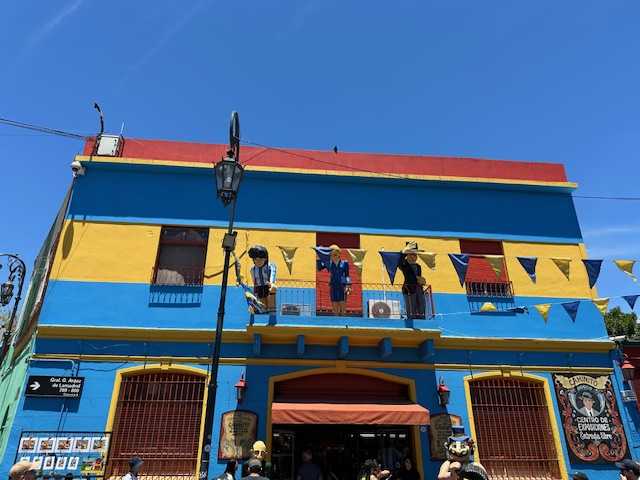
We booked the tour in advance through Get Your Guide. We met our guide at the corner of Caminito and Magallanes Streets. Various paintings and sculptures are attached to the buildings. Above the entrance of the Cachafaz shop, a replica of the famous football (soccer) legend Diego Maradona hoists the World Cup. Down that street, replicas of Juan Peron and Evita look down over another shop.
Caminito Street is full of brightly colored buildings often seen on postcards of Buenos Aires. The many varied colors of paint were used by residents for their houses. They purchased leftover paints from the nearby shipyard docks. We walked down this pedestrian cobblestone street, which is essentially an open-air museum. The walls contain bas-reliefs, tiled artworks, and sculptures.
We spent some time at the mouth of the river, where our guide explained how the La Boca of today was created in 1959 through the initiative of local artist Benito Martin who wanted to preserve the essence of the neighborhood. We then walked through one of La Boca’s historic multi-level colorful tenement houses. Where hundreds of workers once lived, there are now small shops.
Our tour ended at the large blue and yellow Boca Juniors football (soccer) stadium called La Bambonera. Throughout La Boca, there are blue and yellow banners for the legendary Boca Juniors club, including decorated cars for both this team and its rival team, River Plate. We walked by the colorful Republic of La Boca mural, a blue and white homage to the Boca Juniors and the mythical La Boca republic.
Day Seven (Palermo):
Through Viator, we booked in advance a two-hour private walking tour of nature in the Palermo Woods, located within the Palermo neighborhood’s Parque Tres de Febrero, one of the most popular parks in the city. We first walked through a pretty garden that boasts a collection of more than 18,000 roses surrounded by a lake and acres of parkland. This park also features a Greek-influenced bridge, an amphitheater, an Andalusian patio, fountains, and a poets’ garden with 26 busts of famous writers.
Next, we walked by the large Monument to the Spaniards. The monument was a donation by the Spanish community in celebration of the centenary of the Revolución de Mayo of 1810. At its top is a symbolic statue of the republic, with allegoric marble representations of labor and work at its base, and bronze figures that represent four regions of Argentina.
We finished our tour at the Eco Park, formerly a zoo. In 2016, the Buenos Aires city government took the decision to close the 140-year-old Buenos Aires Zoo. The new park houses several older animals in need of medical care, from the former zoo. To better protect the wildlife within the park, it opens for limited hours and permits a maximum of 2,000 visitors each day. Several animals roam freely, including many brown and white rabbit-like Patagonian hares.
Dining and Food Options:
Chui – Our favorite meal was our lunch at the vegan and vegetarian Michelin guide restaurant Chui, in the Villa Crespo neighborhood. We started with a mushroom pate spread on wood fired oven baked sourdough bread. Our vegan pizza was spectacular, with sweet potatoes, pickled oyster mushrooms, cashew, and basil pesto. Prices were moderate and the service was exceptional. Although at first the restaurant looks like an industrial style warehouse, looking closely we saw that it contains a cabinet for growing mushrooms, another to store preserves and pickles, plus a clay oven, and a pizza oven in the huge open kitchen.
Brioche Doree – There are several locations of this French chain. We were able to find tasty pre-made salads at reasonable prices. We ate twice at the location within the Gallerias Pacifico shopping mall.
The posh Gallerias Pacifico mall is located within a Beaux-Arts building built in 1889. Inspired by the Vittorio Emmanuelle II galleries in Milan, the mall is a covered passage with many shops. The large central dome is embellished with painted murals.
Green and Company – There are several locations of this chain in Buenos Aires. We were able to make salads from an extensive salad bar. We ate twice at the location within the Gallerias Pacifico shopping mall.
Azorin – Within the Doubletree Hotel, we had a nice dinner, featuring fish (trout) and side dishes. The prices were moderate, and the service was very good.
Café Manon – The drinks were good, and the prices were moderate at this San Telmo Cafe. The staff were very friendly. The café is nicely decorated with art. This was a nice break from the crowded San Telmo fair.
Café Tortoni – Fern and I went twice to the oldest and most famous café in BA. The café is centrally located at Avenue de Mayo 825. Fern and I had to briefly wait outside to get into the popular café. We had a tasty carrot cake and fabulous drinks. The decorations are incredible!
Markets/grocery stores – In central BA, the markets are rather small, with limited options. We were able to get snack type items and drinks, but not meals. There are many locations of several chains. The Abraham supermarket was better than most.
Tips and Advice – Most guidebooks are outdated, but Lonely Planet Buenos Aires and Fodor’s Essential Argentina provided us with some basic ideas for must see attractions to visit and neighborhood information. My online free subscription to Wander Argentina was helpful for more current advice and articles of interest. We watched the Somebody feed Phil episode where Phil eats his way through BA. Fern and I also listed to several podcasts about Argentina. The Visit a City app and the My Tours City app gave us some current useful information.
It is helpful to have some Argentine pesos for tips and shops where credit cards were not accepted. Due to the super high ATM fees and the fluctuating currency rate, it is best to exchange U.S. dollars in advance through a currency exchange.
Most stores accept Visa credit cards. Hotels also accept American Express.
From neighborhood to neighborhood, Uber is readily available and not expensive. Most drivers spoke limited English. Uber provides a fixed fee in advance. We paid for all Uber rides through the app using a credit card and then added a cash tip with local pesos, which seemed to be appreciated.
Sidewalks are in terrible condition, with holes. We constantly looked down to avoid falling!
Spanish is clearly the prevalent language spoken. English language signage is limited. Unlike major European capitals, many residents here speak little English.
An electrical outlet converter is necessary for U.S. residents. Depending on the facility, the converter should have electrical outlet C, F, I or L. It is best to buy a converter with multiple prong options.
We had no problem accessing the Internet or using our cell phones. With Verizon, we arranged access to our international travel plan prior to our trip.
During January, the time in BA is two hours ahead of U.S. Eastern Time and the weather is warm (around eighty degrees Fahrenheit). Sun hats are essential, as well as hydration on hot days. Six or seven days is plenty of time to see the varied attractions
 Real Travel Adventures