

By Saul Schwartz
Second time in Paris, Fern and I sought a different experience from almost ten years ago, when we saw major sites during a romantic and magical trip. This time, we wanted a more relaxed and authentic Parisian experience.
Getting to Paris: Fortunately, we had a non-stop flight from Washington Dulles to Charles de Gaulle airport. After eating our first baguette in the airport, Fern and I took the REPR B express train from the airport terminal to the Gare du Nord train station in central Paris. From the train station, we took a short Metro ride to our hotel at the Republique station. Our challenge in travel with luggage was the lack of escalators and elevators on the Metro. The trip from airport to hotel took about one hour.
Lodging: We spent six nights at the Crowne Plaza, 10 Place de la Republique, near the Marais district. This elegant hotel is nestled within a historic building, constructed in 1866, with its own courtyard. We chose the Crowne Plaza because it is steps away from five Metro lines and a very short walk to the heart of the Marais district. The fitness center has a nice selection of cardio equipment and weights. The staff were friendly and very willing to answer questions. Our room, facing the courtyard, was comfortable and spacious, by European standards. The hotel faces noisy Republique Square, but our room was quiet.
Day One: In advance, we signed up for a tour of the National Assembly (Parliament) of France at 6:40 p.m. We thought this evening tour would allow us to adjust to the time change. Fern and I took Metro to the 7th district and exited at the Assemblee National Station. During the short walk, our map showed that we were passing the Paris apartment of Julia Child. Although we checked out the apartment building, there was no signage indicating that the famous chef and author had lived there.
The National Assembly is housed within Palace Bourbon. Finished in 1728, the palace was originally built for Louise de Bourbon, daughter of King Louis XIV. The front of the building has a series of Corinthian columns, along with the French flag and a large clock. Although we had signed up for an English language tour on the National Assembly website, Fern and I were informed that the tours were in French. We were provided with a link which gave us limited information in English on the rooms of the tour. We were able to view several beautifully decorated salons with painted ceilings, impressive chandeliers and colorful rugs. The huge library with about 700,000 volumes has five magnificent painted ceiling domes on its high ceiling, painted by Romantic painter Eugene Delacroix. The Palace was designed like Versailles, with one room having a long hallway like the Versailles Hall of mirrors. The courtyard features rotating temporary sculptures.
Prior to the tour, we walked into the Marais. We had a light dinner at Sacha Finkelsztajn, a Yiddish kosher bakery, deli, and prepared foods eatery. Although there is limited seating, we really enjoyed chatting with the shop’s employees. It is hard to miss the shop with its bright yellow exterior! Founded in 1946, this deli is still owned by the third generation of the family. Fern and I really enjoyed the potato knish, the vegetarian sandwich (made to order), and the fabulous poppyseed pastries. The address is 27 Rue de Rosiers.
Day Two: We spent an entire day in the charming Marais (districts 3 and 4). Our goal for this day was to walk around this neighborhood, with its winding streets lined with historic medieval architecture. No metro rides on this day.
In the morning, Fern and I went on a two-hour walking tour of the Jewish Marais. We booked the tour in advance through Viator. Our meeting point was the Saint Paul Metro. Although our guide was not Jewish, he thoroughly explained the Marais’ long and rich Jewish heritage.
We stopped by a magnificent Art Nouveau building with a strking façade: the Agoudas Hakehilos synagogue. The building was inaugurated in 1914 and later classified as a historical monument. This synagogue was the last place of worship built in the Marais district. It is located at 10 rue Pavée. Our guide explained that the public cannot enter.
Then we did enter a Chabad synagogue within a building in the center of the Marais. The Orthodox seating had separate areas for men and women. We were able to chat with the Rabbi, peek in the outside Sukkah, and watch the congregation leaders get ready for the evening Shabbat services.
Our guide then pointed out the memorial on Rue Des Rosiers where a terrorist attack took place on what was then a kosher Jewish restaurant (called Goldberg) and led to the death of six victims in August 1982. Early this year, a suspect was arrested. We also walked by a commemorative plaque of the Zadjner family, of Polish origin, who lived in Paris. The family was caught in a German raid during the occupation of Paris in World War II. The father and three sons died in deportation in 1944. The surviving daughter, Sarah, had the plaque installed. The sons were subject to horrible Nazi experimentations.
In addition to the Jewish sites, our tour guide led us by several attractions of the Marais. The most significant was the Place des Vosges, the oldest planned square in Paris. Built in 1605, this elegant square feature burbling fountains, grassy lawns, and chestnut trees, all hemmed in by brick-red arcades of the surrounding pavilions.
As part of our lunch, we purchased our excellent baguette for the day at Murciano Patisserie-Boulangerie, located at 14 Rue de Rosiers. This elegant kosher bakery also sells traditional Jewish pastries. We learned that baguette prices are technically not set by the government, but are uniformly very low in Paris, averaging only one Euro.
We spent several hours in the afternoon at the Picasso Museum, which features about 400 of his works and is the world’s largest Picasso collection. The three-floor museum is located at 5 Rue de Thorigny in the Hotel Sale, a beautiful seventeenth-century private mansion. The audio guide was helpful. Although we did not buy tickets in advance, the museum was not very crowded. This was Picasso family collection of his artworks.
For a midday break, we sat outside and had drinks at the Café Republique, which faces busy Republique Square, on the edge of the Marais. The historic café is located at 9 Republique Square. Our fellow patrons and staff were friendly. The café faces the 25-meter-high bronze Monument de la Republique. The monument is a personification of the French republic in the form of Marianne.
We ended the day with dinner at the Marais home of Karyn Bauer. Fern and I had arranged this dinner in advance through the Eat With website. Karyn’s bohemian apartment was furnished with the amazing artwork of her partner, Cris, as well as antiques. Cris’s art lined the walls, floor, and ceiling! Karyn cooked an exceptionally tasty four-course vegan dinner for us. We were joined by four other guests, Karyn and Cris, for a great dinner conversation.
Day Three: We took the Metro to Concorde in the first district and walked to Museum de L’Orangerie. With advanced purchase tickets, Fern and I avoided the long line. The highlight of the museum is Monet’s large Water Lilies series of eight large paintings, set out in two galleries. Although the museum was much more crowded than when we visited it ten years ago, these Impressionist works, set in naturally lit rooms, are truly amazing. We had an informal lunch in the museum café.
Walking to the Museum L’Orangerie, we had our first view of this trip of the Eiffel Tower, the Tuileries gardens, and the Seine River.
For the afternoon, in advance of our trip we had booked a tour (through Get Your Guide) of the Sainte Chapelle Church and the Conciergerie. We met our Walks in Europe guide at 3 Boulevard du Palais. She provided us with valuable information and stories.
Saint Chapelle is a thirteenth century gothic chapel right in the center of Paris on the Ile de la Cite (Island of the City), located between the banks of the Seine. Located at 10 Boulevard du Palais, the advanced booking allowed us to skip the very long lines to get into one of the official monuments of Paris. This cathedral was built for King Louis IX. Its functional exterior features buttresses holding up the stone roof and a lacy spire. The interior is jam packed with amazing, colorful stained-glass windows of biblical scenes on two levels. Our guide explained that Saint Chapelle was a royal chapel for the kings.
Next, we toured the Conciergerie, a UNESCO world heritage site. This huge medieval building housed the French revolutionary tribunal and prison. We spent some time within the cell where Marie-Antionette spent her final days in 1793 awaiting her fate at the guillotine. This cell has been transformed into a memorial chapel, with a stained-glass window, a small religious chapel, and a memorial plaque.
Returning to the Marais, we had a nice pasta dinner at Piccola Mia, located on Republique Square. We enjoyed the pasta with red sauce, bread, and drinks on the indoor terrace which gave us a full view of the lively square from bay windows. The menu features a large selection of Italian dishes at reasonable prices. Patrons appeared to be more local than tourists. Staff were friendly and the dinner was leisurely. Then for dessert, we headed over to Brocco Boulangerie, located at 180 Rue de Temple, for decadent chocolate eclairs!
Day Four: We took the Metro to the Eight District to go to the top of the Arc de Triomphe. We did not buy tickets in advance, but the line was short. After climbing 284 steps to the observation deck, Fern and I had great views of the Eiffel Tower, the boulevards jutting out from the arch below, and the skyline of the surrounding neighborhoods. At the base of the Arc, there is the Tomb of the Unknown Solider from World War One with an eternal flame. Inside the Arc, there is a short video explaining the history of the Arc from the time it was commissioned by Napoleon in 1805 through key Parisian events that took place at the arch.
We briefly walked down the Champs de Elysee, the grand boulevard of the right bank. Returning to Marais, we enjoyed an afternoon coffee break at Marais Home Coffee. Located at 41 Boulevard du Temple on Republique Square, this coffee shop was a cozy, bright, and vibrant stop for specialty coffees and teas.
In the evening, Fern and I got dressed up and took the Metro to the eighteenth district to Moulin Rouge. We had booked this sold-out historic spectacle in advance. The theater interior is decorated in a bohemian style, looking like a painting by Toulouse Lautrec in rich reds, deep blacks, and shimmering golds. The elegant three-course vegan dinner, with champagne, exceeded our expectations. During dinner, a small live band performed a wide range of melodies with two singers (in English and French). Then Fern and I watched the fast-paced cabaret show, called the Feerie review. The show features amazing acrobatics, elaborate costumes, and high-energy dancing. It is truly a one-time experience.
Day Five: For our day trip to Giverny, we booked tickets in advance for both Monet’s gardens (on the Foundation Claude Monet website) and the train to Vernon/Giverny (on the SNCF website), both with specific times. Fern and I took the Metro to the Gare Saint Lazare train station for the one-hour ride. Once we arrived in Vernon, we took a ten-minute narrated shuttle bus to the tiny village of Giverny.
Before touring, we had an informal lunch at Gourmandises De Giverny, located on 62 Rue Claude Monet, in the cute town. The staff prepared made-to-order salads for us in the small, charming restaurant. Fern and I briefly strolled through the picturesque village that inspired Monet, with its cafes and art studios. We stopped by the Monet family’s final resting place; a tomb planted with flowers at the church of Giverny.
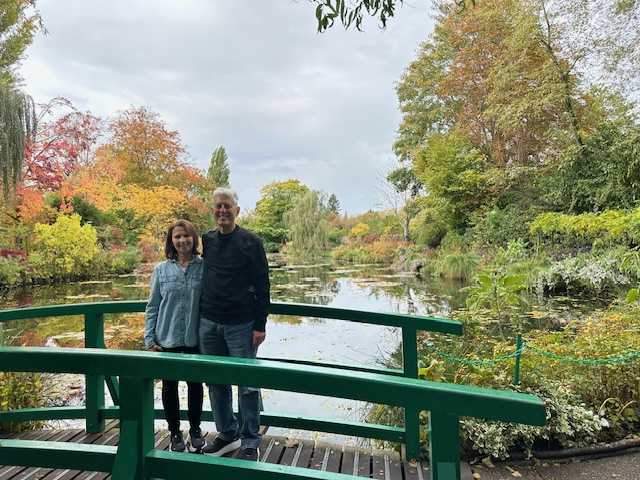
In October, Monet’s gardens are particularly colorful, with the flowers and leaves. There are two parts of the extensive gardens. The water lilies ponds are just like the Monet paintings, with the Japanese bridge and weeping willows. The walled flower gardens in front of the house are just as colorful, filled with trellises of flowers. Inside the pink house, we viewed reproductions of the artist’s studios and paintings. We had scheduled our trip to Paris for October because the gardens close for the year on October 31. Just sitting in the gardens on benches, as we viewed the water lilies ponds, was a highlight of our trip.
Before boarding our train back to Paris, we took a midday coffee and tea break in Vernon at the Le Café de France. The café was filled with locals enjoying a midday drink and chatting.
Day Six: We spent our final full day of the trip with our friends from Cameron Station in Alexandria, Virginia, who live part of the year in Paris. We walked over the Seine on the oldest bridge in Paris, the Pont Neuf, built around 1600.
Samaritaine is a very large department store in the first district. The four of us peaked inside to view the luxury brands, the large glass roof, and the blend of Art Deco and Art Nouveau architecture that extends over a long block.
For much of the day, we wandered through the fifth district and the Left bank neighborhoods. Lunch at La Boissonnerie, on 69 Rue de Seine, was an elegant meal in an intimate bistro.
In the afternoon in the sixth district, we all relaxed on benches in the colorful Luxembourg gardens, within radiant flower beds by the octagonal Grand Basin where children sailed toy boats. The garden is filled with sculptures. The striking monumental seventeenth century Medici fountain was built in 1630 by the widow of King Henry IV, Marie de Medici.
Our friends guided us inside the impressive neoclassical Saint Sulpice Church. The lovely interior of this Catholic church is filled with stained-glass windows, a dome decorated with frescoes, and a famous organ. The second largest church in Paris also contains a marble obelisk which is a meridian line used to calculate the sun’s position throughout the year.
In the mid-afternoon, we stopped for coffee/tea drinks and a dessert at Secco bakery, located at 12 Rue de Mobillon. The chocolate eclairs were very yummy.
Our last stop was visiting the Abbey of Saint Germain des Pres, the oldest existing church in Paris. The exterior features a bell tower built around 990. The brightly colored interior includes a series of lovely biblical frescoes and many stained-glass windows.
Day Seven: As we left Paris on a train to Basel, Switzerland, we reflected on some final thoughts:
Comfortable walking shoes are a must to navigate the cobblestone streets of the Marais.
It is a much more Parisian experience staying in a neighborhood like the Marais, rather than by the tourist Eiffel Tower. This time we did not feel so much like tourists.
Even with two trips to Paris, there are many more attractions to see and experiences to have. We would not hesitate to return!
Rick Steves’ Paris guidebook and his extensive audio guides were very helpful in our planning. The Visit A City app also has current information.
With the Bonjour App, it is now much easier to navigate the 16 Metro lines. The App provides detailed information on the line to take, the length of the trip, where to switch lines, etc. We also referred to the maps within the metro.
Ten years since our first trip to Paris, the locals seemed much more welcoming in 2025.
The Visa credit card is widely accepted, but we did take out Euros at the airport ATM for tips and small purchases. The ATM fee was atypically high.
The October weather was pleasant, with some sun, some clouds, and a little rain – most days. The temperature ranged from around 45 degrees to 65 degrees Fahrenheit.
One day trip during our week in Paris was a nice diversion from the city.
English seems more prevalent in Paris now than ten years ago. Locals did appreciate when we spoke limited French phrases to them.
 Real Travel Adventures