

I am always baffled when people call me brave for travelling alone, for at heart I know I’m a coward. My fear flared up in full force that morning, as I stood in the two-room airport, just outside of Galway, waiting for the fog to lift. Before me on the tarmac, a ten-seater plane shaped like a chubby Tonka toy crouched in readiness, and I found myself debating (once again) the relative merits of death by sea and death by air.
My destination that day was Inishmore, the largest of the three Aran Islands which lie about 30 miles off the coast from Galway in the tumultuous Atlantic Ocean. Inishmore means Big Island, and is 9 miles in length. It is long and flat like a fish, which suits it, since for centuries the main industry was fishing. Fishing still plays a large part in the economy, although the tourist industry also provides income these days for the 900 or so souls who live on the island.
However, I wasn’t going to Inishmore for fish. I was going, first of all, to climb the cliff and see a 2,000-year old stone fort; to experience the beauty and harshness of the land; and to try to discover what has made so many generations cling so tenaciously to this rocky outpost in the sea.
While I was musing about death and my plans, the fog lifted and suddenly we were ready to go. The ticket clerk gaily told me to hop into the front seat beside the pilot, and to “mind your head when you go ’round the wing.” These last words, along with the pilot’s suggestion to buckle our seatbelts, were the sole emergency instructions provided for this flight.
My fear vanished as soon as we left the tarmac and started to float over the fields toward the water. The world looked upside down, and below me I could see the backs of sheep, cows, and a crazy patchwork blanket of tiny green fields hatched with grey fences made of boulders. When we reached the water, I was surprised by the turquoise patches. The ocean looked tropical in parts. Apparently millenia ago, the Aran Islands belonged to the land mass of Spain, but they broke away during the last ice age. Botanists believe this could account for the bizarre existence of rare tropical plants in this corner of northern Europe.
I hardly had time to admire the water before the plane was heading nose-down towards the airstrip on Inishmore. During our brief, eight-minute flight, I had somehow miraculously merged with the plane – I yearned to dip and stretch my arms like wings, but was afraid of obstructing the pilot’s view. Gently, I leaned forward to catch my first glimpse of Inishmore.
The landing was soft and we rolled to a stop in front of a small white one-room bungalow, which turned out to be the airport. A smiling American woman (a sort of Katherine Hepburn type) and a large white fluffy dog came walking out to greet us. The dog circled and sniffed us (was he security? looking for drugs?) then submitted benevolently to our petting and pats on the head. A man with a mini-van was waiting to take us the two miles into town. I paid the £2 and climbed in.

The roads on Inishmore look like the rural roads anywhere in the West of Ireland: gravelled and narrow and lined with fences made of stacked boulders. Walking through these fences can make you feel a bit like a rat in a maze – and in busier parts of the country, a maze with on-coming traffic and no place to escape. Driving is only for the experienced, the brave or the reckless.
The landscape of Inishmore has been described as lunar, because the ground is made up of slabs of rock. Picture Peggy’s Cove multiplied about a thousand times. In-between the cracks in the rocks grow weird and startling mixtures of northern and tropical wildflowers. The tiny patches of green fields that do exist have been painstakingly made by hand over the centuries. The islanders began by digging up the smaller boulders, and stacking them in rows wherever they could find a use (to outline fields, to make roads). Then they placed seaweed on the little scraps of stripped soil, and “grew” the fields. The land provided just enough grass to keep a few sheep, cows and goats alive, and to grow a few potatoes, to supplement the diets of the fishing families.
After passing by some scattered farm houses, we arrived in the village of Kilronan, which is the main port on Inishmore. Ferries and fishing boats sail in and out all day. It’s pleasant to sit at the water’s edge and watch the comings and goings in the harbour. Around the port, there are shops selling the famous knit Aran sweaters and scarves, cards and prints by Irish artists, and CDs and cassettes of Irish music. The tourist office stocks books by local authors, in Gaelic and English. The buildings in the village are one or two stories high, and there are several traditional Irish cottages, with their creamy white-washed walls and dark thatched roofs. Frequently a simple pot of red geraniums in the window adds a splash of brilliant colour.
One of the best ways to get a feel for this island is on foot, so I immediately headed out on my own. After exploring the local folk-museum and having a light lunch, I spent a few hours tramping along the roads, feeling footloose, and enjoying the scenery. When I was tired, I lay down on a rock ledge a few feet from the water, as the sun and breeze took their turns scorching and cooling my skin. Meanwhile, the wind and the rush of the waves beat a noisy racket around my ears; I had forgotten how loud the ocean could be. I pictured myself floating happily off into the air with the seagulls who dipped and dived above my head and cried out to each other in their raucous foreign tongue. Even with the hundreds of visitors who come to the island on summer days, it is remarkably easy to get away and have the ocean to yourself for hours on end.
By the time I got back to the town, I realized I’d made a small mistake. The local mini-vans that offered tours of the island had already left for the morning, and the afternoon tours would get me back to town too late for my flight. It’s good to keep this in mind if you only have one day to explore. Luckily, I was free (and eager, by that time) to return to Inishmore another day.
On my second visit to the island, I travelled by ferry, which is half the price of the plane but less exciting. A huge, modern vessel, the ferry looks much like an airplane on the inside. I kept expecting to see flight attendants whisking up and down the aisles. The ride was so smooth I could hardly believe we were moving.
As soon as we docked at Kilronan, I looked for the mini-vans. A dozen men in soft tweed caps were milling about, talking quietly to each other in the soft Gaelic tongue, looking expectantly but not aggressively towards the newly-arrived tourists. Our driver waited until there were about six or seven passengers, then off we went, lunging down the bumpy roads toward the mysterious sites that make the Aran Islands famous. He filled us in on some of the social history and the sites as we went along.

The jewel of Inishmore is Dun Aengus, a prehistoric site perched on a cliff overlooking the sometimes turbulent Atlantic ocean. On the day I visited, the waters seemed still and serene, but the site still emanated an eerie feeling. The driver let us out at the foot of a rocky hill and we climbed slowly up the slippery, pebbly footpath leading to the structure. The site is fairly isolated, and the walk through an almost lunar landscape takes a good fifteen minutes.
At the top of the cliff stands a high curved stone wall, enclosing a half-moon of space facing the ocean. Inside the half-moon, at the edge of the cliff, there is a raised stone platform. The structure was built more than 2,000 years ago but no one is really sure why.
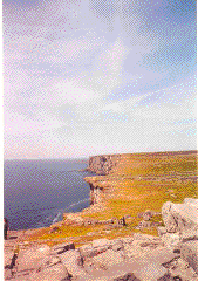
Although the word Dun signifies fort, this is just one of the archeologists’ theories. One of the main arguments against the fort notion is the difficulty of access for all but the fairly fit. (If the fort theory is true, it would give new meaning to the expression “survival of the fittest”.) Other archeologists point out that the lack of a source of drinking water within the site would have made long sieges impossible, and speculate that the platform might have been an altar area where religious ceremonies and sacrifices were performed. When you are standing on the platform, watching fools lying on their stomachs, dangling their arms over the edge of the cliffs for the thrill, it is easy to imagine former generations tossing victims off the edge to their deaths. In any case, this is an emotionally powerful setting. The plain stone platform crowning the cliffs, with the endless ocean and sky as background, surpasses in beauty any gilded church altar I have ever seen.
Our mini-van tour also stopped at the remains of 8th century churches, monasteries and burial grounds. Some of the gravestones, showing entire families of brothers “lost at sea”, made me shiver. The whole island is dotted with pathetic wayside crosses honouring those who died on the water and asking for a prayer for their souls. These reminders of the fragility and shortness of life increased my appreciation of the wonders of the land and the fierce love the islanders must have felt for it when life was on the island was such a struggle. How tempting it must have been to take (as many did) the ferry to Galway and never return.
At the end of the day, my departure from Inishmore was bittersweet. After just two days on the island, I felt like I was leaving an old, charming and fascinating friend. As the ferry pulled away from the port at Kilronan, I looked back, and knew I would return some day. This promise sweetens my memories whenever I think of the Big Island.


[…] Ties that bind: Falling in love with the Aran Islands […]
LikeLike