

Follow a winding, two-lane mountain road up, up, up through forests, fields and clouds to reach the top of Haleakala Volcano, Maui’s “House of the Sun.” At 10,000-feet, the cool air seems fresher as clouds drift by, mountain peaks from across the sea poke through the clouds and the hilly crater beside you changes colors with the light.
You can reach this top-of-the-world magic place in less than two hours from Maui’s popular beach areas. The 35-miles ascent itself takes about an hour.
A good way to explore the area and its mountain towns, botanical gardens, winery and back roads is to stay part-way up it. This year was to be a low-key vacation week on Maui for my husband and me, time to explore new and old sites in depth and with leisure.
MAKAWAO
For three days, we chose to stay part-way up Haleakala’s slopes in Makawao, a small Upcountry town full of artists and shops and eateries. Within five miles from Kahului and the airport, the perspective changes. As you begin to climb the slopes, you feel country, not cities, not resorts.
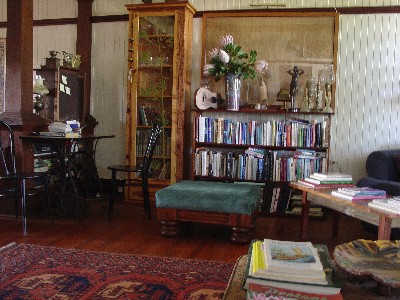
We headed for the Hale Ho’okipa Inn, a 1920’s plantation house listed in the Hawaiian Register of Historic Places. The Inn that’s a B and B, the three-room Kipa Cottage and the owner’s big house are on a cul-de-sac three blocks outside of central Makawao (Mah-kah-WOW).
We had tried for a room in the main house which also as a lovely sitting room but all four rooms were booked during part or all of our stay. We said okay to the more expensive cottage that sleeps four.
It’s nestled on the grounds overlooking the main house and gardens with hibiscus shrubs laden with yellow and red flowers and a 150-year old Cook Island Pine. A fish pond sits surrounded by lush ferns and banana trees, a place to repose in the quiet of Upcountry. There’s an old outdoor Portuguese bread oven under a pergola, and trellised grape vines on the hillside.
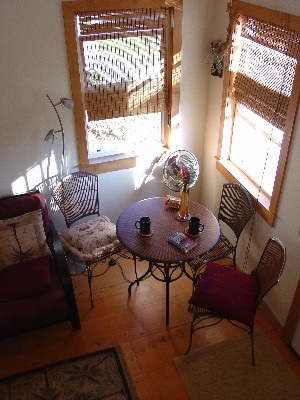
Cheri Attix owns and manages the B and B which she has been building and restoring for ten years. She’s a certified Hawaii State Guide and Maui County Guide and a 30-year resident of Makawao.
We learned about beach towns and museums to visit, hikes and horseback riding and golf for sports, but said we had to drive up the mountain one day. She had clues for that.
“Don’t start until about 8:30 a.m.,” Cheri said. “Then you’ll avoid the bikers coming down the hill with their accompanying vans and bike trailers.”
EXPLORING THE MOUNTAIN
On the road to the mountaintop, there are two visitor centers. Haleakala is a national park with a $10 fee unless you have a yearly or senior park pass. We head for the upper visitor center beyond the park headquarters (10,023-foot elevation).
It overlooks the crater with its shadows and glints of orange- pink and blue-gray. The crater looks like a colorful desert oasis – some writers call it a moonscape. Its shades of colors change with the clouds and angle of the sun.
Rangers give talks and explain that Haleakala is a shield volcano and the cinder cone “crater” did not blow its top. It just lets off steam through cones and blows some ash around.
Silversword plants grow beside the Visitor Center’s parking area. It is preferable to see them in their natural habitat on the mountain slopes, possible years ago. But, here they are protected from people and animals.
Hiking trails lead around the visitor center and into the crater. Car overlooks near the highway afford more views of the mountain. As we drove down the mountain, clouds drifted past us, like dense fog, gone in minutes, all part of the mountain mystique. The road winds and signs slow drivers to 15 miles per hour in many spots. A few road miles and almost a mile lower in elevation, we stopped at woodsy Kula Lodge for lunch and the magnificent ocean and island views from its garden and restaurant.
PAIA AND THE ROAD TO HANA
Cheri said we must visit the beach town of Pa’ia and have lunch at the Pa’ia Fish Market. Also, we’d find a good beach on the Hana Highway close to Paia. She suggested we take time for the Hui No’eau Visual Art Center on Baldwin Avenue on the way down the mountain from Makawao. (It’s only six miles to Paia!) We did it all.
The Hui No’eau Visual Arts Center sits along the road to Pa’ia. The magnificent old Baldwin estate house from 1917 has the art galleries and a gift shop and art studios occupy the outer buildings. Cheri was right – it’s worth a stop and a walk through the house and gardens. Paia is full of arty shops like Hula Hands, natural “supplements” stores, fish restaurants and bistros. It’s part funky l950’s beach town, part historic plantation town.
The Pa’ia Fish House on the corner of Baldwin and Hana Highway has good food and casual eating: place your order, claim a bar-b-que table bench, then weave through the crowd to pick up your order when called. Mahi fish and chips, Ono Burgers, Ahi Burgers, all fresh and good, accompanied with chatter of patrons — surfers, old tourists, residents.
Beyond Paia, along the road to Hana – the Hana Highway – we found Ho’okipa Beach (“windsurfing capital of the world”) and watched the surfers roll in to the sandy shore and waves splash on nearby rocky cliffs). The famous Mama’s Fish House sits on a cliff along the road to Hana. Just once, we drove that highway to its end – gorgeous scenery and hair-raising curves.
OLD WAILUKU INN
After three nights, we came down the mountain to stay in a B & B in Wailuku. Wailuku is an historic town settled by missionaries and sugar planters in the early 19th century. It keeps its early days charm even though it is minutes from the airport, the cruise ship dock and busy Kahilui.
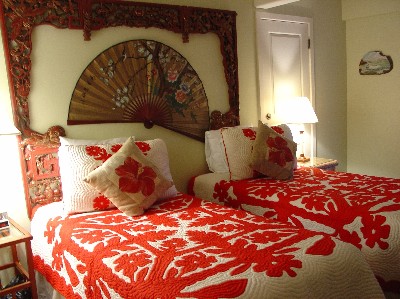
The Old Wailuku Inn is truly an experience – Hawaiian ambience, comfortable main rooms, an open-air front porch that overlooks tropical gardens. Owners of the inn are Hawaiian-born Janice and Tom Fairbanks, gracious hosts. We chose a garden room, the Hibiscus Room, with private patio because it was the least expensive and sounded secluded. Its beds are covered with gorgeous Hawaiian quilts, wood and wicker furniture and a patio full of flowers. Janice’s gourmet breakfasts are the best – sausages and malasadas on Sundays!
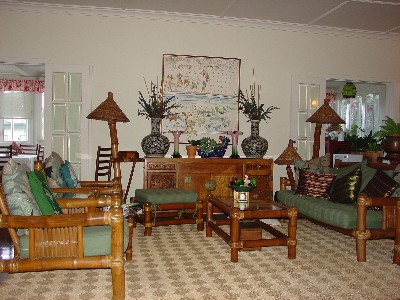
From the Wailuku Inn we explored nearby Bailey House Museum, a Maui Historical Society project. Originally a school started by missionaries in 1837, it is a museum of the 19th century. Don’t miss the adjacent gift shop and the fishing canoe on the grounds. You can pick up a Wailuku Walking Tour booklet here to read as you walk or drive by about the history of the churches, civic buildings and schools along the town’s two main streets.
THE IAO VALLEY
We explored the gorgeous Iao Valley at leisure, only three miles from the Wailuku highway. A stream bubbles down from the Iao Needle, 2,250 feet high (1800’ above the valley floor). It flows under a walk-over bridge and through the botanical garden. Climb a path of 132 steps for the view, maybe take another path that leads to the swimming hole in the stream. This green valley filled with fern, philodendron and a forest of trees was a sacred spot to Hawaiians and historically important. Here, in 1790. Kamahameha I landed along Kahului Bay with a large fleet of canoes. In the Iao Valley, he fought the ruling chief’s son who was in charge at the time. This battle, says the commemorative sign, is said to be one of the most bitter ever fought on Hawaiian soil. As you look out over the valley, you can almost hear, as the marker says, the warriors’ shouts of defiance.
There’s more to explore in the Iao Valley: Kepaniwai Park and Heritage Gardens show houses in a garden setting of the many ethnic groups that came to work the cane fields of Hawaii; the Nature Center, a hands-on place for kids (we ate lunch there and patronized the gift shop).
MORE SIGHTS
Leaving the valley, we turned by mistake from Highway 330 to 340 and traveled along the coast to Waihee instead of Kahului for supplies (wine). But, along the way, we found a golf course at Waiehu with mid-week greens fees of $35, a phenomenon in Hawaii, and a beach where islander families picnicked. Janice recommended a great restaurant called Who’s the Boss on Wailuku’s Main Street. It’s run by a couple who are owners of Chez Paul’s in Lahaina and an Asian restaurant, A Saigon Café, also on Main Street in Kahului. Also, on Main Street on Saturday, we found a street fair.
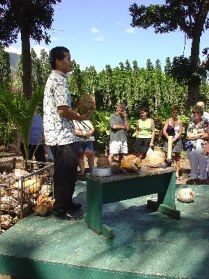
More activities: Maui Tropical Plantation in nearby Waikapu. The Tropical Express Tour shows off the plantation as visitors ride a tram through the orchards and fields. We snacked on macadamia nut ice cream and shopped in the plantation’s country store. We headed for the Ma’alaea Harbor, a few miles toward West Maui, and the Maui Ocean Center. We tried a beach for walking that Janice recommended. It was hard to park and crowded.
But, we soon defected to the fancy hotel area of Wailea where we had once stayed at what is now the Wailea Marriott. What luxury to walk the clean beaches in front of the elegant hotels, have a drink beside the Marriott’s pool and stay for late lunch.
Our slow “adventure” did let us uncover new places and revisit others in depth. The mountain still had its magic appeal, the B and B’s had the lovely Aloha spirit, and the flowers and the sea air smelled delicious.

