

Virtual architect, urban planner, composer and photographer, Emanuel Dimas de Melo Pimento is a Portuguese artist living in Switzerland. He has been selected to create a floating island city of the future in the Tagus River near Lisbon to extend to the Atlantic Ocean. This will be a petroleum-free model for future cities where people, animals, and plants flourish in an environment which can change forms like an amoeba as conditions require. It will use all the natural resources of wind and sunlight. This project, which works closely with the Great Estuary, a work already underway by the architect Carlos Sant’Ana, addresses in concrete and virtual ways how to make a sustainable future for our world and projects this creation, the brainchild of Antonio Cerveira Pinto, to be built to show the world at the 2020 Olympic Games in Lisbon.
Pinto cites the report of Robert L. Hirsch, Roger Bezdek and Robert Wending, “Peaking of World Oil Production: Impacts, Mitigation, & Risk Management”, February 2005,” which was commissioned by the National Energy Technology Laboratory, a U.S. Department of Energy body. The coordinator of this study was in Lisbon last May at the International Workshop on Oil and Gas Depletion, where he presented the Report, which is exerpted below. It was strange to note that in the United States the media have ostracised the Hirsch Report, The forecast given in this report on the catastrophic effects of the energy crisis on the global economy and security which it is believed will occur no later than 2025, (forecast tables of the “Limits to Growth (The 30-Year Update)”, by Donella Meadows, Jorgen Randers and Dennis Meadows.) Human civilization may well have already entered full “overshoot” mode.
The Project’s name,Amores means “love.” The name comes from the great epic Lusiadas by the 16th century Portuguese poet Luis de Camoes, who envisioned a Utopia where people worked and lived in love and preserved their environment. A book by this name has been published to explain the project, Amores by Emanuel Dimas de Melo Pimenta.
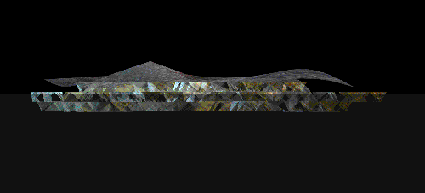
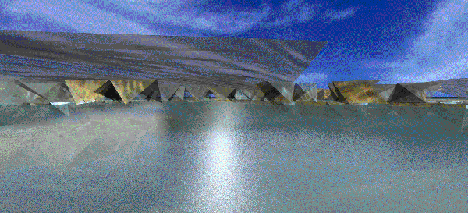
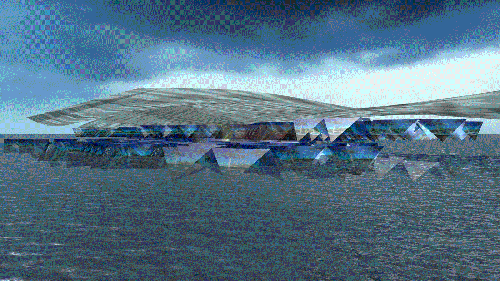
The structure of the city will be in connecting pods built of materials developed by nano-technology and shaped like the facets of a diamond to harness the powers of wind and sunlight and will float on water, yet extend up and down the commerce centers along the Great Estuary of the Tagus, incorporating and yet rendering obsolete the crumbling cities which will eventually have to be abandonned when petroleum energies fail altogether..
He started “O Grande Estuário” (The Great Estuary) in 2004, in close cooperation with the architect Carlos Sant’Ana. The first results were shown on 15 January 2005. On 29 April of the same year, and in the same art gallery, the Quadrum, a set of ideas and proposals were put forward for Lisbon after the oil era, with a time horizon of the year 2020. To transform the Lisbon and Tagus valley region into an eco-technological sanctuary and Lisbon into a major bio-city extending along both banks of the estuary; to expand the centre of Lisbon to the south bank of the river; to promote the candidature of the greater metropolitan area for the 2020 Olympic Games; to prepare the region for the decay and abandonment of the urban suburbs over the next 20-30 years; and finally, to restore the green belts attacked by the industrial and suburban devastation of the past 50 years, have been, until now, the main points of application of a strategy that has the objective of forecasting how this major urban settlement can survive in the extremely adverse context of the accelerated ending of the world’s oil and natural gas reserves.

Pinto says,”We will see in the course of 2006-07 whether the volatility of the energy markets, the probable bursting of the world property bubble, the number of natural catastrophes and pandemics, hunger and new and more surprising military conflicts (of which the nuclear tension in Iran is a terrible warning) will prove that these disturbing scenarios are, unfortunately, correct. If I was the prime minister of Portugal I would look at these warnings with great concern and obtain the support of the next president of the republic for the alliance necessary to impose a real emergency plan in the areas of energy, transport, land use planning, agriculture and fisheries, internal security and national defence … Everything else will follow, in support of these priorities.
“The outlook could not be more depressing. But we owe it to Donella Meadows (a pioneer in identifying this problem) to make the effort to confront this uncertain future with a positive strategy. According to the co-author of “Limits to Growth” (1972, 2004) and of “Beyond The Limits” (1992), we need to make a new revolution, the Sustainability Revolution. And to do this, there is nothing better than following some standards for strategic behaviour: Visioning, Networking, Truth-Telling, Learning and Loving. If we are able to pass on this message and apply it now to the territory we inhabit and in which we live and work, we will be doing ourselves a good service and helping to implement the urgently needed Sustainability Revolution. In Lisbon, this revolution goes by the name of “O Grande Estuário” (The Great Estuary)!
Pinto knew the project would have to be fed by a clear tension between absolute utopia and political strategy: between architecture, city and land planning archetypes and specific projects, persistent designs and games of the possible. Between luminary visions and decisive gestures.”
Pinto wanted the artist/architect Emanuel to think of a floating super-structure that would drift dreamily between the Tagus and the Atlantic, with thousands of people, dogs, cats and waxbills on board, going about their lives working, talking, having fun and being in love. A kind of new Noah’s Ark, the genetic code of which had been symbiotically designed by Buckminster Fuller and Emanuel Dimas de Melo Pimento. Later on, others could then attend to studying the physical and logistical sustainability of the phenomenon. When the Olympic Games finally get under way in Lisbon in 2020 on the new floating district this would not only be the most unique feature of the event but also of the wider ranging fundamental project in progress in the Great Estuary.
Exerpts From The Hirsch Report
«The peaking of world oil production presents the U.S. and the world with an unprecedented risk management problem. As peaking is approached, liquid fuel prices and price volatility will increase dramatically, and, without timely mitigation, the economic, social, and political costs will be unprecedented. Viable mitigation options exist on both the supply and demand sides, but to have substantial impact, they must be initiated more than a decade in advance of peaking.
In 2003, the world consumed just under 80 million barrels per day (MM bpd) of oil. U.S. consumption was almost 20 MM bpd, two-thirds of which was in the transportation sector. The U.S. has a fleet of about 210 million automobiles and light trucks (vans, pick-ups, and SUVs). The average age of U.S. automobiles is nine years. Under normal conditions, replacement of only half the automobile fleet will require 10-15 years. The average age of light trucks is seven years
When world oil peaking will occur is not known with certainty. A fundamental problem in predicting oil peaking is the poor quality of and possible political biases in world oil reserves data. Some experts believe peaking may occur soon. This study indicates that “soon” is within 20 years.
The problems associated with world oil production peaking will not be temporary, and past “energy crisis” experience will provide relatively little guidance. The challenge of oil peaking deserves immediate, serious attention, if risks are to be fully understood and mitigation begun on a timely basis.
Oil peaking will create a severe liquid fuels problem for the transportation sector, not an “energy crisis” in the usual sense that term has been used.
Peaking will result in dramatically higher oil prices, which will cause protracted economic hardship in the United States and the world. However, the problems are not insoluble. Timely, aggressive mitigation initiatives addressing both the supply and the demand sides of the issue will be required.
In the developed nations, the problems will be especially serious. In the developing nations peaking problems have the potential to be much worse.
Mitigation will require a minimum of a decade of intense, expensive effort, because the scale of liquid fuels mitigation is inherently extremely large.
While greater end-use efficiency is essential, increased efficiency alone will be neither sufficient nor timely enough to solve the problem. Production of large amounts of substitute liquid fuels will be required. A number of commercial or near-commercial substitute fuel production technologies are currently available for deployment, so the production of vast amounts of substitute liquid fuels is feasible with existing technology.
Intervention by governments will be required, because the economic and social implications of oil peaking would otherwise be chaotic. The experiences of the 1970s and 1980s offer important guides as to government actions that are desirable and those that are undesirable, but the process will not be easy
Mitigating the peaking of world conventional oil production presents a classic risk management problem:
Mitigation initiated earlier than required may turn out to be premature, if peaking is long delayed.
If peaking is imminent, failure to initiate timely mitigation could be extremely damaging.
Prudent risk management requires the planning and implementation of mitigation well before peaking. Early mitigation will almost certainly be less expensive than delayed mitigation. A unique aspect of the world oil peaking problem is that its timing is uncertain, because of inadequate and potentially biased reserves data from elsewhere around the world. In addition, the onset of peaking may be obscured by the volatile nature of oil prices. Since the potential economic impact of peaking is immense and the uncertainties relating to all facets of the problem are large, detailed quantitative studies to address the uncertainties and to explore mitigation strategies are a critical need.
The purpose of this analysis was to identify the critical issues surrounding the occurrence and mitigation of world oil production peaking. We simplified many of the complexities in an effort to provide a transparent analysis. Nevertheless, our study is neither simple nor brief. We recognize that when oil prices escalate dramatically, there will be demand and economic impacts that will alter our simplified assumptions. Consideration of those feedbacks will be a daunting task but one that should be undertaken.
Our study required that we make a number of assumptions and estimates. We well recognize that in-depth analyses may yield different numbers. Nevertheless, this analysis clearly demonstrates that the key to mitigation of world oil production peaking will be the construction a large number of substitute fuel production facilities, coupled to significant increases in transportation fuel efficiency. The time required to mitigate world oil production peaking is measured on a decade time-scale. Related production facility size is large and capital intensive. How and when governments decide to address these challenges is yet to be determined.
Our focus on existing commercial and near-commercial mitigation technologies illustrates that a number of technologies are currently ready for immediate and extensive implementation. Our analysis was not meant to be limiting. We believe that future research will provide additional mitigation options, some possibly superior to those we considered. Indeed, it would be appropriate to greatly accelerate public and private oil peaking mitigation research. However, the reader must recognize that doing the research required to bring new technologies to commercial readiness takes time under the best of circumstances. Thereafter, more than a decade of intense implementation will be required for world scale impact, because of the inherently large scale of world oil consumption.
In summary, the problem of the peaking of world conventional oil production is unlike any yet faced by modern industrial society. The challenges and uncertainties need to be much better understood. Technologies exist to mitigate the problem. Timely, aggressive risk management will be essential.»
 Real Travel Adventures